Link Copied!
Elena Poniatowska Quotes (1932-)
Author


About Elena Poniatowska
Hélène Elizabeth Louise Amélie Paula Dolores Poniatowska Amor (born May 19, 1932), known professionally as Elena Poniatowska, is a French-born Mexican journalist and author, specializing in works on social and political issues focused on those considered to be disenfranchised especially women and the poor.
Best Elena Poniatowska Quotes
Shortest
Earliest
Explore our curated collection of the most famous and impactful Elena Poniatowska quotes.

“I have always had questions, and to this day, I don't have a single answer.”
“That the poorest Mexicans don't deserve their ruling class is a truth that leaps out at once.”


“The locomotive was the main protagonist of the Mexican Revolution, but the Adelitas and Valentinas came a close second.”
“The ultimate outcome of our actions cannot be known. But despite our limited awareness, I believe we must always act with compassion.”
“The question of being encouraged or discouraged by this or that event cannot be asked if one is to go on with a certain moral conviction.”
“We have all been made bad, we are all needy, all unwanted guests around the feast, invited at the last minute. In recognizing this lies our creativity.”

“Boundaries, after all—of custom, of language, of what is and is not permitted—not only function to keep others out but also keep those inside from expanding.”
“I absorbed Mexico through the maids. A system still persists in Latin America which consists of privileged people having at their beck and call the poorest of the poor.”

“Widows used to go around the way the poet Jaime Sabines would like them to: "There is one way, my love, that you could make me completely happy: die." Now widows are not even merry.”
“Of course, imaginative writing always contains elements of the writer’s lived experience, but there is a different sort of freedom in it than there is in reporting or in novels based on interviews.”

“I have always responded to challenges, followed apocalyptical personalities, apostles, Rasputins, Joan of Arcs who hear voices that come from Heaven, illuminated guides of humanity, holders of truth, priests.”
“Life is very resistant. People-the same cannon fodder that nourishes great universal misfortunes, "the wretched of the earth," as Frantz Fanon called them. Suddenly, during an earthquake, one of them saves a life.”

“According to the El Paso Morning Times, in 1914 there were seventeen thousand men and four thousand women in Pancho Villa's army, but there are many other statistics that show that, without the soldaderas, there would have been no Mexican Revolution.”
“Without realizing it the maids provided me with a version of Benito Juárez; they were all like Benito Juárez. Like him they vindicated themselves: "Dirty foreigners." Like him they defended Mexico, as stubborn as mules. Like him they had no roof of their own and had eaten only poor people's food, and for me, a girl raised on French mashed potatoes, discovering them meant entering into "the other."”
“Carefully I asked them questions, visited them in their crowded neighborhoods, watched their kites cross the sky in February, treated them like kites, because that's how testimonial literature is. It fills one with anxiety, with insecurity. One handles very fragile material, people's hearts; their names, which are their honor; their work; and their time. And one tries to turn it into memorable material.”
“if I had been, say, a French writer, I would have been free to write whatever I wished, which would have been writing of an imaginative sort. But in Mexico, because of the suffering that is the result of centuries of corruption, there is a moral obligation to write of this. I could not ignore it, and, because I have become known for it and have refined my ability to write this way through practice, it became my principal work.”

“I have always been drawn to characters like Jesusa Palancares. María Sabina, the one who performed the ceremony of the sacred mushrooms (LSD in Oaxaca), Juan Perez Jolote (the Chamula peasant from Chiapas), Demetrio Vallejo (the railroad leader), all popular heroes, even if they are not recognized. I admire them because of their wisdom and the way they impart it, with great patience, great prudence, with respect for the ignorance of the person who asks the questions.”
“It is one thing to identify oneself as a citizen of a country and to love its landscape, its people, its arts and culture. It is quite another thing to assess the workings of its social and political structure—the degree of freedom and opportunity enjoyed by its people, its standard of education and quality of life. A Mexican peasant has virtually no chance of becoming anything else. The standard of education was low fifty years ago and, if anything, is even lower today.”
“There is an immense abyss between the very few who have money and the vast number who are poor—and there is scarce concern on the part of those who have for those who do not. The politicians can be numbered among those who have. So my being a Mexican writer and loving my country has come to find its expression in opening up this reality to other Mexicans and to the larger world, expressed through the voices of the least empowered—women, especially, and poor people of both genders.”

“I live to the rhythm of my country and I cannot remain on the sidelines. I want to be here. I want to be part of it. I want to be a witness. I want to walk arm in arm with it. I want to hear it more and more, to cradle it, to carry it like a medal on my chest. Activism is a constant element in my life, even though afterwards I anguish over not having written "my own things." Testimonial literature provides evidence of events that people would like to hide, denounces and therefore is political and part of a country in which everything remains to be done and documented.”
Elena Poniatowska Quotes by Topic
Find exactly what you are looking for by browsing this categorized list of Elena Poniatowska quotes by topic.
Elena Poniatowska on Human sacrifice
“I admire Octavio Paz very much... but I don't but I don't agree with one of his theses about Mexican history. He maintains that the Plaza of the Three Cultures is a place of sacrifices, and that because we have Aztec ancestors we are condemned cyclically to slaughter a great number of people. This thesis is highly debatable... It's not possible to say that because we carry within us the potential for human sacrifice, we retain across the years the need to kill.”

What Elena Poniatowska Said About Others
Discover personal opinions Elena Poniatowska shared regarding contemporaries.
Elena Poniatowska on Cyril Connolly
“Cyril Connolly was right when he said that art needs clean hands.”

Elena Poniatowska on Joan of Arc
“I have always responded to challenges, followed apocalyptical personalities, apostles, Rasputins, Joan of Arcs who hear voices that come from Heaven, illuminated guides of humanity, holders of truth, priests.”

Elena Poniatowska on Grigori Rasputin
“I have always responded to challenges, followed apocalyptical personalities, apostles, Rasputins, Joan of Arcs who hear voices that come from Heaven, illuminated guides of humanity, holders of truth, priests.”

Elena Poniatowska on Enrique Peña Nieto
Elena Poniatowska on Marjorie Agosín
“Marjorie Agosin is like an elf. She disturbs us, amazes us, she forces us to be lighter, less terrestial. In her work, the unexpected and the mysterious go arm in arm. Unique in her genre, Marjorie Agosin could well be the creator of a new fantastic literature in Latin America.”

Elena Poniatowska on Rembrandt
“If you look at early Rembrandt portraits, they are very linear and the brushstrokes are almost invisible. The late ones are much freer, and the brushstrokes are very obvious and as much a part of the work as the subject. These things are never intentional, and I cannot see how they can be explained.”

Elena Poniatowska on Benito Juárez
“Without realizing it the maids provided me with a version of Benito Juárez; they were all like Benito Juárez. Like him they vindicated themselves: "Dirty foreigners." Like him they defended Mexico, as stubborn as mules. Like him they had no roof of their own and had eaten only poor people's food, and for me, a girl raised on French mashed potatoes, discovering them meant entering into "the other."”

Elena Poniatowska on Octavio Paz
“I admire Octavio Paz very much... but I don't but I don't agree with one of his theses about Mexican history. He maintains that the Plaza of the Three Cultures is a place of sacrifices, and that because we have Aztec ancestors we are condemned cyclically to slaughter a great number of people. This thesis is highly debatable... It's not possible to say that because we carry within us the potential for human sacrifice, we retain across the years the need to kill.”

Elena Poniatowska on Stephen Spender
“For Stephen Spender, the Spanish Civil War in 1936 was a war of classes, on an international scale; the capitalistic class, backed by international imperialism, against the democratic will of 80 percent of the Spanish people. In 1990, the reality of Latin America is not very different from Spender's Spain. In Latin America, wars are class wars, on one side the oligarchy linked to the military class and the great capital and, on the other, the poor people, the ones who have nothing to lose. Fear of communism in 1936 is still flagrant in 1990. And more absurd, more mediocre.”

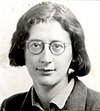
Elena Poniatowska on Simone Weil
“I have read everything by Simone Weil, who was an extraordinary woman gifted with immense empathy. But I think she might have profited from some better advice. She was not physically strong and yet, in order to directly experience the struggle of working people, she undertook factory work that was too much for her. And she also fought in the Spanish Civil War and, being somewhat clumsy, stepped into a pail of boiling oil, was severely burned, and went to Portugal to recuperate. Later, she would eat only the minimal portion of food she believed was available to people in occupied France—a few potatoes perhaps. She had been diagnosed with tuberculosis, and this may well have contributed to her death. (Then, as you see her, she is more of an inspiration than a model.) EP: Yes, an inspiration. She could not have been a model for me because I am neither a genius nor a mystic and, like Leonora, I had children I loved and for whom I was responsible, so that even if I had discovered a vocation of this sort in myself, I could not have lived such an extreme life.”
Quotes About Elena Poniatowska
Gain deeper perspective through quotes about Elena Poniatowska from others.
Kathleen Alcalá Preface on Elena Poniatowska
“Like the Mexican writer Elena Poniatowska, I have tried to tell the stories my characters would tell if they were writers”
Sandra Cisneros on Elena Poniatowska 3 quotes
“(What moves you most in a work of literature?) I’m not yet the writer I aspire to be, but at my age, great books written by women over 60 give me hope. Diana Athill, Colette, Harriett Doerr, Marguerite Duras, Grace Paley, Elena Poniatowska, Jean Rhys, Mercé Rodoreda, to name but a few.”

Beth E. Jörgensen on Elena Poniatowska 2 quotes
“In light of her later books, we tend to read irony into Elena Poniatowska's claim of meek docility, but the lesson of her early interviews predicts Audre Lorde's eloquent and cautionary charge that "the master's tools will never dismantle the master's house. They may allow us temporarily to beat him at his own game, but they will never enable us to bring about genuine change. And this fact is only threatening to those women who still define the master's house as their only source of support."”
About Elena Poniatowska
Hélène Elizabeth Louise Amélie Paula Dolores Poniatowska Amor (born May 19, 1932), known professionally as Elena Poniatowska, is a French-born Mexican journalist and author, specializing in works on social and political issues focused on those considered to be disenfranchised especially women and the poor.