Link Copied!
John Donne Quotes (1572-1631)
Poet
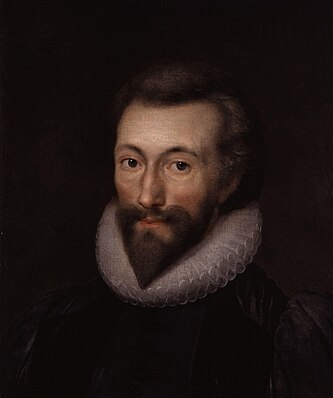













About John Donne
John Donne (22 January 1572 – 31 March 1631) was a Jacobean metaphysical poet. His works include sonnets, love poetry, religious poems, Latin translations, epigrams, elegies, songs, and sermons.
Best John Donne Quotes
Shortest
Earliest
Explore our curated collection of the most famous and impactful John Donne quotes.
“Take heed of loving me.”
“She, and comparisons are odious.”

“Those set our hairs, but these our flesh upright.”

“I do nothing upon myself, and yet am mine own executioner.”
“The flea, though he kill none, he does all the harm he can.”


“She is all states, and all princes, I,
Nothing else is.”
Nothing else is.”
“For God's sake hold your tongue, and let me love.”
“When I died last, and dear, I die
As often as from thee I go.”
As often as from thee I go.”

“Love's mysteries in souls do grow,
But yet the body is his book.”
But yet the body is his book.”
“Oh do not die, for I shall hate
All women so, when thou art gone.”
All women so, when thou art gone.”

“Twice and thrice had I loved thee,
Before I knew thy face or name.”
Before I knew thy face or name.”

“As well a well-wrought urn becomes
The greatest ashes, as half-acre tombs.”
The greatest ashes, as half-acre tombs.”
John Donne Quotes by Topic
Find exactly what you are looking for by browsing this categorized list of John Donne quotes by topic.
John Donne on Human sexual activity 2 quotes
“She's all states, and all princes, I.”

John Donne on Humiliation
“Humiliation is the beginning of sanctification.”

John Donne on Silence
“Weakness invites, but silence feasts oppression.”
John Donne on Religiousness
“For God's sake hold your tongue, and let me love.”

John Donne on Despair
John Donne on Elephants
“Nature's great masterpiece, an elephant, The only harmless great thing.”
John Donne on Ageing
John Donne on Cheek
“So may thy cheeks’ red outwear scarlet dye, And their white, whiteness of the Galaxy;”

What John Donne Said About Others
Discover personal opinions John Donne shared regarding contemporaries.
John Donne on Women 2 quotes
“Licence my roving hands, and let them go, Behind, before, above, between, below. O, my America, my New-found-land, My kingdom, safeliest when with one man mann'd.”
Quotes About John Donne
Gain deeper perspective through quotes about John Donne from others.
Samuel Taylor Coleridge on John Donne
“To read Dryden, Pope, &c., you need only count syllables; but to read Donne you must measure time, and discover the time of each word by the sense of passion.”

Thomas De Quincey on John Donne
“I have heard it said, by the way, that Donne's intolerable defect of ear grew out of his own baptismal name, when harnessed to his own surname -- John Donne. No man, it was said, who had listened to this hideous jingle from childish years, could fail to have his genius for discord, and the abominable in sound, improved to the utmost.”

Edmund Gosse on John Donne
“His writings, like his actions, were faulty, violent, a little morbid even, and abnormal. He was not, and did not attempt to be, an average man. But actions and writings alike, in their strangeness and aloofness, were unadulterated by a tinge of affectation.”
Henry Hallam on John Donne
“Donne is the most inharmonious of our versifiers, if he can be said to have deserved such a name by lines too rugged to seem metre. Of his earlier poems many are very licentious; the later are chiefly devout. Few are good for much; the conceits have not even the merit of being intelligible; it would perhaps be difficult to select three passages that we should care to read again.”

Collected Poems of Muriel Rukeyser on John Donne
“think: poems fixed this landscape: Blake, Donne, Keats”
Disputed Quotes
Quotes attributed to John Donne that are questionable.
“He was the Word, that spake it:
He took the bread and brake it;
And what that Word did make it,
I do believe and take it.”
He took the bread and brake it;
And what that Word did make it,
I do believe and take it.”
About John Donne
John Donne (22 January 1572 – 31 March 1631) was a Jacobean metaphysical poet. His works include sonnets, love poetry, religious poems, Latin translations, epigrams, elegies, songs, and sermons.