Link Copied!
Daniel Patrick Moynihan Quotes (1927-2003)
President, Author, Politician
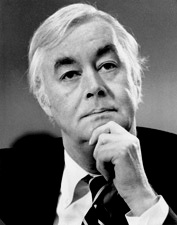

About Daniel Patrick Moynihan
Daniel Patrick Moynihan (March 16, 1927 – March 26, 2003) was an American politician and diplomat. A member of the Democratic Party, he represented New York in the United States Senate from 1977 until 2001 after serving as an adviser to President Richard Nixon, and as the United States' ambassador to India and to the United Nations.
Best Daniel Patrick Moynihan Quotes
Shortest
Earliest
Explore our curated collection of the most famous and impactful Daniel Patrick Moynihan quotes.
“The mudslinging has begun.”
“What is not discussed, will not be advanced.”

“A commonplace of political rhetoric has it that the quality of a civilization may be measured by how it cares for its elderly. Just as surely, the future of a society may be forecast by how it cares for its young.”

“The institution of the family is decisive in determining not only if a person has the capacity to love another individual but in the larger social sense whether he is capable of loving his fellow men collectively. The whole of society rests on this foundation for stability, understanding and social peace.”
“The time may have come when the issue of race could benefit from a period of ''''benign neglect'''.' The subject has been too much talked about. The forum has been too much taken over to hysterics, paranoids, and boodlers on all sides. We need a period in which Negro progress continues and racial rhetoric fades.”
“The policy of the United States is to bring the Negro American to full and equal sharing in the responsibilities and rewards of citizenship. To this end, the programs of the Federal government bearing on this objective shall be designed to have the effect, directly or indirectly, of enhancing the stability and resources of the Negro American family.”
“Political society wants things simple. Political scientists know them to be complex... One could argue that, in part, the leftist impulse is so conspicuous among the educated and well-to-do precisely because they are exposed to more information, and are accordingly forced to choose between living with the strains of complexity, or lapsing into simplism.”
“Everyone is entitled to his own opinion, but not his own facts.
• Variant: Everyone is entitled to their own opinions, but they are not entitled to their own facts.
• Variant: You are entitled to your own opinion, but not your own facts.
• Variant: You are entitled to your own opinion, but you are not entitled to your own facts.
• Variant: You’re entitled to your own opinions. You’re not entitled to your own facts.”
“A case can be made . . . that secrecy is for losers. For people who don't realize how important information really is. The Soviet Union realized this too late. Openness is now a singular, and singularly American, advantage. We put it in peril by poking along in a mode of an age now past. It is time to dismantle government secrecy, this most pervasive of Cold War-era regulations. It is time to begin building the supports for the era of openness that is already upon us.”

“From the wild Irish slums of the 19th century Eastern seaboard, to the riot-torn suburbs of Los Angeles, there is one unmistakable lesson in American history; a community that allows a large number of men to grow up in broken families, dominated by women, never acquiring any stable relationship to male authority, never acquiring any set of rational expectations about the future -- that community asks for and gets chaos. Crime, violence, unrest, disorder -- most particularly the furious, unrestrained lashing out at the whole social structure -- that is not only to be expected; it is very near to inevitable. And it is richly deserved.”
“[T]he nature of the new world system was not so different from the old. It was for the moment more stable, but a reasonable forecast would be that Africa in particular had a century of border wars ahead of it. On the other hand, such was the power of the anticolonial idea that great powers from outside a region had relatively little influence unless they were prepared to use force. China altogether backed Fretilin in Timor, and lost. In Spanish Sahara, Russia just as completely backed Algeria, and its front, known as Polisario, and lost. In both instances the United States wished things to turn out as they did, and worked to bring this about. The Department of State desired that the United Nations prove utterly ineffective in whatever measures it undertook. This task was given to me, and I carried it forward with not inconsiderable success.”
“The most difficult fact for white Americans to understand is that in these terms the circumstances of the Negro American community in recent years has probably been getting worse, not better.
Indices of dollars of income, standards of living, and years of education deceive. The gap between the Negro and most other groups in American society is widening.
The fundamental problem, in which this is most clearly the case, is that of family structure. The evidence — not final, but powerfully persuasive — is that the Negro family in the urban ghettos is crumbling. A middle class group has managed to save itself, but for vast numbers of the unskilled, poorly educated city working class the fabric of conventional social relationships has all but disintegrated. There are indications that the situation may have been arrested in the past few years, but the general post war trend is unmistakable. So long as this situation persists, the cycle of poverty and disadvantage will continue to repeat itself.”
Daniel Patrick Moynihan Quotes by Topic
Find exactly what you are looking for by browsing this categorized list of Daniel Patrick Moynihan quotes by topic.

About Daniel Patrick Moynihan
Daniel Patrick Moynihan (March 16, 1927 – March 26, 2003) was an American politician and diplomat. A member of the Democratic Party, he represented New York in the United States Senate from 1977 until 2001 after serving as an adviser to President Richard Nixon, and as the United States' ambassador to India and to the United Nations.