Link Copied!
Zhou Enlai Quotes (1898-1976)
Leader


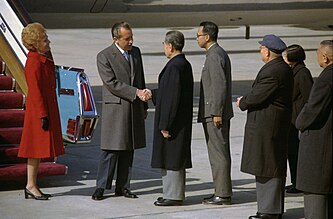
About Zhou Enlai
Zhou Enlai (5 March 1898 – 8 January, 1976), a prominent Chinese Communist leader, was the first Premier of the People's Republic of China, from 1949 until his death.
Best Zhou Enlai Quotes
Shortest
Earliest
Explore our curated collection of the most famous and impactful Zhou Enlai quotes.
“It is too soon to say.”
“For us, it is all right if the talks succeed, and it is all right if they fail.”
“We shall use only peaceful means and we shall not permit any other kind of method.”

“Nikita Khrushchev: You must acknowledge that I come from the working class, while you were born to a family of the bourgeoisie.”

“Today the first unification of the Chinese people has emerged. The people themselves have become the masters of Chinese soil, and the rule of the reactionaries in China has been irrevocably overthrown.”
“Now first of all I would like to talk about the question of different ideologies and social systems. We have to admit that among our Asian and African countries, we do have different ideologies and different social systems. But this does not prevent us from seeking common ground and being united.”

“The Japanese aggressors have driven deep into our country and disaster is imminent. Fellow-countrymen, arise and unite as one! Our great, ancient Chinese nation is indomitable. Arise and fight for national unity! Fight to overthrow Japanese imperialist oppression! The Chinese nation will surely triumph.”
“Along with the people of other countries, we have won tremendous victories in the struggle against colonialism and imperialism, and in particular against the hegemonism of the superpowers. We have smashed imperialist and social-imperialist encirclement, blockade, aggression and subversion, and have strengthened our unity with the people of all countries, and especially the third world countries. China's seat in the United Nations, of which she had long been illegally deprived, has been restored to her.”
“The peoples of Asia and Africa created brilliant ancient civilizations and made tremendous contributions to mankind. But, ever since modern times most of the countries of Asia and Africa in varying degrees have been subjected to colonial plunder and oppression, and have thus been forced to remain in a stagnant state of poverty and backwardness. Our voices have been suppressed, our aspirations shattered, and our destiny placed in the hands of others. Thus, we have no choice but to rise against colonialism.”

“The awakening and growth of the Third World is a major event in contemporary international relations. The Third World has strengthened its unity in the struggle against hegemonism and power politics of the superpowers and is playing an ever more significant role in international affairs. The great victories won by the people of Viet Nam, Laos and Cambodia in their war against U.S. aggression and for national salvation have strongly encouraged the people of the world in their revolutionary struggles against imperialism and colonialism.”

“Our great proletarian cultural revolution is acclaimed and warmly praised by all Marxists-Leninists and revolutionary people of the world and immensely fortifies their revolutionary fighting will and confidence in victory. The handful of imperialists, modern revisionists and reactionaries in various countries are hurling vicious abuse at us precisely because our great cultural revolution has dug out the roots of their subversive activities and their attempts at “peaceful evolution” in China and has thus hit them where it hurts most. Their abuse only proves that we have done the right thing and serves further to expose their reactionary features, their hostility towards the Chinese people and the cause of human progress.”
Zhou Enlai Quotes by Topic
Find exactly what you are looking for by browsing this categorized list of Zhou Enlai quotes by topic.
Zhou Enlai on China–United States relations
“The social systems of China and the United States are fundamentally different, and there exist great differences between the Chinese Government and the United States Government. However, these differences should not hinder China and the United States from establishing normal state relations on the basis of the Five Principles of mutual respect for sovereignty and territorial integrity, mutual nonaggression, non-interference in each other's internal affairs, equality and mutual benefit, and peaceful coexistence; still less should they lead to war. As early as 1955 the Chinese Government publicly stated that the Chinese people do not want to have a war with the United States and that the Chinese Government is willing to sit down and enter into negotiations with the United States Government. This is a policy which we have pursued consistently. We have taken note of the fact that in his speech before setting out for China President Nixon on his part said that “what we must do is to find a way to see that we can have differences without being enemies in war.” We hope that, through a frank exchange of views between our two sides to gain a clearer notion of our differences and make efforts to find common ground, a new start can be made in the relations between our two countries.”

Zhou Enlai on 1972 visit by Richard Nixon to China
“The social systems of China and the United States are fundamentally different, and there exist great differences between the Chinese Government and the United States Government. However, these differences should not hinder China and the United States from establishing normal state relations on the basis of the Five Principles of mutual respect for sovereignty and territorial integrity, mutual nonaggression, non-interference in each other's internal affairs, equality and mutual benefit, and peaceful coexistence; still less should they lead to war. As early as 1955 the Chinese Government publicly stated that the Chinese people do not want to have a war with the United States and that the Chinese Government is willing to sit down and enter into negotiations with the United States Government. This is a policy which we have pursued consistently. We have taken note of the fact that in his speech before setting out for China President Nixon on his part said that “what we must do is to find a way to see that we can have differences without being enemies in war.” We hope that, through a frank exchange of views between our two sides to gain a clearer notion of our differences and make efforts to find common ground, a new start can be made in the relations between our two countries.”
What Zhou Enlai Said About Others
Discover personal opinions Zhou Enlai shared regarding contemporaries.
Zhou Enlai on Jawaharlal Nehru
“I have met many leaders of the world throughout my career. I met Khrushchev. I met Chiang Kai-Shek. I've met American generals. But I have never met a more arrogant man than Nehru.”

Quotes About Zhou Enlai
Gain deeper perspective through quotes about Zhou Enlai from others.
Doug Bandow on Zhou Enlai
“There is nothing to suggest that Zhou was filled with blood lust, enjoyed killing supposed counter-revolutionaries, plotted to imprison tens of millions of regime opponents, or was indifferent to the mass starvation and hardship around him. Indeed, he counseled colleagues and protected them, to the degree possible, from the madness of the Cultural Revolution, essentially an intra-party civil war which ruined the lives of millions of people, including many loyal communist apparatchiks. Like Stalin’s purges, the Cultural Revolution was bloody — estimates of the number of dead start at around 500,000 and top out at three million — and was no less mad, convulsing China for years. Throughout everything, however, Zhou acted as Mao’s chief retainer, a state functionary who helped turn his impoverished nation into a vast prison camp. To have resisted obviously would have been dangerous, but Zhou’s influence within the party was enormous and he could have allied with other critics of Mao, especially after the evident disaster of the Great Leap Forward. But to do so would have been risky, and risk was something Zhou avoided at all costs. … He seemed to embody a sense of personal decency, treating his family, friends, and colleagues well, in contrast to the vindictive, licentious, and unpredictable Mao. Zhou also sought prosperity and stability for China — a communist China, to be sure, but nevertheless one in which people would no longer be starving. A perception that Zhou cared about those ruled by Beijing generated spontaneous popular mourning after his death, even though Mao did not attend the funeral.”
Gao Wenqian on Zhou Enlai
“As a student of acting, he knew how to master the role he was handed. For years, he had been performing the important part of the indispensable servant to perfection, much to the annoyance of Mao, his master. He was almost entirely self-effacing. He knew how to mend the broken pieces of crockery that Mao shattered from time to time. Zhou’s genius for self-abnegation and the deft and artful way that he had of cleaning up a nasty mess aggravated Mao, the master, and piqued his pride. They were the odd couple, but this was no domestic comedy.”
Dag Hammarskjöld on Zhou Enlai
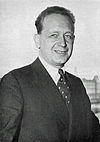
“It is a little bit humiliating when I have to say that Chou En-lai to me appears as the most superior brain I have so far met in the field of foreign politics... so much more dangerous than you imagine because he is so much better a man than you have ever admitted.”
Henry Kissinger on Zhou Enlai
“Mao dominated any gathering; Zhou suffused it. Mao's passion strove to overwhelm opposition; Zhou's intellect would seek to persuade or outmaneuver it. Mao was sardonic; Zhou penetrating. Mao thought of himself as a philosopher; Zhou saw his role as an administrator or a negotiator. Mao was eager to accelerate history; Zhou was content to exploit its currents.”

David Reynolds on Zhou Enlai
“There followed seventeen hours of talks with Zhou Enlai. Here was a man of intellect, culture and charm, who bargained hard yet, unlike Gromyko, thought big. “There was none of the Russian ploymanship, scoring points, rigidity or bullying,” Kissinger later told Nixon. Zhou “spoke with an almost matter-of-fact clarity and eloquence,” nearly always without notes. “He was equally at home in philosophical sweeps, historical analysis, tactical probing, light repartee. His command of facts, and in particular his knowledge of American events, was remarkable.” Zhou Enlai, gushed Kissinger, “ranks with Charles de Gaulle as the most impressive foreign statesman I have met.” As we now know, Zhou was treated by Mao as his round-the-clock diplomatic factotum, forced at times to grovel even more basely than Gromyko did before Khrushchev. In 1972 Mao denied Zhou treatment for bladder cancer lest his premier outlive him, and even refused to pass on a full diagnosis. The statesman who dazzled Kissinger was in reality Mao’s “blackmailed slave.””
Norodom Sihanouk on Zhou Enlai
“He's the truest friend I've ever had. What's more, he's an exquisite man, full of kindness and sophistication, the most aristocratic aristocrat one can meet. To those who can't understand how I, a non-communist, could be friends with Zhou Enlai, I say: "But he's a prince more princely than I am!"”

Jonathan Spence on Zhou Enlai
“Through the ups and downs of the unpredictable Chinese Revolution, Zhou Enlai’s reputation has seemed to stand untarnished. The reasons for this are in part old-fashioned ones: in a world of violent change, not noted for its finesse, Zhou Enlai stood out as elegant, courteous, even courtly; and with his remarkable good looks and fluent intelligence, he seemed to personify the mannerisms of diplomats from a gentler age. At the same time, Zhou’s reputation benefited from the apparently profound contrasts with Mao Zedong, who loved to thrust himself forward into the limelight, and never shrank from taking credit for China’s perpetual upheavals. The title of Gao Wenqian’s book, Zhou Enlai: The Last Perfect Revolutionary, is deliberately sardonic, and is designed to show that far from being perfect, Zhou was in fact fallible, often devious, and capable of great cruelty to his friends and fellow revolutionaries.”
Misattributed Quotes
Quotes mistakenly credited to Zhou Enlai
“The more troops they send to Vietnam, the happier we will be, for we feel that we shall have them in our power, we can have their blood. So if you want to help the Vietnamese you should encourage the Americans to throw more and more soldiers into Vietnam. We want them there. They will be close to China. And they will be in our grasp. They will be so close to us, they will be our hostages. … We are planting the best kind of opium especially for the American soldiers in Vietnam.”
About Zhou Enlai
Zhou Enlai (5 March 1898 – 8 January, 1976), a prominent Chinese Communist leader, was the first Premier of the People's Republic of China, from 1949 until his death.