Link Copied!
Zakir Hussain (musician) Quotes (1951-2024)
Actor, Musician, Artist
About Zakir Hussain (musician)
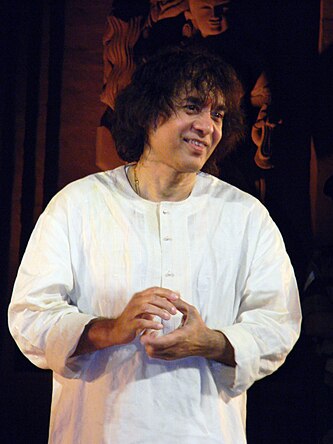
Zakir Hussain (Hindi: ज़ाकिर हुसैन, Urdu: ذاکِر حسین; 9 March 1951 – 15 December 2024) was an Indian musician, renowned in playing the tabla, an Indian percussion musical instrument. A child prodigy playing at the age of five he evolved to become the reigning king of tabla players. He was also musical producer, film actor and composer. He had rendered unforgettable solo as also many fusion music with other famous artists. He has 145 albums to his credit with Indian and western artists. He had also scored music for films and television serials. He was awarded the Padma Shri in 1988, and Padma Bhushan in 2002. He was also recipient of the Sangeet Natak Akademi Award in 1990. He also received the United States National Endowment for the Arts's National Heritage Fellowship award in 1999.
Best Zakir Hussain (musician) Quotes
Shortest
Earliest
Explore our curated collection of the most famous and impactful Zakir Hussain (musician) quotes.

“That’s the reason I’m Zakir Hussain and not Zakir Hussain Allah Rakha Khan. And believe me there’s no pride when I say that.”

“If it weren’t for the masters we wouldn’t have audiences for Indian classical music across the world. As for taking their mission forward, we have a long way to go.”
“Every time you step out on to the stage, you learn something which helps you grow and be a better communicator. It’s not like you’re the master. You’re always a student.”
“I think that commercialization in the long run will not affect the integrity of the music. In every venture, musical or otherwise, you will always have good and bad. The same applies here.”

“Similarly people talk about me now but they don't realise that there are equally good tabla players around. I wouldn't call myself a torchbearer or anything of that sort. I am just one of those who is able to articulate, may be slightly better than others.”
“From being made to wait in the kitchen to becoming the cynosure of attention and interacting with the who’s who has been a big leap. Music is no longer something that ‘respectable people’ keep children away from. We’ve had corporate czars and barons like Arvind Parekh and Brijbhushan Kabra taking to music.”

“The plan is to always have a plug into my past, where I am from. And how deep that is and having that gave me confidence to be able to expand. I am confident that I have something (music) that is backing me and that is always there for me... so that I can explore more, learn and grow more as an artiste and as a musician.”

“Every winter I am here sometimes for two or four months. These are my roots, this is where I feel I must come to grow and learn as an artist. I must always come back to the guru to learn and grow more as a musician. There is no question of going anywhere and forgetting where I came from because that would be like losing my identity.”
“The social media is making conventional media obsolete. So its becoming necessary to hawk anything to keep going. I don’t blame the media. But where do you draw the line? Within the scheme of things, is it not possible to keep track of one’s responsibility and help nurture cultural legacy? How else will the coming generations know of our culture?”

“Suddenly I am like the poster boy of music, but I think the whole idea is to realise how deep is the base of Indian art and culture, how many fabulous young artistes there are, how many incredible great senior artistes are present today but not seen in limelight. We all have our turn at being the spokesperson for something or the other," the renowned musician.”
“I’ve never wanted to fit in Abbaji’s shoes and am happy to walk in my own. My father made it categorically clear even when my brothers or me performed with him. “I don’t expect my sons to be me because what I’m doing is already done. They’ve to be better than me,” he’d say. “Photocopies are eventually consigned to the dust bin and only originals preserved.”
“I usually do field work before I sit down to play with somebody; in other words I go listen to them play in a concert, listen to their music, tapes, whatever, so that when I sit down with them, I have a vague idea what their temperament is about and what kind of musical patterns they enjoy playing. Solo, I am the captain of the ship, and I decide what I will play and dictate the pace of the show.”

“When I began there was an expectation that I play like Abbaji, but over the years luckily for me music lovers got around to accepting me for what I play... Look at others like Ustad Bismillah Khan’s son who has lost his way in trying to play shehnai like his father. Copying his father is one thing but taking his music forward is quite another.”
“You open London Times and you find reviews of Western classical music concerts finding pride of place even if the concerts themselves have less than 200 people in a hall meant for 1,500. They do this because they want to highlight what they see as their socio-cultural legacy.”
“As a child I remember accompanying Abbaji to private mehfils in the homes of the ‘beautiful people.’ While they wined and dined, musicians would wait in the kitchen and only come out when summoned. I personally remember bringing back large Tiffin carrier|tiffin carriers with left-over food as honorarium.”
“I’d have to say that accompanying vocalists is tougher, especially if you are with artistes of the calibre of Pt Jasraj or Vidushi Kishori Amonkar. The first 45 minutes can be very involved, intense and slow. You have to concentrate and focus because when things are slow, each beat is magnified a thousand-fold. Even a small chisel at the end of beat stands out.”
“I firmly believe that the primary role of the tabla is saath-sangat. Which is why I enjoy being on stage with Shivji (Pt Shivkumar Sharma), Amjadbhai (Amjad Ali Khan) or Birju Maharaj. I look forward to these concerts. Unlike a solo concert where I am my own boss, here I have to strike a dialogue in the music-making process. This enriches and makes me a better musician and tabla player.”
“As far as Indian music is concerned I wouldn't call myself a torchbearer. It's the media that focuses on it, like at one time Pandit Ravi Shankar was the poster boy of Indian music. It did not matter that there were equally good sitar players in India that time. Everybody talked about him and not others like Pandit Nikhil Banerjee or Ustad Ali Anwar Khan”
“There are incredible number of great Indian artists around like Aditya Kalyanpur, Subhankar Banerjee, Satyajit Talwakar, Amaan and Ayan, among women are Anuradha Pal and others. It is great that such musicians are around. But the media has not adopted to give them the push or put them in open. They deserve to be up there.”
Quotes About Zakir Hussain (musician)
Gain deeper perspective through quotes about Zakir Hussain (musician) from others.
Peter Lavezzoli on Zakir Hussain (musician)
“At seventeen Hussain went on forty-day self-imposed retreat known as a chilla, where a musician practices in isolation until a state is reached in which the music and musician become one. The removal of everyday distractions, combined with single-minded concentration on the practice allows the musician to attain a state of Samadhi or meditative absorption, where one enters into a deeper relationship with one’s own music, and comes in direct contact with the source of music itself. Visions and hallucinations are not uncommon, where one’s musical ancestors may appear and offer encouragement or criticism. What is certain is that the musician makes remarkable progress in his craft. Hussain recalls his first Chilla in Hart’s drumming “I saw things in the music that I had never seen before, new combinations, new patterns”. Six month’s later, against his father’s advice, Zakir was ready to do a second chilla. This time around, the visions were more intense, and Hussain had a premonition that he would soon go to America.”
The on Zakir Hussain (musician)
“The peerless North Indian tabla player...the blur of his fingers rivals the beat of a hummingbird’s wings.”
Pandit Nayan Ghosh on Zakir Hussain (musician)
“Zakir bhai is indeed a phenomenon of our times. It is not surprising that young tabla players are inspired or influenced by him but cloning will only give them a temporary impetus.”
About Zakir Hussain (musician)
Zakir Hussain (Hindi: ज़ाकिर हुसैन, Urdu: ذاکِر حسین; 9 March 1951 – 15 December 2024) was an Indian musician, renowned in playing the tabla, an Indian percussion musical instrument. A child prodigy playing at the age of five he evolved to become the reigning king of tabla players. He was also musical producer, film actor and composer. He had rendered unforgettable solo as also many fusion music with other famous artists. He has 145 albums to his credit with Indian and western artists. He had also scored music for films and television serials. He was awarded the Padma Shri in 1988, and Padma Bhushan in 2002. He was also recipient of the Sangeet Natak Akademi Award in 1990. He also received the United States National Endowment for the Arts's National Heritage Fellowship award in 1999.