Link Copied!
William Styron Quotes (1925-2006)
Writer, Leader, Novelist
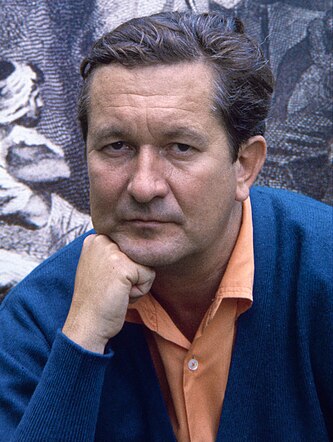

About William Styron
William Clark Styron, Jr. (11 June 1925 – 1 November 2006) was an American novelist. He is most famous for two controversial novels: the Pulitzer Prize-winning The Confessions of Nat Turner (1967), depicting the life of Nat Turner, the leader of an 1831 Virginia slave revolt, and Sophie's Choice (1979), which deals with the Holocaust.
Best William Styron Quotes
Shortest
Earliest
Explore our curated collection of the most famous and impactful William Styron quotes.
“Numberless factors shape one's needs and longings.”
“My life and work have been far from free of blemish, and so I think it would be unpardonable for a biographer not to dish up the dirt.”
“A great book should leave you with many experiences, and slightly exhausted at the end. You live several lives while reading it.”
“The good writing of any age has always been the product of someone's neurosis, and we'd have a mighty dull literature if all the writers that came along were a bunch of happy chuckleheads.”

“In Paris on a chilling evening late in October of 1985 I first became fully aware that the struggle with the disorder in my mind — a struggle which had engaged me for several months — might have a fatal outcome.”
“Camus's great essay "Reflections on the Guillotine" was alone almost enough - in its persuasive logic and eloquence - to make me an enemy of capital punishment.”
“I had now reached that phase of the disorder where all sense of hope had vanished, along with the idea of a futurity; my brain, in thrall to its outlaw hormones, had become less an organ of thought than an instrument registering, minute by minute, varying degrees of its own suffering.”
“It could be all unwittingly that I wrote in Darkness Visible what amounted to a Rosetta stone for my other work.”

“I raise my eyes upward. There alone amidst the blue, steadfast, unmoving, fiery marvel of brightness, shines the morning star. Never has that star seemed so radiant, and I stand gazing at it and do not move though the chill of the damp floor imprisons my feet in piercing icebound pain.
Surely I come quickly …”
Surely I come quickly …”
“The Shabaka [Sundiata Waglini] story illuminates the most sordid defects of capital punishment. His blackness and poverty helped doom him. He was ruthlessly cheated; it was never his privilege to be granted - even for a phantom crime - the incarceration [i.e. instead of death row] that it meted out to others and that carries the possibility of redemption.”
“I shivered in the knowledge of the futility of all ambition. My mouth was sour with the yellow recollection of death and blood-smeared fields and walls. I watched the girl slip away, vanish without a hand laid upon her. Who knows but whether we were not doomed to lose. I know nothing any longer. Nothing. Did I really wish to vouchsafe a life for the one that I had taken?”
“I discovered that I had, in the past two decades, written a far greater amount in the essay form than I remembered. Certainly I have written enough of it to demonstrate that I harbor no disdain for literary journalism or just plain journalism, under whose sponsorship I have been able to express much that has fascinated me, or alarmed me, or amused me, or otherwise engaged my attention when I was not writing a book.”

“Neither the Protestant church nor Anglo-American law was equipped to cope with the staggering problem of the status of the Negro: forced to choose between regarding him as a moral human being and as property, they chose the definition of property. The result was the utter degradation of a people. It was an oppression unparalled in human history.
This is the problem we are faced with today: too many white Americans still deny the Negro his position as a moral human being.”
This is the problem we are faced with today: too many white Americans still deny the Negro his position as a moral human being.”

“I would have done it all again. I would have destroyed them all. Yet I would have spared one. I would have spared her that showed me Him whose presence I had not fathomed or maybe never even known. Great God, how early it is! Until now I had almost forgotten His name.
“Come!” the voice booms, but commanding me now: Come, My son! I turn in surrender.
Surely I come quickly. Amen.
Even so, come, Lord Jesus.
Oh how bright and fair the morning star …”
“Come!” the voice booms, but commanding me now: Come, My son! I turn in surrender.
Surely I come quickly. Amen.
Even so, come, Lord Jesus.
Oh how bright and fair the morning star …”
“Depression is a disorder of mood, so mysteriously painful and elusive in the way it becomes known to the self — to the mediating intellect — as to verge close to being beyond description. It thus remains nearly incomprehensible to those who have not experienced it in its extreme mode, although the gloom, “the blues” which people go through occasionally and associate with the general hassle of everyday existence are of such prevalence that they do give many individuals a hint of the illness in its catastrophic form.”
“Grieving, yet somehow unbending, steadfast, unafraid, the voice rose through the evening like memory, and a gust of wind blew up from the river, dimming the song, rustling the trees, then died and became still. I’ll lay in de grave and stretch out my arms … Suddenly the voice ceased, and all was quiet.
Then what I done was wrong, Lord? I said. And if what I done was wrong, is there no redemption?
I raised my eyes upward but there was no answer, only the gray impermeable sky and night falling fast over Jerusalem.”
Then what I done was wrong, Lord? I said. And if what I done was wrong, is there no redemption?
I raised my eyes upward but there was no answer, only the gray impermeable sky and night falling fast over Jerusalem.”
“The Consumers Union Report on Smoking was an aid to my stopping a two-pack-a-day habit which commenced in early infancy. For myself, after two or three days of great flaccidity of spirit, an aimless oral yearning, aching moments of hunger at the pit of the stomach, and an awful intermittent urge to burst into tears, the problem resolved itself, and in less than a week all craving vanished. Curiously, for the first time in my life, I developed a racking cough, but this, too, disappeared. A sense of smugness, a kind of fatness of soul, is the reward for such a struggle.”
“For those who have dwelt in depression’s dark wood, and known its inexplicable agony, their return from the abyss is not unlike the ascent of the poet, trudging upward and upward out of hell’s black depths and at last emerging into what he saw as “the shining world.” There, whoever has been restored to health has almost always been restored to the capacity for serenity and joy, and this may be indemnity enough for having endured the despair beyond despair.
E quindi uscimmo a riveder le stelle.
And so we came forth, and once again beheld the stars.”
E quindi uscimmo a riveder le stelle.
And so we came forth, and once again beheld the stars.”
“William Blackburn [i.e. one of William Styron's teachers] cared about writing and had an almost holy concern for the langage.
Before too long my work got much better. I sweated like a coolie over my essays, themes and fledgling short stories until my splintered syntax and humpbacked prose achieved a measure of clarity and grace.
He informed me that one could not become a writer without a great deal of reading. To write one must read, he repeated, read . . .
He was unquestionably a glorious teacher. I deeply miss him. It helped immeasurably to have him tell me, at the age of twenty-one, that I could become a writer.”
“Simon Wiesenthal, the head of the Jewish Center of Documentation in Vienna, expressed his feelings on the matter in a recent interview:
"[...] I've battled for years with Jewish organisations, warning them that we shouldn't always talk about the six million Jews who died in the Holocaust. I say let's talk about eleven million civilians, among them six million Jews, who were killed. It's our Jewish fault that in the eyes of the world this whole problem became reduced to the problem between the Nazis and the Jews; the problem obviously was much broader." ”
"[...] I've battled for years with Jewish organisations, warning them that we shouldn't always talk about the six million Jews who died in the Holocaust. I say let's talk about eleven million civilians, among them six million Jews, who were killed. It's our Jewish fault that in the eyes of the world this whole problem became reduced to the problem between the Nazis and the Jews; the problem obviously was much broader." ”

“RIDING DOWN TO Port Warwick from Richmond, the train begins to pick up speed on the outskirts of the city, past the tobacco factories with their ever-present haze of acrid, sweetish dust and past the rows of uniformly brown clapboard houses which stretch down the hilly streets for miles, it seems, the hundreds of rooftops all reflecting the pale light of dawn; past the suburban roads still sluggish and sleepy with early morning traffic, and rattling swiftly now over the bridge which separates the last two hills where in the valley below you can see the James River winding beneath its acid-green crust of scum out beside the chemical plants and more rows of clapboard houses and into the woods beyond.”

“And as I began to discipline and harness myself, began for the first time to examine as coldly and as clinically as I could the tough problems which before this I had refused to face, I had a fine revelation. I realized that what had been lacking in my novelist's vision was really a sense of architecture - a symmetry, perhaps unobtrusive but always there, without which a novel sprawls, becoming a self-indulgent octopus. It was a matter of form, and up until now this was an issue that out of laziness or fear, perhaps both, I had tried to avoid.
I completed Lie Down in Darkness on a spring evening in 1951 in a room on West Eighty-Eighth Street in Manhattan.”
I completed Lie Down in Darkness on a spring evening in 1951 in a room on West Eighty-Eighth Street in Manhattan.”
“Writers ever since writing began have had problems, and the main problem narrows down to just one word — life. Certainly this might be an age of so-called faithlessness and despair we live in, but the new writers haven’t cornered any market on faithlessness and despair, any more than Dostoyevsky or Marlowe or Sophocles did. Every age has its terrible aches and pains, its peculiar new horrors, and every writer since the beginning of time, just like other people, has been afflicted by what that same friend of mine calls “the fleas of life”—you know, colds, hangovers, bills, sprained ankles, and little nuisances of one sort or another. They are the constants of life, at the core of life, along with nice little delights that come along every now and then.”

“For in virtually any other serious sickness, a patient who felt similar devastation would be lying flat in bed, possibly sedated and hooked up to the tubes and wires of life-support systems, but at the very least in a posture of repose and in an isolated setting. His invalidism would be necessary, unquestioned and honorably attained. However, the sufferer from depression has no such option and therefore finds himself, like a walking casualty of war, thrust into the most intolerable social and family situations. There he must, despite the anguish devouring his brain, present a face approximating the one that is associated with ordinary events and companionship. He must try to utter small talk, and be responsive to questions, and knowingly nod and frown and, God help him, even smile.”

William Styron Quotes by Topic
Find exactly what you are looking for by browsing this categorized list of William Styron quotes by topic.
William Styron on Morning
William Styron on Remedy
“Depression in its major stages possesses no quickly available remedy: failure of alleviation is one of the most distressing factors of the disorder as it reveals itself to the victim, and one that helps situate it squarely in the category of grave diseases.”

William Styron on Suicide
“To those of us who have suffered severe depression - myself included - this general unawareness of how relentlessly the disease can generate an urge to self-destruction seems widespread; the problem badly needs illumination. What is saddening about Primo Levi's death is the suspicion that his way of dying was not inevitable and that with proper care he might have been rescued from the abyss. I find it difficult not to believe that if Mr Levi had been under capable hospital attention, sequestered from the unbearable daily world in a setting where he would have been safe from his self-destructive urge, and where time would have permitted the storm raging in his brain to calm itself and die away, he would be among us now.”
William Styron on Religious views on love
“'''''Let your love flow out on all living things. These words at some level have the quality of a strapping homily. Nonetheless, they are remarkably beautiful, strung together in their honest lump-like English syllables... Let your love flow out on all living things.'' But there are a couple of problems with this precept of mine. The first is, of course, that it is not mine. It springs from the universe and is the property of God, and the words have been intercepted — on the wing, so to speak — by such mediators as Lao-tzu, Jesus, Gautama Buddha and thousands upon thousands of lesser prophets, including your narrator, who heard the terrible truth of their drumming somewhere between Baltimore and Wilmington and set them down with the fury of a madman sculpting in stone.'''”
William Styron on Love
“'''''Let your love flow out on all living things. These words at some level have the quality of a strapping homily. Nonetheless, they are remarkably beautiful, strung together in their honest lump-like English syllables... Let your love flow out on all living things.'' But there are a couple of problems with this precept of mine. The first is, of course, that it is not mine. It springs from the universe and is the property of God, and the words have been intercepted — on the wing, so to speak — by such mediators as Lao-tzu, Jesus, Gautama Buddha and thousands upon thousands of lesser prophets, including your narrator, who heard the terrible truth of their drumming somewhere between Baltimore and Wilmington and set them down with the fury of a madman sculpting in stone.'''”

Quotes About William Styron
Gain deeper perspective through quotes about William Styron from others.
Conversations with James Baldwin on William Styron
“"Confessions of Nat Turner," is a book I admire very much. But, you see, I read that book as the "Confessions of Bill Styron" and I'm not trying to put the book down when I say that. I respect the book very much. I respect him very much and I respect his attempt to grapple with something almost no one in his generation is prepared to even look at... The book meant something to me because it was a white Southern writer's attempt to deal with something that was tormenting him and frightening him. I respect him very much for that. Now, as to his execution, what is one to say about it? (“I'm still waiting for the white writer to write a novel about a lynching from the point of view of the lyncher.”) Yes, I quite agree with you. I said before that America's effort to avoid the presence of black people constricts American literature. It creates a trap white writers find themselves in.”
About William Styron
William Clark Styron, Jr. (11 June 1925 – 1 November 2006) was an American novelist. He is most famous for two controversial novels: the Pulitzer Prize-winning The Confessions of Nat Turner (1967), depicting the life of Nat Turner, the leader of an 1831 Virginia slave revolt, and Sophie's Choice (1979), which deals with the Holocaust.