Link Copied!
William Jennings Bryan Quotes (1860-1925)
President, Politician
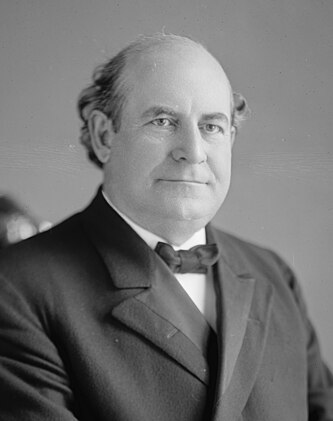


About William Jennings Bryan
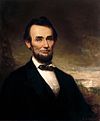
William Jennings Bryan (19 March 1860 – 26 July 1925) was an American lawyer, statesman, and politician. He was a three-time Democratic Party nominee for President of the United States, and famously supported Tennessee's Butler Act against the teaching of evolution at the Scopes Trial of 1925.
Best William Jennings Bryan Quotes
Shortest
Earliest
Explore our curated collection of the most famous and impactful William Jennings Bryan quotes.
“Dear me, think of it, niggers speaking French!”


“Success is brought by continued labor and continued watchfulness. We must struggle on, not for one moment hesitate, nor take one backward step.”
“We object to bringing this question down to the level of persons. The individual is but an atom; he is born, he acts, he dies; but principles are eternal; and this has been a contest over a principle.”

“A man who murders another shortens by a few brief years the life of a human being; but he who votes to increase the burden of debts upon the people of the United States assumes a graver responsibility.”

“I have been so satisfied with the Christian religion that I have spent no time trying to find arguments against it. … I am not afraid now that you will show me any. I feel that I have enough information to live and die by.”
“This is not a contest between persons. The humblest citizen in all the land, when clad in the armor of a righteous cause, is stronger than all the hosts of error. I come to speak to you in defence of a cause as holy as the cause of liberty—the cause of humanity.”
“Next to the ministry I know of no more noble profession than the law. The object aimed at is justice, equal and exact, and if it does not reach that end at once it is because the stream is diverted by selfishness or checked by ignorance. Its principles ennoble and its practice elevates.”
“You come to us and tell us that the great cities are in favor of the gold standard; we reply that the great cities rest upon our broad and fertile prairies. Burn down your cities and leave our farms, and your cities will spring up again as if by magic; but destroy our farms and the grass will grow in the streets of every city in the country.”

“The real question is, Did God use evolution as His plan? If it could be shown that man, instead of being made in the image of God, is a development of beasts we would have to accept it, regardless of its effort, for truth is truth and must prevail. But when there is no proof we have a right to consider the effect of the acceptance of an unsupported hypothesis.”

“The poor man who takes property by force is called a thief, but the creditor who can by legislation make a debtor pay a dollar twice as large as he borrowed is lauded as the friend of a sound currency. The man who wants the people to destroy the Government is an anarchist, but the man who wants the Government to destroy the people is a patriot.”

“There are two ideas of government. There are those who believe that, if you will only legislate to make the well-to-do prosperous, their prosperity will leak through on those below. The Democratic idea, however, has been that if you legislate to make the masses prosperous, their prosperity will find its way up through every class which rests up on them.”
“Your Honor, I think I can shorten this testimony. The only purpose Mr. Darrow has is to slur at the Bible, but I will answer his question. I will answer it all at once, and I have no objection in the world. I want the world to know that this man, who does not believe in a God, is trying to use a court in Tennessee to slur at it, and while it will require time, I am willing to take it.”

“Appearance too often takes the place of reality — the stamp of the coin is there, and the glitter of the gold, but, after all, it is but a worthless wash. Sham is carried into every department of life, and we are being corrupted by show and surface. We are too apt to judge people by what they have, rather than by what they are; we have too few Hamlets who are bold enough to proclaim, "I know not seem!"”

“Science is a magnificent force, but it is not a teacher of morals. It can perfect machinery, but it adds no moral restraints to protect society from the misuse of the machine. It can also build gigantic intellectual ships, but it constructs no moral rudders for the control of storm tossed human vessel. It not only fails to supply the spiritual element needed but some of its unproven hypotheses rob the ship of its compass and thus endangers its cargo.”

“I have studied the Bible for about 50 years, or sometime more than that, but, of course, I have studied it more as I have become older than when I was but a boy. … I believe everything in the Bible should be accepted as it is given there: some of the Bible is given illustratively. For instance: "Ye are the salt of the earth." I would not insist that man was actually salt, or that he had flesh of salt, but it is used in the sense of salt as saving God's people.”

“You cannot judge a man's life by the success of a moment, by the victory of an hour, or even by the results of a year. You must view his life as a whole. You must stand where you can see the man as he treads the entire path that leads from the cradle to the grave — now crossing the plain, now climbing the steeps, now passing through pleasant fields, now wending his way with difficulty between rugged rocks — tempted, tried, tested, triumphant.”

“If they dare to come out in the open field and defend the gold standard as a good thing, we will fight them to the uttermost. Having behind us the producing masses of this nation and the world, supported by the commercial interests, the laboring interests and the toilers everywhere, we will answer their demand for a gold standard by saying to them: You shall not press down upon the brow of labor this crown of thorns, you shall not crucify mankind upon a cross of gold.”
“But if each day we gather some new truths, plant ourselves more firmly upon principles which are eternal, guard every thought and action, that it may be pure, and conform our lives more nearly to that Perfect Model, we shall form a character that will be a fit background on which to paint the noblest deeds and the grandest intellectual and moral achievements; a character that cannot be concealed, but which will bring success in this life and form the best preparation for that which is beyond.”
“Character is the entity, the individuality of the person, shining from every window of the soul, either as a beam of purity, or as a clouded ray that betrays the impurity within. The contest between light and darkness, right and wrong, goes on; day by day, hour by hour, moment by moment, our characters are being formed, and this is the all-important question which comes to us in accents ever growing fainter as we journey from the cradle to the grave, "Shall those characters be good or bad?"”

“Why, these men would destroy the Bible on evidence that would not convict a habitual criminal of a misdemeanor. They found a tooth in a sand pit in Nebraska with no other bones about it, and from that one tooth decided that it was the remains of the missing link. They have queer ideas about age too. They find a fossil and when they are asked how old it is they say they can't tell without knowing what rock it was in, and when they are asked how old the rock is they say they can't tell unless they know how old the fossil is.”

William Jennings Bryan Quotes by Topic
Find exactly what you are looking for by browsing this categorized list of William Jennings Bryan quotes by topic.
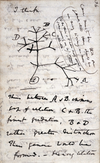
William Jennings Bryan on Evolution 5 quotes
“If they believe it (evolution), they go back to scoff at the religion of their parents.”
William Jennings Bryan on War 2 quotes
“The Government of the United States would be constrained to hold the Imperial German government to a strict accountability for such acts of their naval authorities.”

William Jennings Bryan on Science 2 quotes
“Science is a magnificent force, but it is not a teacher of morals. It can perfect machinery, but it adds no moral restraints to protect society from the misuse of the machine. It can also build gigantic intellectual ships, but it constructs no moral rudders for the control of storm tossed human vessel. It not only fails to supply the spiritual element needed but some of its unproven hypotheses rob the ship of its compass and thus endangers its cargo.”

William Jennings Bryan on Gold
“You shall not press down upon the brow of labor this crown of thorns—you shall not crucify mankind upon a cross of gold!”
William Jennings Bryan on Armour
“The humblest citizen in all the land, when clad in the armor of a righteous cause, is stronger than all the hosts of error.”
William Jennings Bryan on Destiny
William Jennings Bryan on Spirit
“If that vital spark that we find in a grain of wheat can pass unchanged through countless deaths and resurrections, will the spirit of man be unable to pass from this body to another?”
William Jennings Bryan on Human
William Jennings Bryan on Citizenship
“This is not a contest between persons. The humblest citizen in all the land, when clad in the armor of a righteous cause, is stronger than all the hosts of error. I come to speak to you in defence of a cause as holy as the cause of liberty—the cause of humanity.”

William Jennings Bryan on Publicity
“The government being the people’s business, it necessarily follows that its operations should be at all times open to the public view. Publicity is therefore as essential to honest administration as freedom of speech is to representative government. “Equal rights to all and special privileges to none” is the maxim which should control in all departments of government.”

William Jennings Bryan on Money
“And who can suffer injury by just taxation, impartial laws and the application of the Jeffersonian doctrine of equal rights to all and special privileges to none? Only those whose accumulations are stained with dishonesty and whose immoral methods have given them a distorted view of business, society and government. Accumulating by conscious frauds more money than they can use upon themselves, wisely distribute or safely leave to their children, these denounce as public enemies all who question their methods or throw a light upon their crimes.”

William Jennings Bryan on Economy of India under the British Raj
“Let no one cite India as an argument in defense of colonialism. On the Ganges and the Indus the Briton, in spite of his many notable qualities and his large contribution to the world's advancement, has demonstrated, as many have before, man's inability to exercise, with wisdom and justice, irresponsible power over the helpless people. He has conferred some benefits upon India, but he has extorted a tremendous price for them. While he has boasted of bringing peace to the living, he has led millions to the peace of the grave; while he has dwelt upon order...he has impoverished the country by legalized pillage.”

William Jennings Bryan on Monetary reform
“We say in our platform that we believe that the right to coin and issue money is a function of government. We believe it. We believe that it is a part of sovereignty, and can no more with safety be delegated to private individuals than we could afford to delegate to private individuals the power to make penal statutes or levy taxes…Those who are opposed to this proposition tell us that the issue of paper money is a function of the bank, and that the government ought to go out of the banking business. I stand with Jefferson rather than with them, and tell them, as he did, that the issue of money is a function of government, and that the banks ought to go out of the governing business… When we have restored the money of the Constitution, all other reform will be possible, but until this is done there is no other reform that can be accomplished.”
Quotes About William Jennings Bryan
Gain deeper perspective through quotes about William Jennings Bryan from others.
Mary Ritter Beard on William Jennings Bryan
“The nomination of Mr. Bryan by the Democrats and his endorsement by the majority of the Populists made a strong appeal to the labor vote. In that campaign the Democrats vigorously denounced "capitalism and the money power," and arrayed the masses against the classes. They proposed income taxes on the rich, free silver or an abundance of money in circulation, limitation of injunctions, and other measures which proved attractive to trade unionists in their struggle against powerful employers of labor, and especially against the great trusts with which they had found themselves unable to cope on equal terms.”

James Robert Brown on William Jennings Bryan
“History had been unkind to William Jennings Bryan, characterizing him as a Bible-thumping buffoon. Bryan was anything but the bumpkin he is made out to be in common accounts of the Scopes trial. … William Jennings Bryan was a great American hero, someone in whom people on the Left can take a sympathetic interest. A century ago, he was a leading populist politician … He was a strong opponent of the runaway capitalism of his day and fought hard and effectively for progressive social change, including votes for women, progressive income tax, and for getting the United States off the gold standard, which was a terrible burden on the American working class.”
The Autobiography of W.E.B. Du Bois: A Soliloquy on Viewing My Life from the Last Decade of Its First Century on William Jennings Bryan
“The impassioned plea of Bryan in 1896 that labor be not "crucified upon a cross of gold" could not be wholly ridiculed to silence. The Populist movement which swept over the West and South, I began now to believe, was a third party movement of deep significance and it was kept from political power on the one hand by the established election frauds of the South, of which I knew, and by the fabulous election fund which made McKinley President of the United States.”
Emma Goldman on William Jennings Bryan
“The free-silver campaign was at its height. The proposition for the free coinage of silver at the ratio with gold of sixteen to one had become a national issue almost overnight. It gained in strength by the sudden ascendancy of William Jennings Bryan, who had stampeded the Democratic Convention by an eloquent speech and the catch phrase: "You shall not press down upon the brow of labour the crown of thorns, you shall not crucify mankind upon the cross of gold." [...] I could not share the enthusiasm for Bryan, partly because I did not believe in the political machine as a means of bringing about fundamental changes, and also because there was something weak and superficial about Bryan. I had a feeling that his main aim was to get into the White House rather than "strike off the chains" from the people. I resolved to steer clear of him. I sensed his lack of sincerity and I did not trust him.”

David M. Kennedy on William Jennings Bryan
“Democrats, strong in the cotton region, generally agreed on a low-tariff policy but on little else. Hard-money ‘‘Bourbon’’ Democrats in the Grover Cleveland mold clashed with inflationists whose perennial champion was William Jennings Bryan, ‘‘Boy Orator of the Platte,’’ the ‘‘Great Commoner’’ whose affected rusticity symbolized the economic and cultural gulf that separated Main Street from Wall Street. Self-made men like James Michael Curley of Boston or Al Smith and Robert Wagner of New York, champions of labor who had scrambled up out of immigrant ghettoes like Roxbury or Hell’s Kitchen, sat uneasily in party councils with cotton-South barons like Mississippi’s Senator Pat Harrison or rural Texans like John Nance Garner, men who saw in cheap, nonunion labor their region’s major economic resource. Cerebral reformers like Harvard law professor Felix Frankfurter barely coexisted in the same party with antic populist demagogues like Louisiana’s Huey Long. Cultural differences, too, cleaved the party along the lines that separated Catholics and Jews from old-stock Protestants, divided anti-Prohibition ‘‘wets’’ from fundamentalist ‘‘drys,’’ and distanced urban immigrants from rural Klansmen. These conflicting forces had locked in such irreconcilable conflict at the Democrats’ presidential nominating convention of 1924 in New York that only after 103 ballots did the weary and sweltering delegates settle on a compromise ticket. It had corporation lawyer John W. Davis at its head and Nebraska governor Charles W. Bryan, brother of the Great Commoner, in the vice-presidential slot. Davis’s crushing defeat by Calvin Coolidge seemed to confirm the suspicions of many pundits that the roiling, fractionated mob known as the Democratic Party could never be fashioned into a coherent instrument of governance. ‘‘I don’t belong to an organized political party,’’ quipped America’s favorite humorist, Will Rogers. ‘‘I’m a Democrat.’’”
Peter Krass on William Jennings Bryan
“Unfortunately for the Republicans, William Jennings Bryan was a great orator and took the early lead in the public's eye. Bryan, flashing steel-blue eyes and well-kept teeth, vowed to fight the money kings of Wall Street and wholly supported unlimited coinage of silver.”
J.C. Long on William Jennings Bryan
“Bryan's contribution to his age was primarily his belief in the inherent dignity of the common man. Brought up in the tradition of Jefferson and Jackson, The Peerless Leader opposed the trespassing upon individual freedom either by socialism or by corporate aggrandizement. The modern equivalent of The Commoner's jousts would lie in the saving to the individual of a degree of control in his own destiny and personality amid the complications of a machine era. There is no paint box of present day colors to create again that figure of purple and silver. His principles are everlasting, and to that extent an- other may come to be called a Great Commoner. But as a human being, as an individual, he was alone of his kind. The label that his early followers gave him suggests this. What a wealth of adoration, of personality, and of the singular timbre of his times is wrapped up in his title "The Peerless Leader." In millions of homes throughout the nation he was a hope, a defender, and a personal godfather. The backlog of his strength in the myriad battles which he engaged upon was his devotion to his people and theirs to him.”
H.L. Mencken on William Jennings Bryan
“As for William Jennings Bryan, of whom so much piffle, pro and con, has been written, the whole of his political philosophy may be reduced to two propositions, neither of which is true. The first is the proposition that the common people are wise and honest, and the second is the proposition that all persons who refuse to believe it are scoundrels. Take away the two, and all that would remain of Jennings would be a somewhat greasy bald-headed man with his mouth open.”
H. L. Mencken on William Jennings Bryan 2 quotes
“Bryan was a vulgar and common man, a cad undiluted. He was ignorant, bigoted, self-seeking, blatant and dishonest. His career brought him into contact with the first men of his time; he preferred the company of rustic ignoramuses. … Imagine a gentleman, and you have imagined everything that he was not.”

Steven O'Brien on William Jennings Bryan
“Called by his admirers the Great Commoner, William Jennings Bryan was a tireless defender of the poor against the rich and a prophet of reform and humanitarianism. Without a doubt he was the voice of the Democratic party at the turn of the century, and his style and dedication kept him at center stage for thirty-five years of turbulent American politics.”
Henry Fairfield Osborn on William Jennings Bryan 3 quotes
“The Earth Speaks, clearly, distinctly, and, in many of the realms of Nature, loudly, to William Jennings Bryan, but he fails to hear a single sound. The earth speaks from the remotest periods in its wonderful life history in the Archaeozoic Age, when it reveals only a few tissues of its primitive plants. Fifty million years ago it begins to speak as “the waters bring forth abundantly the moving creatures that hath life.” In successive eons of time the various kinds of animals leave their remains in the rocks which compose the deeper layers of the earth, and when the rocks are laid bare by wind, frost, and storm we find wondrous lines of ascent invariably following the principles of creative evolution, whereby the simpler and more lowly forms always precede the higher and more specialized forms. The earth speaks not of a succession of distinct creations but of a continuous ascent, in which, as the millions of years roll by, increasing perfection of structure and beauty of form are found; out of the water-breathing fish arises the air-breathing amphibian; out of the land-living amphibian arises the land-living, air-breathing reptile, these two kinds of creeping things resembling each other closely. The earth speaks loudly and clearly of the ascent of the bird from one kind of reptile and of the mammal from another kind of reptile. This is not perhaps the way Bryan would have made the animals, but this is the way God made them!”

Elizabeth Sanders on William Jennings Bryan
“The national Democratic Party, having absorbed the Populist Party and rebuffed its own northeastern conservative wing, became the bearer of agrearian demands in national politics. Thus it was that so much of the old populist program could be enacted years after the Populist Party and the Farmers' Alliance had faded away. The politically committed farmer and the extraordinary figure of William Jennings Bryan — at once a national party chief, agrarian social-movement leader, and the country's foremost progressive reformer — made this translation possible.”
Source on William Jennings Bryan 3 quotes
“His climaxing journalistic feat of 1921 was his publication by way of The Commoner Press of the Bryan National Legislative Program. The contents covered most of his frustrated recommendations for the 1920 Democratic party platform and a number of other heretofore undisclosed proposals. Among the latter were appeals for limiting future presidential terms to one term of six years, nationwide primaries open to all voters, a U.S.-sponsored world disarmament conference, federal legislation prohibiting the gambling in futures of essential commodities, and federal ownership of all water power resources. He further urged the individual states to inaugurate “public-good enterprises,” such as cooperative fuel yards (along lines already shaped and proved by his brother in Lincoln), state-owned slaughterhouses, and nonprofit, state-owned filling stations. He pounded away at monopolies, taking as his special target Rockefeller’s Standard Oil Company. He reiterated the special role of towns and cities in effecting public-good benefits, citing Mayor John F. Hylan’s plan for New York City’s ownership and operation of its own transit system as an admirable example of municipal progressivism.”
Charles Morrow Wilson on William Jennings Bryan
“Meanwhile, the Commoner resumed his role as unofficial international peace maker.”
About William Jennings Bryan
William Jennings Bryan (19 March 1860 – 26 July 1925) was an American lawyer, statesman, and politician. He was a three-time Democratic Party nominee for President of the United States, and famously supported Tennessee's Butler Act against the teaching of evolution at the Scopes Trial of 1925.