Link Copied!
William Byrd Quotes (1534-1623)
Poet, Composer
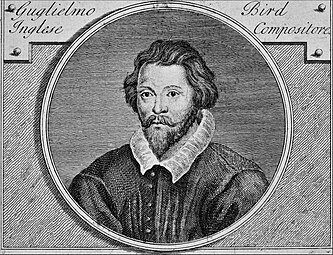

About William Byrd
William Byrd (between 1534 and 1543 – 4 July 1623) was an English composer and poet.
William Byrd Quotes
Shortest
Earliest
Explore our curated collection of the most famous and impactful William Byrd quotes.
“Sure you have made me passing glad
That you your mind so soon removed,
Before that I the leisure had
To choose you for my best beloved”
That you your mind so soon removed,
Before that I the leisure had
To choose you for my best beloved”
“So long as I was in your sight
I was your heart, your soul, your treasure;
And evermore you sobb'd and sigh'd
Burning in flames beyond all measure:
—Three days endured your love to me,
And it was lost in other three!”
I was your heart, your soul, your treasure;
And evermore you sobb'd and sigh'd
Burning in flames beyond all measure:
—Three days endured your love to me,
And it was lost in other three!”
William Byrd Quotes by Topic
Find exactly what you are looking for by browsing this categorized list of William Byrd quotes by topic.
William Byrd on Mind
“My minde to me a kingdome is, Such perfect joy therein I finde As farre exceeds all earthly blisse That God or Nature hath assignde Though much I want that most would have Yet still my minde forbids to crave.”

Quotes About William Byrd
Gain deeper perspective through quotes about William Byrd from others.
John Baldwin on William Byrd
“An Englishman, by name, William Birde for his skill. Which I should heve sett first, for soe it was my will, Whose greater skill and knowledge dothe excelle all at this tyme And far to strange countries abroade his skill dothe shyne; Famous men be abroad, and skilful in the arte I do confesse the fame and not from it starte; But in Ewroppe is none like to our Englishe man, Which dothe so farre exceede, as trulie I it scan As ye cannot finde out his equale in all thinges Throwghe out the worlde so wide, and so his fame now ringes. With fingers and with penne he hathe not now his peere; For in this worlde so wide is none can him come neere, The rarest man he is in musicks worthy arte That now on earthe doth liue: I speake it from my harte Or heere to fore hath been or after him shall come None suche I feare shall rise that may be calde his sonne.”
Edmund Fellowes on William Byrd
“If we consider Byrd's versatility alone, and the fact that he produced work of the highest class in every field that he explored, it becomes abundantly clear that he did stand above all his contemporaries. Like Palestrina, he wrote magnificently for the Latin rites of the Church. Nor was he behind any of his contemporaries in his capacity for handling ingenious and complex contrapuntal devices such as were in vogue among the Church musicians of the sixteenth century. His contrapuntal skill was astonishing. Like Tallis, Tye, and Robert Whyte, he excelled in music for the English Church whether for the Latin or English rites. Like Marenzio, Wilbye, and Weelkes, he could write finely in the madrigalian style, not only when treating the severer subjects, where again he stands alone, but also in the lighter vein, as we shall see presently when dealing more closely with this branch of the subject. Like Bull, Gibbons, and Giles Farnaby, he wrote with exceptional fertility of invention for the keyed instruments of his day, yet here again he excelled the others; while for the viols he produced chamber-music which to-day amazes students of musical form when its date is borne in mind.”
Henry Hadow on William Byrd
“They call William Byrd the English Palestrina; I shall not rest until Palestrina is called the Italian Byrd!”
Thomas Morley on William Byrd
Henry Peacham on William Byrd
“For Motets, and Musicke of pietie and devotion, as well for the honour of our Nation, as the merit of the man, I prefer above all our Phoenix, M. William Byrd, whom in that kind, I know not whether any may equall. I am sure none excell, even by the judgement of France and Italy, who are very sparing in the commendation of strangers, in regard of that conceipt they hold of themselves. His Cantiones Sacrae, as also his Gradualia, are meer Angelicall and Divine; and being of himselfe naturally disposed to Gravity and Pietie, his veine is not so much for leight Madrigals or Canzonets, yet his Virginella, and some others in his first set, cannot be mended by the best Italian of them all.”
About William Byrd
William Byrd (between 1534 and 1543 – 4 July 1623) was an English composer and poet.