Link Copied!
Wilhelm Keitel Quotes (1882-1946)
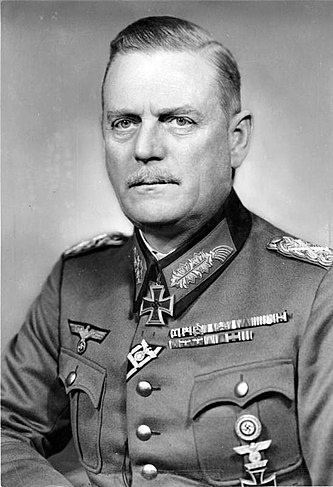

About Wilhelm Keitel
Wilhelm Bodewin Johann Gustav Keitel (September 22, 1882 – October 16, 1946) was a German field marshal and war criminal who held office as chief of the Oberkommando der Wehrmacht (OKW), the high command of Nazi Germany's Armed Forces, during the Second World War. In that capacity, Keitel signed a number of criminal orders and directives that led to numerous war crimes. Keitel's rise to the Wehrmacht high command began with his appointment as the head of the Armed Forces Office at the Reich Ministry of War in 1935. Having taken command of the Wehrmacht in 1938 Hitler replaced the ministry with the OKW and Keitel became its chief. He was reviled among his military colleagues as Hitler's habitual "yes-man".
Best Wilhelm Keitel Quotes
Shortest
Earliest
Explore our curated collection of the most famous and impactful Wilhelm Keitel quotes.
“I call on God Almighty to have mercy on the German people. More than two million German soldiers went to their death for the fatherland before me. I follow now my sons - all for Germany.”

“I am a soldier and I worked for the kaiser, under Ebert, Hindenburg, and Hitler, all the same way, for the past 44 years.”
“It is tragic to have to realize that the best I had to give as a soldier, obedience, and loyalty, was exploited for purposes which could not be recognized at the time, and that I did not see that there is a limit set even for a soldier's performance to his duty. That is my fate.”

“Why did the generals who have been so ready to term me a complaisant and incompetent yes-man fail to secure my removal? Was that all that difficult? No, that wasn't it; the truth was that nobody would have been ready to replace me, because each one knew that he would end up just as much a wreck as I.”
“The Führer has ordered that the enemy employs in partisan warfare Communist-trained fanatics who do not hesitate to commit any atrocity. It is more than ever a question of life and death. This fight has nothing to do with soldierly gallantry or principles of the Geneva Convention. If the fight against the partisans in the East, as well as in the Balkans, is not waged with the most brutal means, we will shortly reach the point where the available forces are insufficient to control the area. It is therefore not only justified, but it is the duty of the troops to use all means without restriction, even against women and children, so long as it ensures success. Any consideration for the partisans is a crime against the German people.”
Wilhelm Keitel Quotes by Topic
Find exactly what you are looking for by browsing this categorized list of Wilhelm Keitel quotes by topic.
Quotes About Wilhelm Keitel
Gain deeper perspective through quotes about Wilhelm Keitel from others.
Ewald von Kleist on Wilhelm Keitel
“If you want my own plain opinion about Keitel's orders, I will tell you. They were the orders of a stupid follower of Hitler. I myself paid very little attention to them and I think any attempt to justify his orders would be a mistake on the part of those of us who are steeped in military tradition and good conduct. I trust you will not quote me on these observations. I knew Keitel fairly well and I think that he is a decent person. It was simply that Hitler wanted a weak general in that powerful position in order to be able to have complete control of him. If I had held Keitel's position under Hitler, I wouldn't have lasted two weeks.”
About Wilhelm Keitel
Wilhelm Bodewin Johann Gustav Keitel (September 22, 1882 – October 16, 1946) was a German field marshal and war criminal who held office as chief of the Oberkommando der Wehrmacht (OKW), the high command of Nazi Germany's Armed Forces, during the Second World War. In that capacity, Keitel signed a number of criminal orders and directives that led to numerous war crimes. Keitel's rise to the Wehrmacht high command began with his appointment as the head of the Armed Forces Office at the Reich Ministry of War in 1935. Having taken command of the Wehrmacht in 1938 Hitler replaced the ministry with the OKW and Keitel became its chief. He was reviled among his military colleagues as Hitler's habitual "yes-man".