Link Copied!
Vyasa Quotes (0-)
Author
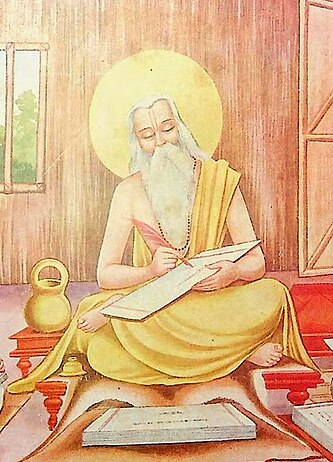


About Vyasa
Veda Vyasa (Devanagari: व्यास, वेदव्यास veda-vyāsa), or simply Vyasa, is a central and revered figure in most Hindu traditions. He is also sometimes called Krishna Dvaipāyana (referring to his complexion and birthplace). He is the one who classified the Vedas into four parts). He is the author of the Mahabharata, as well as a character in it. He is considered to be the scribe of both the Vedas and Puranas. According to Hindu beliefs, Vyasa is an incarnation of God Vishnu.
Best Vyasa Quotes
Shortest
Earliest
Explore our curated collection of the most famous and impactful Vyasa quotes.
“Remember me when things are to be done.”
“All right, I also have a condition:that you should not write down anything without grasping the full significance of what I say.”

“Passionless is the consciousness of being Master on the part of one who has rid himself of thirst for either seen or revealed objects.”

“Therefore, arise and conquer your foes... These warriors stand already slain by Me, and you will only be an instrument of My work, O expert archer.”

“Those who perform all their duties for My sake, who depend upon Me and are devoted to Me, who are free from attachment, and are without malice toward all beings, such devotees certainly come to Me.”
“The Supreme Lord said: I am mighty Time, the source of destruction that comes forth to annihilate the worlds. Even without your participation, the warriors arrayed in the opposing army shall cease to exist.”

“Various inscriptions refer to the Mbh (Mahabharata) as the composition of Vyasa, the Veda divider, the son of Parasara, and as containing 100,000 verses...”
“I recognize You as the supreme imperishable being, the Ultimate Truth to be known by the scriptures. You are the support of all creation; You are the eternal protector of Sanātan Dharma (the Eternal Religion); and You are the everlasting Supreme Divine Personality.”
“Although the MBh is the text having the most information about Vyasa, there are few references to him in Sanskrit literature that predated the MBh or is atleast contemporaneous with the early phase.”
“It has been said by Sanatkumara and the great-spirited Vyasa, and it is enjoined in the Veda, O, King that one should go to Pratudaka on pilgrimage.”
“He will be a man with strength of a myriad elephants, a great and royal rsi, of great fortune, great power, and great intelligence. And 100 powerful sons will be his, but because of his mother’s lack of virtue, he shall be born blind.”

“In all living beings exists the self-benediction, ‘would that I were never to cease. May I live on’. And this self-benediction cannot exist in him who has not experienced the nature of death. And by this experience of a former life is inferred. This is the affliction of Love of Life, which flows by its own potency.”


“Vyasa’s activities in the MBh cover the full range of activities traditionally deemed appropriate for a brahmin. Unquestionably Vyasa is the epic’s foremost expert on the Veda and the ritual activity enjoined by the Veda. Having rearranged the one Veda into four texts, Vyasa taught those to his five pupils along with MBh as the fifth Veda.”


“...causing of injuries to others is of three descriptions, that which is done and that which is permitted to be done. Each again is three-fold. Prompted by desire of gain, as in the case of one who desires to obtain flesh and skin; prompted by anger as in the case of a man who has received some injury; done though ignorance of the real nature of an act, under the impression that the act proposed is a virtue.”
Vyasa Quotes by Topic
Find exactly what you are looking for by browsing this categorized list of Vyasa quotes by topic.
Vyasa on Pigs
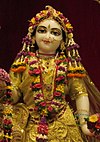
Vyasa on Radha
“...these two [Krishna and Radha], and Sri Radha in particular, are so wonderful. Who can understand them? Even Krishna is bewildered by Radharani, what then can Anantasesa and others know about Her (muhyanti yat surayah)? Land (mrt) turns into water and flows, while water (vari) takes on the character of land and becomes stunned upon hearing the flute of Sri Krishna, which He plays only to attract Sri Radha, whose effulgence (tejah) dims the light of the stars and moon, tejo vari mrdam yatha vinimayo. Among the gopis there are three kinds, those who favor Radha (headed by Lalita), those who serve in the opposition's side (headed by Candravali) and those who take sometimes the side of Radha and sometimes the side of Krishna (headed by Visakha).”
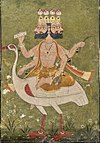
Vyasa on Brahma
“In every third world age (Dvapara), Vishnu, in the person of Vyasa, in order to promote the good of mankind, divides the Veda, which is properly but one, into many portions. Observing the limited perseverance, energy, and application of mortals, he makes the Veda fourfold, to adapt it to their capacities; and the bodily form which he assumes, in order to effect that classification, is known by the name of Veda-vyasa. Of the different Vyasas in the present Manvantara and the branches which they have taught, you shall have an account. Twenty-eight times have the Vedas been arranged by the great Rishis in the Vaivasvata Manvantara... and consequently eight and twenty Vyasas have passed away; by whom, in the respective periods, the Veda has been divided into four. The first... distribution was made by Svayambhu (Brahma) himself; in the second, the arranger of the Veda (Vyasa) was Prajapati... (and so on up to twenty-eight).”
What Vyasa Said About Others
Discover personal opinions Vyasa shared regarding contemporaries.
Vyasa on Draupadi 2 quotes
“The gods have already declared that she will become the wife of all the five Pandava brethren... Pandava brethren were five incarnations of [[w:Indra|Indra, and thus were but as one.”
About Vyasa
Veda Vyasa (Devanagari: व्यास, वेदव्यास veda-vyāsa), or simply Vyasa, is a central and revered figure in most Hindu traditions. He is also sometimes called Krishna Dvaipāyana (referring to his complexion and birthplace). He is the one who classified the Vedas into four parts). He is the author of the Mahabharata, as well as a character in it. He is considered to be the scribe of both the Vedas and Puranas. According to Hindu beliefs, Vyasa is an incarnation of God Vishnu.