Link Copied!
Valmiki Quotes (0-)
Author, Poet
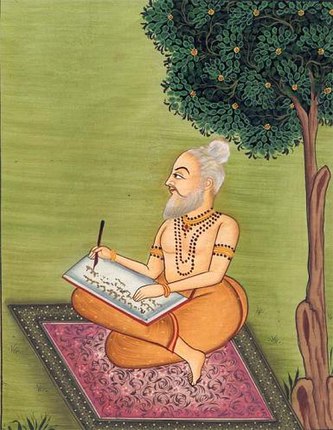

About Valmiki
Valmiki (Sanskrit: वाल्मीकि Vālmīki) is celebrated as the harbinger-poet in Sanskrit literature. He is the author of the epic Rāmāyaṇa, based on the attribution in the text of the epic itself. He is revered as the Ādi Kavi, which translates to First Poet, for he invented śloka (i.e. first verse or epic metre), which set the base and defined the form to Sanskrit poetry.
Best Valmiki Quotes
Shortest
Earliest
Explore our curated collection of the most famous and impactful Valmiki quotes.
“Sit by me.”
“What did she do wrong?”
“I have no companions here.”
“Just name me one honest man and I'll move.”

“Act now Valmiki; Call out and the rest must follow.”

“Would I ever? See how Life goes by, with every creature doing what follows his nature. Master, what can I say to you?”
“What a crime! There was not one bit of meat on that little bird. What use is a world run all wrong without a grain of mercy on it?”
“This is truly how I remember the ways of the world. Those words I cursed him with make a verse, and that verse could be sung to music.”
“Heartbroken the dead bird’s mate cried – Your long feathers! Your tuneful songs. A bird hunter came from the forest holding a bow. Valmiki’s heart was pounding and he cursed the killer.”
“Roman transliteration:
mā niṣāda pratiṣṭhāṁ tvamagamaḥ śāśvatīḥ samāḥ
yat krauñcamithunādekam avadhīḥ kāmamohitam”
mā niṣāda pratiṣṭhāṁ tvamagamaḥ śāśvatīḥ samāḥ
yat krauñcamithunādekam avadhīḥ kāmamohitam”

“Nothing. She is innocent and blameless. She has lived as Rama’s queen ten thousand years; before that Rama saved her from great danger by wondrous and incredible deeds. And now behold one of the terrors of kingship, that Rama let her go because his people talk against her. Get up, save her life with you and your companions; and make in measured words the song of Rama, and teach it to Rama’s two sons.”
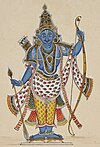
“Rama rules as King in Ayodhya. He is born in the Solar race and a descendant of the Sun; he is brave and gentle and firm in fight. By Rama's command his adorable Queen Sita is being brought here into the forest on a chariot, and though she suspects nothing yet, here she will be left abandoned. Unless you comfort her she will drown herself in Ganga and kill as well her unborn sons by Rama.”
“English translation:
You will find no rest for the long years of Eternity
For you killed a bird in love and unsuspecting
• In: Ramayana translated by William Buck in:Ramayana, Motilal Banarsidass Publ., 1 January 2000, p. 7.”
You will find no rest for the long years of Eternity
For you killed a bird in love and unsuspecting
• In: Ramayana translated by William Buck in:Ramayana, Motilal Banarsidass Publ., 1 January 2000, p. 7.”
“In all this world, I pray thee, who
Is virtuous, heroic, true?
Firm in his vows, of grateful mind,
To every creature good and kind?
Alone most fair to all men’s eyes?
Devoid of envy, firm, and sage,
Whose tranquil soul ne'er yields to rage?
Whom, when his warrior wrath is high,
Do Gods embattled fear and fly?
Whose noble might and gentle skill
The triple world can guard from ill? Who is the best of princes, he
Who loves his people’s good to see.”

“Valmiki went alone to the clear Ganga waterside and bathed. He washed away the anthill dust and peeled grey bark from a tree and made new fresh clothes.Then he sat back resting against a stone. He watched two small water birds in a tree nearby. The male bird was singing to his mate when before Valmiki’s eyes an arrow hit him, and the little bird fell from the limb. He thrashed on the ground an instant and then lay dead and blood drops strained his feathers.”
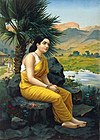
“Valmiki stood up and broke free out of that hard anthill. Suddenly he saw all around him many houses of hermits and their families, young trees carefully watered, a retreat cleared from the forest. Four boys ran up to him from the river and cried "The wife of some great warrior weeps by Ganges. She is fair as a Goddess fallen from heaven, all bewildered, all alone, never seen before, with child, and with small gifts tied from the city within a silk cloth beside her. Go to her, welcome her and protect her.”
“And the high mandate of his sire.
Led by the Lord who rules the sky,
The Gods and heavenly saints drew nigh,
And honoured him with worthy meed,
Rejoicing in each glorious deed.
His task achieved, his foe removed,
He triumphed, by the Gods approved.
By grace of Heaven he raised to life
The chieftains slain in mortal strife;
Then in the magic chariot through
The clouds to Nandigráma flew.
Met by his faithful brothers there,
He loosed his votive coil of hair:
Thence fair Ayodhyá's town he gained,
And o'er his father's kingdom reigned.
Disease or famine ne'er oppressed
His happy people, richly blest.”
“As a young man, Valmiki searched through the world seeking open friendship and happiness and hope and finding none of these he went alone into the empty forest where no man lived, to as spot where the Tamasa River flows into Ganga. There he sat for years without moving, so still that white ants built an anthill over him. There Valmiki sat inside that anthill for thousands of years with only his eyes showing out, trying to find the True, his hands folded and his mind lost in contemplation.”
What Valmiki Said About Others
Discover personal opinions Valmiki shared regarding contemporaries.
Valmiki on Women 2 quotes
“The husband enhances the beauty of a woman more than her ornaments.”

Quotes About Valmiki
Gain deeper perspective through quotes about Valmiki from others.
William Buck on Valmiki
“Valmiki the Poet held all the moving world inside a water drop in his hand. The gods and saints from heaven looked down on Lanka, And Valmiki looked down at the gods in the morning of Time.”
Devdutt Pattanaik on Valmiki
“His [Valmiki’s] Ramayan is generally treated as Adi Kavya, the first Sanskrit poetry ever written. While it was part of oral tradition for centuries, it reached its final form somewhere between 200 BC and 200 AD. The content took a lyrical form after he experienced a painful episode.”

Govindaraju Ramakrishna Rao in on Valmiki
“Legendary sage Valmiki, venerated as the ‘Adikavi’, First Poet, in Sanskrit, though unequivocally recognises Rama as an incarnation of Lord Vishnu in Threthayuga, second aeon in the cycle of ages, depicts the hero Rama as the most virtuous human being, personifying all the highest ingredients of Dharma.”
Narendra Modi on December on Valmiki
“Rishi Valmiki taught us that in order to make progress in society, you have to take along Shabari with you; if you want your society to progress, you have to ensure that even vanars stand by you. If you want to move ahead, you have to embrace Kevat. ...We have come together at this place to express our commitment to follow his message.... Rishi Valmiki laid central focus on awakening the power of truth in order to destroy evil. He did not desire or envisage the slaying of demonic forces merely through the force of war. He has presented a whole vision of a well-organised society in order to defeat asuri (demonic) powers. Prabhu Ramchandra was competent to handle his adversary [Ravan] by himself. But Rishi Valmiki inspired him to mobilise and carry along the power of the entire range of vanjeevan (forest life) including vanars (monkeys), to ignite divine energy in them for the purpose of destroying subversive forces in society that appear in the form of asuras (demons). This social mobilisation of the good included not just Ravan’s own brother and son, but his whole family. Rishi Valmiki has taught us to live by energising and bringing together positive energies of society in order to destroy asuri shakti. He taught us that in order to make progress in society, you have to take along Shabari with you; if you want your society to progress, you have to ensure that even vanars stand by you. If you want to move ahead, you have to embrace Kevat . Rishi Valmiki gave all these messages. We have come together at this place to express our commitment to follow his message.”
In on Valmiki 6 quotes
“It is surely more important to discover what he [Valmiki] had in mind when he wrote the work [Ramayana] and how he intended his readers to study and interpret it. From this standpoint, there is hardly any doubt that his intention was to delineate Rama as an avatar.”
Source on Valmiki 10 quotes
“He [Válmíki] was the son of Varuna, the regent of the waters, one of whose names is Prachetas. According to the Adhyátmá Rámáyana, the sage, although a Bráhman by birth, associated with foresters and robbers. Attacking on one occasion the seven Rishis, they expostulated with him successfully, and taught him the mantra of Ráma reversed, or Mará, Mará, in the inaudible repetition of which he remained immovable for thousands of years, so that when the sages returned to the same spot they found him still there, converted into a valmik or ant-hill, by the nests of the termites, whence his name of Válmíki.”
About Valmiki
Valmiki (Sanskrit: वाल्मीकि Vālmīki) is celebrated as the harbinger-poet in Sanskrit literature. He is the author of the epic Rāmāyaṇa, based on the attribution in the text of the epic itself. He is revered as the Ādi Kavi, which translates to First Poet, for he invented śloka (i.e. first verse or epic metre), which set the base and defined the form to Sanskrit poetry.