Link Copied!
Umberto Boccioni Quotes (1882-1916)
Painter, Revolutionary
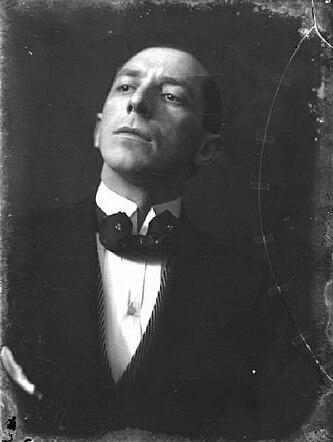

About Umberto Boccioni
Umberto Boccioni (October 19, 1882 – August 17, 1916) was an Italian painter and sculptor in Futurism. Despite his short life he helped shape the revolutionary aesthetic of movement (dynamism), speed, and technology of the Futurism movement as one of its principal figures.
Best Umberto Boccioni Quotes
Shortest
Earliest
Explore our curated collection of the most famous and impactful Umberto Boccioni quotes.
“No one can any longer believe that an object ends where another begins.”

“The time has passed for our sensations in painting to be whispered. We wish them in the future to sing and re-echo upon our canvasses in deafening and triumphant flourishes.”
“The harmony of the lines and folds of modern dress works upon our sensitiveness with the same emotional and symbolical power as did the nude upon the sensitiveness of the old masters.”
“All shadows have their light, each shadow being an autonomous unit forming a new individuality with its own chiaroscuro: it is no longer a form that is half-shadow, half-light, as hat hitherto been the case.”

“Our bodies penetrate the sofas upon which we sit and the sofas penetrate our bodies. The motorbus rushes into the houses which it passes, and in their turn the houses throw themselves upon the bus and are blended with it.”
“..the moving whirlwind of modernity through its crowds, its cars, its telegraph poles, its bare, working-class neighbourhoods, its noises, its squeals, its violence, its cruelty, its cynicism, and its relentless pushiness.”

“[to erect].. ..a new altar throbbing with dynamism as pure and exultant as those which were elevated to divine mystery through religious contemplation.”

“It will be readily admitted that brown tints have never coursed beneath our skin; it will be discovered that yellow shines forth in our flesh, that red blazes, and that green, blue and violet dance upon it with untold charms, voluptuous and caressing.”

“.. the number of the engine [of the train], its profile shown in the upper part of the picture, its wind-cutting fore-part in the center, symbolical of parting, indicates the features of the scene that remain indelibly impressed upon the mind [of the viewer].”
“The gesture which we would reproduce on canvas shall no longer be a fixed moment in universal dynamism. It shall simply be the dynamic sensation itself. Indeed, all things move, all things run, all things are rapidly changing.. .We would at any price re-enter into life.”
“How is it possible still to see the human face pink, now that our life, redoubled by noctambulism, has multiplied our perceptions as colourists? The human face is yellow, red, green, blue, violet.”

“Who can still believe in the opacity of bodies since our sharpened and modified sensitivity has already penetrated the obscure manifestations of the medium? Why should we forget in our creations the double power of our sight, capable of giving results analogous to those of X-rays?”
“..since our past is the greatest in the world and thus all the more dangerous for our life!.. .We must smash, demolish and destroy our traditional harmony, which makes us fall into a 'gracefullness' created by timid and sentimental cubs [cubs refers sneering to the Cubists ].”
“..if the objects will be mathematical values, the ambient in which they live will be a particular rhythm in the emotion which surrounds them. The graphic translation of this rhythm will be a state of form, a state of color, each of which will give back to the spectator the 'state of mind' which produced it..”

“A profile is never motionless before our eyes, but it constantly appears and disappears. On account of the persistency of an image upon the retina, moving objects constantly multiply themselves; their form changes like rapid vibrations.. .To paint a human figure you must not paint it; you must render the whole of its surrounding atmosphere.”
“We wanted a complementarity of form and colour. So we made a synthesis of analyses of colour (the divisionism of Seurat, Signac and Cross) and analyses of form (of Picasso and Georges Braque).”
“In the first Manifesto that we launched on the 8th of March, 1910, from the stage of the Chiarella Theater in Turin, we expressed our deep-rooted disgust with, our proud contempt for, and our happy rebellion against vulgarity, mediocrity, the fanatical and snobbish worship of all that is old, attitudes which are suffocating Art in our Country.”
“Not only have we radically abandoned the motive fully developed according to its determined and, therefore, artificial equilibrium, but we suddenly and purposely intersect each motif with one or more other motifs of which we never give the full development but merely the initial, central, of final notes.. .We thus arrived at what we call the painting of states of mind.”
“The first painting to appear with an affirmation of simultaneity was mine and had the following title: 'Simultaneous visions', [Boccioni painted in 1911]. It was exhibited in the galerie Bernheim in Paris, and in the same exhibition my Futurist painter friends also appeared with similar experiments in simultaneity.”
“I work a lot but don't seem to finish. That is, I hope what I am doing means something because I don't know what I am doing. It's strange and terrible but I feel calm. Today I worked non-stop for six hours on a sculpture and I don't know what the result is.. .Planes upon planes, sections of muscles, of a face and then? And the total effect? Does what I create live? Where will I end up?”
Umberto Boccioni Quotes by Topic
Find exactly what you are looking for by browsing this categorized list of Umberto Boccioni quotes by topic.
Umberto Boccioni on Futurism 4 quotes
View all 4 quotes on Futurism →
Quotes About Umberto Boccioni
Gain deeper perspective through quotes about Umberto Boccioni from others.
I have lived on Umberto Boccioni
“Abito a Corso di Porta Romana da più di trent'anni, e ancora oggi, se mi spingo fuori dai soliti percorsi, mi succede di fare qualche scoperta, come la casa dove risiedeva Boccioni ai primi del Novecento, quando il grande pittore futurista Boccioni si stabilì a Milano con la madre, in via Adige in un modesto stabile tardo-liberty. In via Isonzo c'era solo lo scalo ferroviario, dopo il cavalcavia di Corso Lodi soltanto prati e marcite, e in via Mantova non esisteva ancora il vecchio mulino della Saiwa.”
Quote of Filippo Marinetti on Umberto Boccioni
“..a member of anarchist and revolutionary circles, attracted in turn by violent action and by dream, before resolving to dedicate him to painting.”
Quote of Giacomo Balla his former art-teacher - repeated on Umberto Boccioni
“They did not want anything to do with me in Paris and they [the younger Futurist artists Boccioni and Gino Severini ] were right: they have gone much further than I, but I will work and I too will progress.”
Quote of Carlo Carrà on Umberto Boccioni
“This bubbling and whirling of forms and lights, composed of sounds, noises, and smells has been partly achieved by me [= Carra,] in my 'Anarchical funeral' [the painting, Carra painted ca 1910-1911].. ..by Boccioni in his 'States of Minds' and 'Forces of a Street' [both paintings Boccioni painted in 1911], by Russolo in 'Rebellion' (1911) and Severini in 'Pan-Pan' [the first version, which Severini painted in 1909-1911], paintings which were violently discussed at our first Paris [Futurist] exhibition in 1912.”
Quote of Carlo Carrà in on Umberto Boccioni 2 quotes
“Boccioni, Russolo and I all met in the Porta Vittoria café [in Milan, Italy], close to where we all lived, and we enthusiastically outlined a draft of our appeal [the Manifesto of Futurist Painters, late February, 1910]. The final version was somewhat laborious; we worked on it all day, all three of us and finished it that evening with Marinetti and the help of Decio Cinti, the group's secretary.”
Grace Glueck on Umberto Boccioni
“In the brief life span of the Italian Futurist movement, the short-lived Umberto Boccioni was a blazing comet.. .Boccioni was a fiery theoretician of the movement, drafting two Futurist Manifestos in 1910 and 1912 that exalted the force and energy of contemporary life. They called for an art that glorified speed, violence and the machine age, one that above all reflected the dynamism of an engine-driven civilization.”
Michael Glover on Umberto Boccioni
“Boccioni's gift was to bring a fresh eye to reality in ways that, we now recognise, defined the nature of the modern movement in the visual arts and literature, too”
About Umberto Boccioni
Umberto Boccioni (October 19, 1882 – August 17, 1916) was an Italian painter and sculptor in Futurism. Despite his short life he helped shape the revolutionary aesthetic of movement (dynamism), speed, and technology of the Futurism movement as one of its principal figures.