Link Copied!
Thomas More Quotes (1478-1535)
Writer, Politician, King
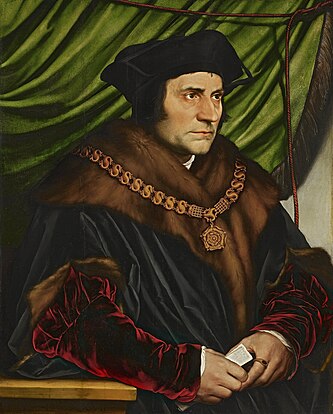




About Thomas More
Saint Thomas More (7 February 1478 – 6 July 1535), also known as Sir Thomas More, was an English lawyer, writer, and politician. He is chiefly remembered for his principled refusal to accept King Henry VIII's claim to be the supreme head of the Church of England, a decision which ended his political career and led to his execution as a traitor. In 1935, four hundred years after his death, More was canonized in the Catholic Church and was later declared the patron saint of statesmen, lawyers, and politicians.
Best Thomas More Quotes
Shortest
Earliest
Explore our curated collection of the most famous and impactful Thomas More quotes.
“If honor were profitable, everybody would be honorable.”
“See me safe up: for in my coming down, I can shift for myself.”
“Yea, marry, now it is somewhat, for now it is rhyme; before it was neither rhyme nor reason.”
“The increasing influence of the Bible is marvelously great, penetrating everywhere. It carries with it a tremendous power of freedom and justice guided by a combined force of wisdom and goodness.”
“They wonder much to hear that gold, which in itself is so useless a thing, should be everywhere so much esteemed, that even men for whom it was made, and by whom it has its value, should yet be thought of less value than it is.”
“Now there was a young gentleman which had married a merchant's wife. And having a little wanton money, which him thought burned out the bottom of his purse, in the first year of his wedding took his wife with him and went over sea, for none other errand but to see Flanders and France and ride out one summer in those countries.”
“leges habent perquam paucas. sufficiunt enim sic institutis paucissimae. quin hoc in primis apud alios improbant populos, quod legum interpretumque uolumina, non infinita sufficiunt. ipsi uero censent iniquissimum; ullos homines his obligari legibus; quae aut numerosiores sint, quam ut perlegi queant; aut obscuriores quam ut a quouis possint intelligi.”
“And when the devil hath seen that they have set so little by him, after certain essays, made in such times as he thought most fitting, he hath given that temptation quite over. And this he doth not only because the proud spirit cannot endure to be mocked, but also lest, with much tempting the man to the sin to which he could not in conclusion bring him, he should much increase his merit.”
“Quam ob rem pulcherrima similitudine declarat Plato, cur merito sapientes abstineant a capessenda quippe republica. Cum populum videant in plateas effusum assiduis imbribus perfundi, nec persuadere queant illis, ut se subducant pluviae, tectaque subeant. Gnari nihil profuturos sese si exeant, quam ut una compluantur, semet intra tecta continent habentes satis, quando alienae stultitiae non possunt mederi, si ipsi saltem sint in tuto.”
“I must say, extreme justice is an extreme injury: For we ought not to approve of those terrible laws that make the smallest offences capital, nor of that opinion of the Stoics that makes all crimes equal; as if there were no difference to be made between the killing a man and the taking his purse, between which, if we examine things impartially, there is no likeness nor proportion. God has commanded us not to kill, and shall we kill so easily for a little money?”
“I think putting thieves to death is not lawful; and it is plain and obvious that it is absurd and of ill consequence to the commonwealth that a thief and a murderer should be equally punished; for if a robber sees that his danger is the same if he is convicted of theft as if he were guilty of murder, this will naturally incite him to kill the person whom otherwise he would only have robbed; since, if the punishment is the same, there is more security, and less danger of discovery, when he that can best make it is put out of the way; so that terrifying thieves too much provokes them to cruelty.”
“Haec non suis commodis prosperitatem, sed ex alienis metitur incommodis.http://books.google.com/books?id=6REuAAAAMAAJ&q=%22haec+non+suis+commodis+prosperitatem+sed+ex+alienis+metitur+incommodis%22&pg=PA306#v=onepage
• Translation: This vice [Pride] does not measure happiness so much by its own conveniences, as by the miseries of others.
• Alternate translation: [Pride] measures her prosperity not by her own goods but by others' wants.”
• Translation: This vice [Pride] does not measure happiness so much by its own conveniences, as by the miseries of others.
• Alternate translation: [Pride] measures her prosperity not by her own goods but by others' wants.”

“Therefore I must say that, as I hope for mercy, I can have no other notion of all the other governments that I see or know, than that they are a conspiracy of the rich, who, on pretence of managing the public, only pursue their private ends, and devise all the ways and arts they can find out; first, that they may, without danger, preserve all that they have so ill-acquired, and then, that they may engage the poor to toil and labour for them at as low rates as possible, and oppress them as much as they please; and if they can but prevail to get these contrivances established by the show of public authority, which is considered as the representative of the whole people, then they are accounted laws”

“In no victory do they glory so much as in that which is gained by dexterity and good conduct without bloodshed. In such cases they appoint public triumphs, and erect trophies to the honour of those who have succeeded; for then do they reckon that a man acts suitably to his nature, when he conquers his enemy in such a way as that no other creature but a man could be capable of, and that is by the strength of his understanding. Bears, lions, boars, wolves, and dogs, and all other animals, employ their bodily force one against another, in which, as many of them are superior to men, both in strength and fierceness, so they are all subdued by his reason and understanding.”

“One rule observed in their council is, never to debate a thing on the same day in which it is first proposed; for that is always referred to the next meeting, that so men may not rashly and in the heat of discourse engage themselves too soon, which might bias them so much that, instead of consulting the good of the public, they might rather study to support their first opinions, and by a perverse and preposterous sort of shame hazard their country rather than endanger their own reputation, or venture the being suspected to have wanted foresight in the expedients that they at first proposed; and therefore, to prevent this, they take care that they may rather be deliberate than sudden in their motions.”
“Those among them that have not received our religion do not fright any from it, and use none ill that goes over to it, so that all the while I was there one man was only punished on this occasion. He being newly baptised did, notwithstanding all that we could say to the contrary, dispute publicly concerning the Christian religion, with more zeal than discretion, and with so much heat, that he not only preferred our worship to theirs, but condemned all their rites as profane, and cried out against all that adhered to them as impious and sacrilegious persons, that were to be damned to everlasting burnings. Upon his having frequently preached in this manner he was seized, and after trial he was condemned to banishment, not for having disparaged their religion, but for his inflaming the people to sedition; for this is one of their most ancient laws, that no man ought to be punished for his religion.”

“The island of Utopia is in the middle two hundred miles broad, and holds almost at the same breadth over a great part of it, but it grows narrower towards both ends. Its figure is not unlike a crescent. Between its horns the sea comes in eleven miles broad, and spreads itself into a great bay, which is environed with land to the compass of about five hundred miles, and is well secured from winds. In this bay there is no great current; the whole coast is, as it were, one continued harbour, which gives all that live in the island great convenience for mutual commerce. But the entry into the bay, occasioned by rocks on the one hand and shallows on the other, is very dangerous. In the middle of it there is one single rock which appears above water, and may, therefore, easily be avoided; and on the top of it there is a tower, in which a garrison is kept; the other rocks lie under water, and are very dangerous. The channel is known only to the natives; so that if any stranger should enter into the bay without one of their pilots he would run great danger of shipwreck.”
“There are several sorts of religions, not only in different parts of the island, but even in every town; some worshipping the sun, others the moon or one of the planets. Some worship such men as have been eminent in former times for virtue or glory, not only as ordinary deities, but as the supreme god. Yet the greater and wiser sort of them worship none of these, but adore one eternal, invisible, infinite, and incomprehensible Deity; as a Being that is far above all our apprehensions, that is spread over the whole universe, not by His bulk, but by His power and virtue; Him they call the Father of All, and acknowledge that the beginnings, the increase, the progress, the vicissitudes, and the end of all things come only from Him; nor do they offer divine honours to any but to Him alone. And, indeed, though they differ concerning other things, yet all agree in this: that they think there is one Supreme Being that made and governs the world, whom they call, in the language of their country, Mithras. They differ in this: that one thinks the god whom he worships is this Supreme Being, and another thinks that his idol is that god; but they all agree in one principle, that whoever is this Supreme Being, He is also that great essence to whose glory and majesty all honours are ascribed by the consent of all nations.”
“They have no lawyers among them, for they consider them as a sort of people whose profession it is to disguise matters and to wrest the laws, and, therefore, they think it is much better that every man should plead his own cause, and trust it to the judge, as in other places the client trusts it to a counsellor; by this means they both cut off many delays and find out truth more certainly; for after the parties have laid open the merits of the cause, without those artifices which lawyers are apt to suggest, the judge examines the whole matter, and supports the simplicity of such well-meaning persons, whom otherwise crafty men would be sure to run down; and thus they avoid those evils which appear very remarkably among all those nations that labour under a vast load of laws. Every one of them is skilled in their law; for, as it is a very short study, so the plainest meaning of which words are capable is always the sense of their laws; and they argue thus: all laws are promulgated for this end, that every man may know his duty; and, therefore, the plainest and most obvious sense of the words is that which ought to be put upon them, since a more refined exposition cannot be easily comprehended, and would only serve to make the laws become useless to the greater part of mankind, and especially to those who need most the direction of them; for it is all one not to make a law at all or to couch it in such terms that, without a quick apprehension and much study, a man cannot find out the true meaning of it, since the generality of mankind are both so dull, and so much employed in their several trades, that they have neither the leisure nor the capacity requisite for such an inquiry.”
“Utopus having understood that before his coming among them the old inhabitants had been engaged in great quarrels concerning religion, by which they were so divided among themselves, that he found it an easy thing to conquer them, since, instead of uniting their forces against him, every different party in religion fought by themselves. After he had subdued them he made a law that every man might be of what religion he pleased, and might endeavour to draw others to it by the force of argument and by amicable and modest ways, but without bitterness against those of other opinions; but that he ought to use no other force but that of persuasion, and was neither to mix with it reproaches nor violence; and such as did otherwise were to be condemned to banishment or slavery.
This law was made by Utopus, not only for preserving the public peace, which he saw suffered much by daily contentions and irreconcilable heats, but because he thought the interest of religion itself required it. He judged it not fit to determine anything rashly; and seemed to doubt whether those different forms of religion might not all come from God, who might inspire man in a different manner, and be pleased with this variety; he therefore thought it indecent and foolish for any man to threaten and terrify another to make him believe what did not appear to him to be true. And supposing that only one religion was really true, and the rest false, he imagined that the native force of truth would at last break forth and shine bright, if supported only by the strength of argument, and attended to with a gentle and unprejudiced mind; while, on the other hand, if such debates were carried on with violence and tumults, as the most wicked are always the most obstinate, so the best and most holy religion might be choked with superstition, as corn is with briars and thorns; he therefore left men wholly to their liberty, that they might be free to believe as they should see cause.”
This law was made by Utopus, not only for preserving the public peace, which he saw suffered much by daily contentions and irreconcilable heats, but because he thought the interest of religion itself required it. He judged it not fit to determine anything rashly; and seemed to doubt whether those different forms of religion might not all come from God, who might inspire man in a different manner, and be pleased with this variety; he therefore thought it indecent and foolish for any man to threaten and terrify another to make him believe what did not appear to him to be true. And supposing that only one religion was really true, and the rest false, he imagined that the native force of truth would at last break forth and shine bright, if supported only by the strength of argument, and attended to with a gentle and unprejudiced mind; while, on the other hand, if such debates were carried on with violence and tumults, as the most wicked are always the most obstinate, so the best and most holy religion might be choked with superstition, as corn is with briars and thorns; he therefore left men wholly to their liberty, that they might be free to believe as they should see cause.”
Thomas More Quotes by Topic
Find exactly what you are looking for by browsing this categorized list of Thomas More quotes by topic.
Thomas More on Fire
“They lepe lyke a flounder out of a fryenge panne into the fyre.”

Thomas More on Prayer
Thomas More on Eucharist
Thomas More on Rights
“Every man has by the law of nature a right to such a waste portion of the earth as is necessary for his subsistence.”

Thomas More on Monuments
“For men use, if they have an evil tourne, to write it in marble; and whoso doth us a good tourne we will write it in duste.”

Thomas More on Dexterity
Thomas More on Basic income
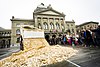
“This method of dealing with thieves is both unjust and undesirable. As a punishment, it's too severe, and as a deterrent, it's quite ineffective. Petty larceny isn't bad enough to deserve the death penalty. And no penalty on earth will stop people from stealing, if it's their only way of getting food. In this respect, you English, like most other nations, remind me of these incompetent schoolmasters, who prefer caning their pupils to teaching them. Instead of inflicting these horrible punishments, it would be far more to the point to provide everyone with some means of livelihood, so that nobody's under the frightful necessity of becoming, first a thief, and then a corpse.”
What Thomas More Said About Others
Discover personal opinions Thomas More shared regarding contemporaries.
Quotes About Thomas More
Gain deeper perspective through quotes about Thomas More from others.
Albert Edwin Avey on Thomas More
“Thomas More was educated at Oxford and the Inns of Court. He was a friend of Erasmus and was an outstanding representative of Renaissance humanism. He lectured on Augustine's City of God and, in 1516, published Utopia, which was both a description of an ideal commonwealth, and a satire upon the society of his day.”
Archie Brown on Thomas More
“On an altogether higher level, intellectually and in its humanity, was the work of Sir Thomas More. One of the most intriguing early portrayals of an imagined communist society is to be found in More’s Utopia, published in 1516. With this book, he gave a name to the entire genre of utopian fiction, of which several thousand examples saw the light of day over the next five hundred years. More himself eventually suffered the same fate as John Ball (and Müntzer) – he was executed, although, unlike Ball, not primarily for anything he wrote or said. In contrast also to Ball, he had risen high in English society, holding the important rank of lord chancellor. He was beheaded because he did not endorse Henry VIII’s decision to appoint himself the supreme head of the Church in England, thereby supplanting the pope. More did not openly oppose the king. He was put to death principally for opinions he did not make public, his very silence becoming a ‘political crime’. Yet More’s Utopia would, on the face of it, appear to be more subversive of the hierarchy largely taken for granted in medieval Europe than his silence over the king’s extension of his powers.”
R. A. Lafferty on Thomas More
Robert Service on Thomas More 2 quotes
“Christ’s message was spiritual in nature and omitted to indicate the institutional means to achieve its ultimate aim. Certain thinkers in later centuries suggested that state power could be used to bring about equal access to food, shelter and reward. Two influential works were Thomas More’s Utopia in 1516 and Tomaso Campanella’s City of the Sun in 1601. More could not imagine that the common man, still less the common woman, might independently attain the perfection of society without order from above.”
Jeremy Taylor on Thomas More
“Do not the work of God negligently and idly: let not thy heart be upon the world when thy hand is lift up in prayer; and be sure to prefer an action of religion, in its place and proper season, before all worldly pleasure, letting secular things, that may be dispensed with in themselves, in these circumstances wait upon the other; not like the patriarch, who ran from the altar in St. Sophia to his stable, in all his pontificals, and in the midst of his office, to see a colt newly fallen from his beloved and much-valued mare Phorbante. More prudent and severe was that of Sir Thomas More, who, being sent for by the king when he was at his prayers in public, returned answer, he would attend him when he had first performed his service to the King of kings.”
Robert Whittington on Thomas More
“A man of an angel's wit and singular learning. I know not his fellow. For where is the man of that gentleness, lowliness and affability? And, as time requireth, a man of marvelous mirth and pastimes, and sometime of as sad gravity. A man for all seasons.”
Misattributed Quotes
Quotes mistakenly credited to Thomas More
“As for rosemarie, I lett it run alle over my garden walls,
not onlie because my bees love it,
but because 'tis the herb sacred to remembrance and therefore to friendship,
whence a sprig of it hath a dumb language that maketh ye chosen emblem at our funeral wakes and in our buriall grounds.”
not onlie because my bees love it,
but because 'tis the herb sacred to remembrance and therefore to friendship,
whence a sprig of it hath a dumb language that maketh ye chosen emblem at our funeral wakes and in our buriall grounds.”
About Thomas More
Saint Thomas More (7 February 1478 – 6 July 1535), also known as Sir Thomas More, was an English lawyer, writer, and politician. He is chiefly remembered for his principled refusal to accept King Henry VIII's claim to be the supreme head of the Church of England, a decision which ended his political career and led to his execution as a traitor. In 1935, four hundred years after his death, More was canonized in the Catholic Church and was later declared the patron saint of statesmen, lawyers, and politicians.