Link Copied!
Theodore Schultz Quotes (1902-1998)
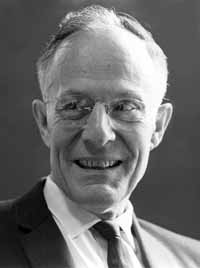

About Theodore Schultz
Theodore William "Ted" Schultz (30 April 1902 – 26 February 1998) was an American economist and chairman of the University of Chicago Department of Economics, who was the 1979 winner, jointly with William Arthur Lewis, of the Nobel Memorial Prize in Economic Sciences.
Best Theodore Schultz Quotes
Shortest
Earliest
Explore our curated collection of the most famous and impactful Theodore Schultz quotes.

“Human beings are incontestably capital from an abstract and mathematical point of view.”
“Investment in human capital accounts for most of the impressive rise in the real earnings per worker.”
“There are comparatively few significant inefficiencies in the allocation of the factors of production in traditional agriculture.”

“Most people in the world are poor. If we knew the economy of being poor, we would know much of the economics that really matter. Most of the world's poor people earn their living in agriculture. If we knew the economics of agriculture, we would know much of the economic of being poor.”

“Much of what we call consumption constitutes investment in human capital. Direct expenditures on education, health, and internal migration to take advantage of better job opportunities are clear examples. Earnings foregone by mature students attending school and by workers acquiring on the-job training are equally clear examples.”
“The adverse economic events following the First World War turned me toward economics... I learned during my youth how hard it was for farm families to stay solvent. Farm product prices fell abruptly by more than half. Banks went bankrupt and many farmers suffered foreclosures. Was politics or economics to blame? I opted for economics.”
“Cultural and behavioral scholars are uneasy about this use of their studies. Fortunately, the intellectual tide has begun to turn. Increasing numbers of economists have come to realize that standard economic theory is just as applicable to the scarcity problems that confront low income countries as to the corresponding problems of high income countries.”

“This branch of economics has suffered from several intellectual mistakes. The major mistake has been the presumption that standard economic theory is inadequate for understanding low income countries and that a separate economic theory is needed. Models developed for this purpose were widely acclaimed until it became evident that they were at best intellectual curiosities.”

“Although it is obvious that people acquire useful skills and knowledge, it is not obvious that these skills and knowledge are a form of capital, that this capital is in substantial part a product of deliberate investment, that it has grown in Western societies at a much faster rate than conventional (nonhuman) capital, and that this growth may well be the most distinctive feature of the economic system.”
“[Schultz specifically refers to the manner in which inputs are used when he states that one implication of his] efficient but poor hypothesis... [is] that the combination of crops grown, the number of times and depth of cultivation, the time of planting, watering, and harvesting, the combination of hand tools, ditches to carry water to the fields, draft animals and simple equipment -- are all made with a fine regard for marginal costs.”
“Activities that improve human capabilities [can be divided into] five major categories: (1) health facilities and services, broadly conceived to include all expenditures that affect the life expectancy, strength and stamina, and the vigor and vitality of a people; (2) On-the job training, including old-style apprenticeship organized by firms; (3) formally organized education at elementary, secondary and higher levels; (4) study programs for adults that are not organized by firms, including extension programs in agriculture; (5) Migration of individuals and families to adjust to changing job opportunities.”
“The mere thought of investment in human beings is offensive to some among us. Our values and beliefs inhibit us from looking upon human beings as capital goods, except in slavery, and this we abhor... To treat human beings as wealth that can be augmented by investment runs counter to deeply held values. It seems to reduce man once again to a mere material component, something akin to property. And for man to look upon himself as a capital good, even if it did not impair his freedom, may seem to debase him... (But) by investing in themselves, people can enlarge the range of choice available to them. It is one way free men can enhance their welfare.”

Theodore Schultz Quotes by Topic
Find exactly what you are looking for by browsing this categorized list of Theodore Schultz quotes by topic.
Theodore Schultz on Agriculture
“The adverse economic events following the First World War turned me toward economics... I learned during my youth how hard it was for farm families to stay solvent. Farm product prices fell abruptly by more than half. Banks went bankrupt and many farmers suffered foreclosures. Was politics or economics to blame? I opted for economics.”
Quotes About Theodore Schultz
Gain deeper perspective through quotes about Theodore Schultz from others.
James Heckman on Theodore Schultz
“He's a transitional figure who bridged the gap between the old-style study of institutions and modern economics [that relies on theory and statistical analysis]”
Pasour Jr on Theodore Schultz
“Schultz’s domestic agricultural policy views, especially early on, were highly interventionist. In his work on domestic agricultural policy during WWII, Schultz was quite critical of the decentralized price system and envisaged a large role for government in U.S. agriculture. Moreover, government intervention continued to play a key role in his approach to domestic farm policy following the war. But Schultz’s views shifted notably in the classical liberal direction in his economic development work, which emphasized distortions by government programs affecting farmers in low-income countries.”
About Theodore Schultz
Theodore William "Ted" Schultz (30 April 1902 – 26 February 1998) was an American economist and chairman of the University of Chicago Department of Economics, who was the 1979 winner, jointly with William Arthur Lewis, of the Nobel Memorial Prize in Economic Sciences.