Link Copied!
Stephen Hawking Quotes (1942-2018)
Physicist, Author, Director











-100px.png)






-100px.jpg)



About Stephen Hawking
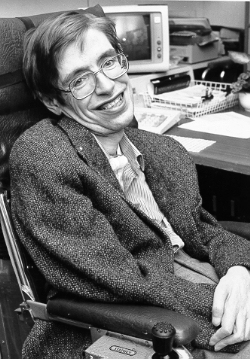
Stephen William Hawking CH CBE FRS (8 January 1942 - 14 March 2018) was a British theoretical physicist, cosmologist, author and Director of Research at the Centre for Theoretical Cosmology within the University of Cambridge.
Best Stephen Hawking Quotes
Shortest
Earliest
Explore our curated collection of the most famous and impactful Stephen Hawking quotes.


“It is not clear that intelligence has any long-term survival value.”

“It is not even clear that intelligence has any long-term survival value.”
“We hold these truths to be self-evident that all P-brains are created equal.”
“I am discounting reports of UFOs. Why would they appear only to cranks and weirdos?”
“To confine our attention to terrestrial matters would be to limit the human spirit.”

“Equations are just the boring part of mathematics. I attempt to see things in terms of geometry.”
“Galileo, perhaps more than any other single person, was responsible for the birth of modern science.”
Published online and later highlighted in mainstream media, this question probes humanity's long-term survival amidst political instability, social disruption, and ecological crises.
“In a world that is in chaos politically, socially and environmentally, how can the human race sustain another 100 years?”
“My goal is simple. It is a complete understanding of the universe, why it is as it is and why it exists at all.”



“I think that it's important for scientists to explain their work, particularly in cosmology. This now answers many questions once asked of religion.”

“We are just an advanced breed of monkeys on a minor planet of a very average star. But we can understand the Universe. That makes us something very special.”
“The life we have on Earth must have spontaneously generated itself. It must therefore be possible for life to generate spontaneously elsewhere in the universe.”

“Science predicts that many different kinds of universe will be spontaneously created out of nothing. It is a matter of chance which we are in.”

“It's tempting to dismiss the notion of highly intelligent machines as mere science fiction, but this would be a mistake, and potentially our worst mistake ever.”
“There ought to be something very special about the boundary conditions of the universe and what can be more special than that there is no boundary?”
“Mathematics is more than a tool and language for science. It is also an end in itself, and as such, it has, over the centuries, affected our worldview in its own right.”
“I discount suggestions that UFOs contain beings from outer space, as I think that any visits by aliens would be much more obvious - and probably also much more unpleasant.”
“So next time someone complains that you have made a mistake, tell him that may be a good thing. Because without imperfection, neither you nor I would exist.”
“There is a fundamental difference between religion, which is based on authority and science, which is based on observation and reason. Science will win, because it works.”
“To show this diagram properly, I would really need a four dimensional screen. However, because of government cuts, we could manage to provide only a two dimensional screen.”

Stephen Hawking admitted his "biggest blunder" in science was believing information was destroyed in black holes, a view he later revised due to the AdS/CFT correspondence.
“I used to think that information was destroyed in black holes. But the AdS/CFT correspondence led me to change my mind. This was my biggest blunder, or at least my biggest blunder in science.”
“It is a waste of time to be angry about my disability. One has to get on with life and I haven't done badly. People won't have time for you if you are always angry or complaining.”

“With current technology interstellar travel is utterly impractical. Alpha Centauri can never become a holiday destination.”
“The downside of my celebrity is that I cannot go anywhere in the world without being recognized. It is not enough for me to wear dark sunglasses and a wig. The wheelchair gives me away.”
Hawking's darkly humorous musing on computer viruses, stemming from a 1994 speech, highlights a pessimistic view of humanity's creative impact on existence.
“I think computer viruses should count as life … I think it says something about human nature that the only form of life we have created so far is purely destructive. We've created life in our own image.”
“I imagine what happens to human consciousness when we die is much like turning off a computer. I don’t believe in a heaven for computers. I think the after-life is a fairy story for people afraid of the dark.”

“The world has changed far more in the past 100 years than in any other century in history. The reason is not political or economic but technological — technologies that flowed directly from advances in basic science.”
“The whole history of science has been the gradual realization that events do not happen in an arbitrary manner, but that they reflect a certain underlying order, which may or may not be divinely inspired.”

“The Steady State theory was what Karl Popper would call a good scientific theory: it made definite predictions, which could be tested by observation, and possibly falsified. Unfortunately for the theory, they were falsified.”

“Evolution has ensured that our brains just aren't equipped to visualise 11 dimensions directly. However, from a purely mathematical point of view it's just as easy to think in 11 dimensions, as it is to think in three or four.”
“On seeing the Enterprise's warp engine while visiting the set of Star Trek: The Next Generation (where he would briefly play himself in the 1993 episode Descent, Part I), Hawking smiled and said: I'm working on that.”

“My expectations were reduced to zero when I was 21. Everything since then has been a bonus.
• Unsourced variant: "When one's expectations are reduced to zero, one really appreciates everything one does have."”
• Unsourced variant: "When one's expectations are reduced to zero, one really appreciates everything one does have."”

“One could say: "The boundary condition of the universe is that it has no boundary." The universe would be completely self-contained and not affected by anything outside itself. It would neither be created nor destroyed. It would just BE.”

“Maybe that is our mistake: maybe there are no particle positions and velocities, but only waves. It is just that we try to fit the waves to our preconceived ideas of positions and velocities. The resulting mismatch is the cause of the apparent unpredictability.”
“It is a matter of common experience that things get more disordered and chaotic with time. This observation even has its own law, the so-called second law of thermodynamics.”


“If aliens visit us, the outcome would be much as when Columbus landed in America, which didn't turn out well for the Native Americans. … We only have to look at ourselves to see how intelligent life might develop into something we wouldn't want to meet.”
“What I have done is to show that it is possible for the way the universe began to be determined by the laws of science. In that case, it would not be necessary to appeal to God to decide how the universe began. This doesn't prove that there is no God, only that God is not necessary.”
“We shouldn't be surprised that conditions in the universe are suitable for life, but this is not evidence that the universe was designed to allow for life. We could call order by the name of God, but it would be an impersonal God. There's not much personal about the laws of physics.”
“The development of full artificial intelligence could spell the end of the human race. We cannot quite know what will happen if a machine exceeds our own intelligence, so we can't know if we'll be infinitely helped by it, or ignored by it and sidelined, or conceivably destroyed by it.”
“Just like a computer, we must remember things in the order in which entropy increases. This makes the second law of thermodynamics almost trivial. Disorder increases with time because we measure time in the direction in which disorder increases. You can’t have a safer bet than that!”


“I don't believe that the ultimate theory will come by steady work along existing lines. We need something new. We can't predict what that will be or when we will find it because if we knew that, we would have found it already! It could come in the next 20 years, but we might never find it.”
“Someone told me that each equation I included in the book would halve the sales. I therefore resolved not to have any equations at all. In the end, however, I did put in one equation, Einstein's famous equation, . I hope that this will not scare off half of my potential readers.”

Hawking, during a 1994 debate with Penrose, used the analogy of God throwing unseen dice in black holes to challenge Einstein's deterministic universe.
“So Einstein was wrong when he said, "God does not play dice." Consideration of black holes suggests, not only that God does play dice, but that he sometimes confuses us by throwing them where they can't be seen.”

“Because there is a law such as gravity, the universe can and will create itself from nothing. Spontaneous creation is the reason there is something rather than nothing, why the universe exists, why we exist. It is not necessary to invoke God to light the blue touch paper and set the universe going.”
“The human race is just a chemical scum on a moderate-sized planet, orbiting around a very average star in the outer suburb of one among a hundred billion galaxies. We are so insignificant that I can't believe the whole universe exists for our benefit. That would be like saying that you would disappear if I closed my eyes.”
“If a superior alien civilisation sent us a text message saying, 'We'll arrive in a few decades', would we just reply, 'OK, call us when you get here, we'll leave the lights on'? Probably not, but this is more or less what has happened with AI.”
Appearing in multiple news outlets, astronomer Seth Shostak speculates on the potentially devastating consequences of contact between humanity and a more advanced alien civilization.
“[on the possibility of contact with an alien civilization]: I think it would be a disaster. The extraterrestrials would probably be far in advance of us. The history of advanced races meeting more primitive people on this planet is not very happy, and they were the same species. I think we should keep our heads low.”

“If you like, you can call the laws of science 'God', but it wouldn't be a personal God that you would meet and put questions to. Although, if there were such a God, I would like to ask however did he think of anything as complicated as M-theory in eleven dimensions.”
“The laws of science, as we know them at present, contain many fundamental numbers, like the size of the electric charge of the electron and the ratio of the masses of the proton and the electron. ... The remarkable fact is that the values of these numbers seem to have been very finely adjusted to make possible the development of life.”
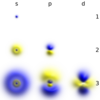
“Thus it seems that even God is bound by the uncertainty principle, and can not know both the position, and the speed, of a particle. So God does play dice with the universe. All the evidence points to him being an inveterate gambler, who throws the dice on every possible occasion.”
“I have lived with the prospect of an early death for the last 49 years. I'm not afraid of death, but I'm in no hurry to die. I have so much I want to do first ... I regard the brain as a computer which will stop working when its components fail. There is no heaven or afterlife for broken down computers; that is a fairy story for people afraid of the dark.”

During a 1980 Caltech physics class, Stephen Hawking, when questioned about quantum mechanics interpretations, humorously likened himself to Herman Göring regarding Schrödinger's Cat, prompting his assistant to clarify the reference.
“I regard [the many worlds interpretation] as self-evidently correct. [T.F.: Yet some don't find it evident to themselves.] Yeah, well, there are some people who spend an awful lot of time talking about the interpretation of quantum mechanics. My attitude — I would paraphrase Goering—is that when I hear of Schrödinger's cat, I reach for my gun.”
“If one made a research grant application to work on time travel it would be dismissed immediately. No government agency could afford to be seen to be spending public money on anything as way out as time travel. Instead one has to use technical terms like closed time-like curves, which are code for time travel.”

In a 2015 Reddit AMA, Stephen Hawking warned that unchecked capitalism, rather than robots themselves, poses the greatest threat of technological unemployment and inequality.
“If machines produce everything we need, the outcome will depend on how things are distributed. Everyone can enjoy a life of luxurious leisure if the machine-produced wealth is shared, or most people can end up miserably poor if the machine-owners successfully lobby against wealth redistribution. So far, the trend seems to be toward the second option, with technology driving ever-increasing inequality.”

“When I gave a lecture in Japan, I was asked not to mention the possible re-collapse of the universe, because it might affect the stock market. However, I can re-assure anyone who is nervous about their investments that it is a bit early to sell: even if the universe does come to an end, it won't be for at least twenty billion years. By that time, maybe the GATT trade agreement will have come into effect.”
“Even if there is only one possible unified theory, it is just a set of rules and equations. What is it that breathes fire into the equations and makes a universe for them to describe? The usual approach of science of constructing a mathematical model cannot answer the questions of why there should be a universe for the model to describe. Why does the universe go to all the bother of existing?”
“The universe would have expanded in a smooth way from a single point. As it expanded, it would have borrowed energy from the gravitational field, to create matter. As any economist could have predicted, the result of all that borrowing, was inflation. The universe expanded and borrowed at an ever-increasing rate. Fortunately, the debt of gravitational energy will not have to be repaid until the end of the universe.”
“We are each free to believe what we want and it is my view that the simplest explanation is there is no God. No one created the universe and no one directs our fate. This leads me to a profound realization. There is probably no heaven, and no afterlife either. We have this one life to appreciate the grand design of the universe, and for that, I am extremely grateful. (Quoted from the Discovery Channel, 15 August 2011.)”

“I regard it as almost inevitable that either a nuclear confrontation or environmental catastrophe will cripple the Earth at some point in the next 1,000 years which, as geological time goes, is the mere blink of an eye. By then I hope and believe that our ingenious race will have found a way to slip the surly bonds of Earth and will therefore survive the disaster.”
Stephen Hawking believed this optimistic and accessible concluding sentence about understanding "the mind of God" was crucial to the phenomenal success of *A Brief History of Time*.
“If we do discover a complete theory, it should in time be understandable in broad principle by everyone, not just a few scientists. Then we shall all, philosophers, scientists, and just ordinary people, be able to take part in the discussion of the question of why it is that we and the universe exist. If we find the answer to that, it would be the ultimate triumph of human reason — for then we would know the mind of God.”
“Many people would claim that the boundary conditions are not part of physics but belong to metaphysics or religion. They would claim that nature had complete freedom to start the universe off any way it wanted. That may be so, but it could also have made it evolve in a completely arbitrary and random manner. Yet all the evidence is that it evolves in a regular way according to certain laws. It would therefore seem reasonable to suppose that there are also laws governing the boundary conditions.”
“The subject of this book is the structure of space-time on length-scales from 10-13cm, the radius of an elementary particle, up to 1028cm, the radius of the universe. ...we base our treatment on Einstein's General Theory of Relativity. This theory leads to two remarkable predictions about the universe: first, that the final fate of massive stars is to collapse behind an event horizon to form a 'black hole' which will contain a singularity; and secondly, that there is a singularity in our past which constitutes, in some sense, a beginning to the universe.”
“One might think this means that imaginary numbers are just a mathematical game having nothing to do with the real world. From the viewpoint of positivist philosophy, however, one cannot determine what is real. All one can do is find which mathematical models describe the universe we live in. It turns out that a mathematical model involving imaginary time predicts not only effects we have already observed but also effects we have not been able to measure yet nevertheless believe in for other reasons. So what is real and what is imaginary? Is the distinction just in our minds?”
“It has certainly been true in the past that what we call intelligence and scientific discovery have conveyed a survival advantage. It is not so clear that this is still the case: our scientific discoveries may well destroy us all, and even if they don’t, a complete unified theory may not make much difference to our chances of survival. However, provided the universe has evolved in a regular way, we might expect that the reasoning abilities that natural selection has given us would be valid also in our search for a complete unified theory, and so would not lead us to the wrong conclusions.”

“For millions of years, mankind lived just like the animals. Then something happened which unleashed the power of our imagination. We learned to talk and we learned to listen. Speech has allowed the communication of ideas, enabling human beings to work together to build the impossible. Mankind's greatest achievements have come about by talking, and its greatest failures by not talking. It doesn't have to be like this. Our greatest hopes could become reality in the future. With the technology at our disposal, the possibilities are unbounded. All we need to do is make sure we keep talking.”
“I believe that disabled people should concentrate on things that their handicap doesn’t prevent them from doing and not regret those they can’t do … I visited the Soviet Union seven times. The first time I went with a student party in which one member, a Baptist, wished to distribute Russian-language Bibles and asked us to smuggle them in. We managed this undetected, but by the time we were on our way out the authorities had discovered what we had done and detained us for a while. However, to charge us with smuggling Bibles would have caused an international incident and unfavorable publicity, so they let us go after a few hours.”
“The danger is that global warming may become self-sustaining, if it has not done so already. The melting of the Arctic and Antarctic ice caps reduces the fraction of solar energy reflected back into space, and so increases the temperature further. Climate change may kill off the Amazon and other rain forests, and so eliminate once one of the main ways in which carbon dioxide is removed from the atmosphere. The rise in sea temperature may trigger the release of large quantities of carbon dioxide, trapped as hydrides on the ocean floor. Both these phenomena would increase the greenhouse effect, and so global warming further. We have to reverse global warming urgently, if we still can.”
“All my life, I have been fascinated by the big questions that face us, and have tried to find scientific answers to them.
• Unsourced variant: All of my life, I have been fascinated by the big questions that face us, and have tried to find scientific answers to them. Perhaps that is why I have sold more books on physics than Madonna has on sex. This quote seems to combine the above sentence from Stephen Hawking's Universe with a statement from the Foreword to The Illustrated Brief History of Time: As Nathan Myhrvold of Microsoft (a former post-doc of mine) remarked: I have sold more books on physics than Madonna has on sex.”
• Unsourced variant: All of my life, I have been fascinated by the big questions that face us, and have tried to find scientific answers to them. Perhaps that is why I have sold more books on physics than Madonna has on sex. This quote seems to combine the above sentence from Stephen Hawking's Universe with a statement from the Foreword to The Illustrated Brief History of Time: As Nathan Myhrvold of Microsoft (a former post-doc of mine) remarked: I have sold more books on physics than Madonna has on sex.”
During a 1994 debate, Stephen Hawking contrasted his positivist view, prioritizing predictive power, with Roger Penrose's Platonist demand for quantum theory to reflect reality, using the famous Schrödinger's cat thought experiment as an example.
“These lectures have shown very clearly the difference between Roger and me. He's a Platonist and I'm a positivist. He's worried that Schrödinger's cat is in a quantum state, where it is half alive and half dead. He feels that can't correspond to reality. But that doesn't bother me. I don't demand that a theory correspond to reality because I don't know what it is. Reality is not a quality you can test with litmus paper. All I'm concerned with is that the theory should predict the results of measurements. Quantum theory does this very successfully. It predicts that the result of an observation is either that the cat is alive or that it is dead. It is like you can't be slightly pregnant: you either are or you aren't.”
“Einstein is the only figure in the physical sciences with a stature that can be compared with Newton. Newton is reported to have said "If I have seen further than other men, it is because I stood on the shoulders of giants." This remark is even more true of Einstein who stood on the shoulders of Newton. Both Newton and Einstein put forward a theory of mechanics and a theory of gravity but Einstein was able to base General Relativity on the mathematical theory of curved spaces that had been constructed by Riemann while Newton had to develop his own mathematical machinery. It is therefore appropriate to acclaim Newton as the greatest figure in mathematical physics and the Principia is his greatest achievement.”
In 2007, the Bulletin of the Atomic Scientists moved the Doomsday Clock forward, citing nuclear weapons and, notably, a growing understanding of humanity's impact on climate change.
“As scientists, we understand the dangers of nuclear weapons and their devastating effects, and we are learning how human activities and technologies are affecting climate systems in ways that may forever change life on Earth. As citizens of the world, we have a duty to alert the public to the unnecessary risks that we live with every day, and to the perils we foresee if governments and societies do not take action now to render nuclear weapons obsolete and to prevent further climate change... There’s a realization that we are changing our climate for the worse. That would have catastrophic effects. Although the threat is not as dire as that of nuclear weapons right now, in the long term we are looking at a serious threat.”
“I'm sorry to disappoint science fiction fans, but if information is preserved, there is no possibility of using black holes to travel to other universes. If you jump into a black hole, your mass energy will be returned to our universe but in a mangled form which contains the information about what you were like but in a state where it can not be easily recognized. It is like burning an encyclopedia. Information is not lost, if one keeps the smoke and the ashes. But it is difficult to read. In practice, it would be too difficult to re-build a macroscopic object like an encyclopedia that fell inside a black hole from information in the radiation, but the information preserving result is important for microscopic processes involving virtual black holes.”

“Any physical theory is always provisional, in the sense that it is only a hypothesis: you can never prove it. No matter how many times the results of experiments agree with some theory, you can never be sure that the next time the result will not contradict the theory. On the other hand, you can disprove a theory by finding even a single observation that disagrees with the predictions of the theory. As philosopher of science Karl Popper has emphasized, a good theory is characterized by the fact that it makes a number of predictions that could in principle be disproved or falsified by observation. Each time new experiments are observed to agree with the predictions the theory survives, and our confidence in it is increased; but if ever a new observation is found to disagree, we have to abandon or modify the theory.”
“As I shall describe, the prospects for finding such a theory seem to be much better now because we know so much more about the universe. But we must beware of overconfidence - we have had false dawns before! At the beginning of this century, for example, it was thought that everything could be explained in terms of the properties of continuous matter, such as elasticity and heat conduction. The discovery of atomic structure and the uncertainty principle put an emphatic end to that. Then again, in 1928, physicist and Nobel Prize winner Max Born told a group of visitors to Gottingen University, "Physics, as we know it, will be over in six months." His confidence was based on the recent discovery by Dirac of the equation that governed the electron. It was thought that a similar equation would govern the proton, which was the only other particle known at the time, and that would be the end of theoretical physics. However, the discovery of the neutron and of nuclear forces knocked that one on the head too. Having said this, I still believe there are grounds for cautious optimism that we may now be near the end of the search for the ultimate laws of nature.”
“If you are disabled, it is probably not your fault, but it is no good blaming the world or expecting it to take pity on you. One has to have a positive attitude and must make the best of the situation that one finds oneself in; if one is physically disabled, one cannot afford to be psychologically disabled as well. In my opinion, one should concentrate on activities in which one's physical disability will not present a serious handicap. I am afraid that Olympic Games for the disabled do not appeal to me, but it is easy for me to say that because I never liked athletics anyway. On the other hand, science is a very good area for disabled people because it goes on mainly in the mind. Of course, most kinds of experimental work are probably ruled out for most such people, but theoretical work is almost ideal. My disabilities have not been a significant handicap in my field, which is theoretical physics. Indeed, they have helped me in a way by shielding me from lecturing and administrative work that I would otherwise have been involved in. I have managed, however, only because of the large amount of help I have received from my wife, children, colleagues and students. I find that people in general are very ready to help, but you should encourage them to feel that their efforts to aid you are worthwhile by doing as well as you possibly can.”
“The ultimate objective test of free will would seem to be: Can one predict the behavior of the organism? If one can, then it clearly doesn't have free will but is predetermined. On the other hand, if one cannot predict the behavior, one could take that as an operational definition that the organism has free will … The real reason why we cannot predict human behavior is that it is just too difficult. We already know the basic physical laws that govern the activity of the brain, and they are comparatively simple. But it is just too hard to solve the equations when there are more than a few particles involved … So although we know the fundamental equations that govern the brain, we are quite unable to use them to predict human behavior. This situation arises in science whenever we deal with the macroscopic system, because the number of particles is always too large for there to be any chance of solving the fundamental equations. What we do instead is use effective theories. These are approximations in which the very large number of particles are replaced by a few quantities. An example is fluid mechanics … I want to suggest that the concept of free will and moral responsibility for our actions are really an effective theory in the sense of fluid mechanics. It may be that everything we do is determined by some grand unified theory. If that theory has determined that we shall die by hanging, then we shall not drown. But you would have to be awfully sure that you were destined for the gallows to put to sea in a small boat during a storm. I have noticed that even people who claim everything is predetermined and that we can do nothing to change it, look before they cross the road. … One cannot base one's conduct on the idea that everything is determined, because one does not know what has been determined. Instead, one has to adopt the effective theory that one has free will and that one is responsible for one's actions. This theory is not very good at predicting human behavior, but we adopt it because there is no chance of solving the equations arising from the fundamental laws. There is also a Darwinian reason that we believe in free will: A society in which the individual feels responsible for his or her actions is more likely to work together and survive to spread its values.”
Stephen Hawking Quotes by Topic
Find exactly what you are looking for by browsing this categorized list of Stephen Hawking quotes by topic.
Stephen Hawking on Black hole 4 quotes
Challenging Einstein's deterministic view, Stephen Hawking argued in a 1994 debate with Penrose that black holes suggest God plays dice, obscuring the results.
“So Einstein was wrong when he said, "God does not play dice." Consideration of black holes suggests, not only that God does play dice, but that he sometimes confuses us by throwing them where they can't be seen.”

Stephen Hawking on Science 3 quotes
“Science could predict that the universe must have had a beginning.”
Stephen Hawking on Uncertainty principle 3 quotes
“[T]he laws of physics need not break down at the origin of the universe. The state of the universe and its contents, like ourselves, are completely determined by the laws of physics, up to the limit set by the uncertainty principle. So much for free will.”

Stephen Hawking on Gravity 3 quotes
“Bodies like the earth are not made to move on curved orbits by a force called gravity; instead, they follow the nearest thing to a straight path in a curved space, which is called a geodesic. A geodesic is the shortest (or longest) path between two nearby points.”
- Stephen Hawking, H–K)

Stephen Hawking on Quantum mechanics 2 quotes
“Einstein was confused, not the quantum theory.”
- Stephen Hawking, H)

What Stephen Hawking Said About Others
Discover personal opinions Stephen Hawking shared regarding contemporaries.
Stephen Hawking on Albert Einstein
Stephen Hawking on Paul Dirac
“Dirac has done more than anyone this century, with the exception of Einstein, to advance physics and change our picture of the universe. He is surely worthy of the memorial in Westminster Abbey. It is just a scandal that it has taken so long.”
Stephen Hawking on Roger Penrose
“Although I'm regarded as a dangerous radical by particle physicists for proposing that there may be loss of quantum coherence, I'm definitely a conservative compared to Roger. I take the positivist viewpoint that a physical theory is just a mathematical model and that it is meaningless to ask whether it corresponds to reality. All that one can ask is that its predictions should be in agreement with observation. I think Roger is a Platonist at heart but he must answer for himself.”

Stephen Hawking on Albert Einstein and politics
“Einstein's earliest political activity came during the First World War, when he was a professor in Berlin. Sickened by what he saw as the waste of human lives, he became involved in antiwar demonstrations. [...] Einstein's second great cause was Zionism. Although he was Jewish by descent, Einstein rejected the biblical idea of God. However, a growing awareness of anti-Semitism, both before and during the First World War, led him gradually to identify with the Jewish community, and later to become an outspoken supporter of Zionism. [...] Throughout his life, Einstein's efforts toward peace probably achieved little that would last—and certainly won him few friends.”

Quotes About Stephen Hawking
Gain deeper perspective through quotes about Stephen Hawking from others.
Freeman Dyson on Stephen Hawking 3 quotes
“In the year 1900 Max Planck wrote... E = hv, where E is the energy of a light wave, v is its frequency, and h is... Plank's constant. It said that energy and frequency are the same thing measured in different units. Plank's constant gives you a rate of exchange for for converting frequency into energy... But in the year 1900 this made no physical sense. Even Plank himself did not understand it. ...Now Hawking has written down an equation which looks rather like Plank's equation... S = kA, where S is the entropy of a black hole, A is the area of its surface, and k is... Hawking's constant. Entropy means roughly the same thing as the heat capacity of an object. ...Hawking's equation says that entropy is really the same thing as area. The exchange rate... is given by Hawking's constant... But what does it really mean to say that entropy and area are the same thing? We are as far away from understanding that now as Planck was of understanding quantum mechanics in 1900. ...[T]his equation will emerge as a central feature of the still unborn theory which will tie together gravitation and quantum mechanics and thermodynamics.”
Dennis Overbye on Stephen Hawking
“Hawking's intitial foray into quantum gravity was more modest than Wheeler's and other[s]... a sneak approach. He first wanted to know what the effect was of an ordinary, classic, curved-space gravitational field on a quantum system. He called this the semiclassical approach. Until that day, most quantum calculations had been done as if gravity didn't exist — they were hard enough without it in normal flat space-time... [Hawking accomplished this by] envisioning an "atom" whose nucleus was a catastrophically powerful black hole... Starobinsky ventured the opinion that rotating black holes would spray elementary particles. ...It was known from Penrose's work, among others, that you could extract energy from the spin of a black hole just like any other dynamo... in particles and radiation just like it did from a particle generator. ... But Hawking ... resolved to redo the calculation for himself ...he decided to warm up first, by calculating the rate of emission from a nonrotating quantum hole. He knew the answer should be no emission. ... his results were embarrassing. His imaginary black hole was spewing matter and radiation ... he was reluctant to tell anybody but his closest friends; he was afraid Bekenstein would hear about it. ... It meant that holes had temperatures, just as Bekenstein's work implied.”
Misattributed Quotes
Quotes mistakenly credited to Stephen Hawking
About Stephen Hawking
Stephen William Hawking CH CBE FRS (8 January 1942 - 14 March 2018) was a British theoretical physicist, cosmologist, author and Director of Research at the Centre for Theoretical Cosmology within the University of Cambridge.