Freeman Dyson on Stephen Hawking
← Back to Stephen Hawking Profile
“In the year 1900 Max Planck wrote... E = hv, where E is the energy of a light wave, v is its frequency, and h is... Plank's constant. It said that energy and frequency are the same thing measured in different units. Plank's constant gives you a rate of exchange for for converting frequency into energy... But in the year 1900 this made no physical sense. Even Plank himself did not understand it. ...Now Hawking has written down an equation which looks rather like Plank's equation... S = kA, where S is the entropy of a black hole, A is the area of its surface, and k is... Hawking's constant. Entropy means roughly the same thing as the heat capacity of an object. ...Hawking's equation says that entropy is really the same thing as area. The exchange rate... is given by Hawking's constant... But what does it really mean to say that entropy and area are the same thing? We are as far away from understanding that now as Planck was of understanding quantum mechanics in 1900. ...[T]his equation will emerge as a central feature of the still unborn theory which will tie together gravitation and quantum mechanics and thermodynamics.”
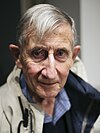
“A few years ago, I had the good fortune to be lecturing in Tokyo at the same time as the cosmologist Stephen Hawking. Walking the streets of Tokyo with Hawking in his wheelchair was an amazing experience. I felt as if I were taking a walk through Galilee with Jesus Christ. Everywhere we went, crowds of Japanese silently streamed after us, stretching out their hands to touch Hawking's wheelchair. Hawking enjoyed the spectacle with detached good humor. I was thinking of an account that I had read of Einstein's visit to Japan in 1922. The crowds had streamed after Einstein as they streamed after Hawking seventy years later.”
“On the whole, the public shows good taste in its choice of idols. Einstein and Hawking earned their status as superstars, not only by their scientific discoveries but by their outstanding human qualities. Both of them fit easily into the role of icon, responding to public adoration with modesty and good humor and with provocative statements calculated to command attention. Both of them devoted their lives to an uncompromising struggle to penetrate the deepest mysteries of nature, and both still had time left over to care about the practical worries of ordinary people. The public rightly judged them to be genuine heroes, friends of humanity as well as scientific wizards.”