Harold Macmillan on Stanley Baldwin
← Back to Stanley Baldwin Profile
“Baldwin...was undoubtedly looked up to with something like affection by Members in every part of the House. The young and progressive wing of his party had a special regard for him. His speeches, particularly on industrial problems, struck just the note which we thought appropriate and illuminating. The fact that the Right wing and especially the so-called "Industrials" had little love for him, confirmed our feelings... In these early days, I knew him only as the man who had led us to a great electoral victory and who had made it possible, through his reputation for decency and fair-mindedness, to win the support of working men and women throughout the country.”
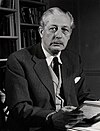
“Baldwin had made a deep impression, upon all those who heard it, by his broadcast in the previous election. The radio broadcast...was used effectively for the first time in 1924... Baldwin had adopted a method—afterwards perfected by President Roosevelt—of what was to be called "the fireside chat". He was simple, clear, moderate, and seemed to remember the vital point that in a radio speech...the audience is confined to two or three people in their own homes. They want talk, not a speech... At the time of the General Strike his wisdom and sympathy impressed us all, as had his famous speech on the Political Levy Bill the year before... He affected to dislike "intellectuals". But that is a common pose of men of high intellectual qualifications; and Baldwin was certainly much more of a sensitive artist than of a rugged countryman. For he was half Celt... Even to the most superficial observer it was clear that Baldwin operated at his best in a crisis, and this was followed by a need for rest and recuperation. He was highly strung, nervous, and indeed the opposite in almost every way to the "image"...which the party machine built up of him. It was said of Lord Liverpool that the secret of his policy was that he had none. To some extent, this was true of Baldwin also. Protection, "safeguarding", defence, above all European problems, did not excite him unduly. He was not a great administrator. He was an influence, and an influence for good. The fact that he commanded the respect and even affection of the Labour Opposition confirmed our admiration for our leader.”
“His...purpose was so to conduct the affairs as to bridge the dangerous division into which the nation had fallen in the years immediately following the First War. He therefore set out by studied moderation to win for himself a position almost above party. Baldwin wooed the Labour Members in the House of Commons and won their confidence. His whole philosophy led him to regard it as one of his main tasks to make the Labour Party safe for democracy, and to lead it away from revolutionary to constitutional methods. Moreover, he knew that the Conservative Party had no future unless it could win the support of that central body of electors... It should therefore be the Centre and Left of the Conservative Party which should dominate its policies, and not the Right. In this spirit and by such methods, class strife and crude ideologies would be gradually tamed. It was partly owing to his example and understanding that the terrible suffering and discontent, caused by large-scale unemployment, did not take the form of dangerous and subversive movements.”
“Nevertheless, if, in the important task of preserving and fostering the underlying unity of the nation on which its ultimate strength depends, Baldwin succeeded, in the supreme duty of a Prime Minister—the preservation of honourable peace and the military posture to enable Britain to play in any period her appropriate role—he failed. He left to his successor, in terms of the foreign situation and the ability of Britain to meet the rapidly approaching dangers, a bleak and barren heritage, although he handed on, at any rate in terms of human feeling, a country where kindliness and decency still ruled, and men and women, when the test came, had the spirit to meet it worthily.”