Link Copied!
Stafford Cripps Quotes (1889-1952)
President, Politician

About Stafford Cripps
Sir Richard Stafford Cripps (24 April 1889 – 21 April 1952) was a British Labour Party politician, barrister, and diplomat. He served as British Ambassador to the Soviet Union at the beginning of World War II, and later joined Prime Minister Winston Churchill's war cabinet. He later served as President of the Board of Trade and Chancellor of the Exchequer under Prime Minister Clement Attlee.
Best Stafford Cripps Quotes
Shortest
Earliest
Explore our curated collection of the most famous and impactful Stafford Cripps quotes.
“Emphatically no, and I never have been.”


“His Majesty's Government have not the slightest intention of devaluing the pound.”

“[In the case of sterling devaluation was] neither necessary nor will it take place.”
“It is fundamental to Socialism that we should liquidate the British Empire as soon as we can.”


“The workers must now make it clear beyond all doubt that they will not support the Government or its armaments in its mad policy which it is now pursuing.”
“...we do not contemplate taking any action to alter the rate of sterling in relation to other currencies, as we do not believe that this will be rendered necessary or advisable.”
“All sorts of excuses were being given why we should uphold rearmament, including the old-fashioned "For God, King and Country" patriotism, assisted by all the tomfoolery of jubilees and coronations.”
“I do not believe it would be a bad thing for the British working-class if Germany defeated us. It would be a disaster for the profit-makers and capitalists, but not necessarily for the working-class.”

“Every possible effort should be made to stop recruiting for the Armed Forces. This may, and probably would, lead to some form of conscription being proposed or introduced. Thus would be provided a most favourable political platform upon which to fight the National Government.”
“The Government decided...to reduce the dollar exchange value of the pound sterling. In the last few days we have settled what the new rate should be and now I have to tell you of that decision; it is that in place of the present rate, fixed in 1946, of $4 3c. for the pound the rate will in future be $2 80c. to the pound.”
“We must bring home to the people the seriousness of the country's present plight and the future problems that we face. We must convince them of their power to overcome all difficulties by common effort. We must draw out from people that courage and determination which have always been the hallmarks of the British character.”
“Though we have achieved considerable success in our policy of increasing production and maintaining full employment, this has been accompanied by constant pressure for higher wages resulting in higher prices. We have not yet found out how we can maintain full employment in combination with stable or decreasing costs and prices.”
“It must be the duty of the next Labour Government in power to make an immediate challenge to the capitalist system and take the banks and the land into the custody of the people. The time had come to drop all hesitancy and to be bold. If they returned a Socialist Government next time, it was going to "do things," whatever it cost.”
“Unless during the first five years so great a degree of change has been accomplished as to deprive Capitalism of its power, it is unlikely that a Socialist Party will be able to maintain its position of control without adopting some exceptional means, such as the prolongation of the life of Parliament for a further term without an election.”
“The problem of dealing with the armed forces of the Crown is the most difficult one we will have to face when we do get into power. The Labour Party will have to face the fact that it is a class Party...It has to be prepared to take steps more forceful than even the steps taken at the time of the Ulster Rebellion.”
“The reactionaries of our Movement are keen to prevent Socialists from coming into it. The last thing anyone should do is to pander to the reactionaries by staying out. James Maxton and Harry Pollitt should be the Leaders of the Labour Movement today”
“Our position is such that we could not 'integrate' our economy into that of Europe in any manner that would prejudice the full discharge of these other responsibilities. At the same time, Britain regarded herself as bound up in western Europe, not only in economic, strategic and political interests, but in our culture and indeed in our participation in the heritage of Christian civilization.”

“The [Labour] Government's first step will be to call Parliament together at the earliest moment and place before it an Emergency Powers Bill to be passed through in all its stages on the first day. This Bill will be wide enough in its terms to allow all that will be immediately necessary to be done by ministerial orders. These orders must be incapable of challenge in the Courts or in any way except in the House of Commons.”
“The National Government's only remedy for a difficult national problem was to arm and arm and arm, regardless of the lessons of history and the proved fact that armament racing could only end in war. ... If we are plunged in war I devoutly hope that the workers of this country will use it for the purpose of revolution. I hope that the present government can be made to understand that that will happen. It will be a very healthy thought for them to have in the back of their mind.”

“Money cannot make armaments. Armaments can only be made by the skill of the British working class, and it is the British working class who would be called upon to use them. To-day you have the most glorious opportunity that the workers have ever had if you will only use the necessity of capitalism in order to get power yourselves. The capitalists are in your hands. Refuse to make munitions, refuse to make armaments, and they are helpless. They would have to hand the control of the country over to you.”
“...we must avoid a competitive raising of wages and conditions in a scarce labour market, which raises prices. ... If we allow prices to rise because of internal costs rising, we shall lose and not gain our overseas markets, or at least not be able to gain new ones in the competition. Therefore, incentives must be strictly limited to increased production so that more earnings mean more production. We cannot in any circumstances afford to pay more for the same or less production. We must await the further raising of the levels of earnings until we can provide the goods upon which those earnings can be spent. In the same way, let me point out, that large profits drawn from industry today are just as inimical because they, too, raise the price levels and, furthermore, they offer an immediate temptation for the demand for greater salaries.”

Quotes About Stafford Cripps
Gain deeper perspective through quotes about Stafford Cripps from others.
Clement Attlee on Stafford Cripps
“He was a man the greatness of whose intellectual and practical abilities was matched by his nobility of character and high idealism. ... I believe he did immense service to this country.”
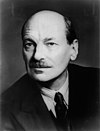
The British government sent Sir Stafford Cripps on Stafford Cripps
“As one who has been a nationalist leader and worker for India's independence, though now my activity is no longer in the political but in the spiritual field, I wish to express my appreciation of all you have done to bring about this offer. I welcome it as an opportunity given to India to determine for herself, and organise in all liberty of choice, her freedom and unity, and take an effective place among the world's free nations. I hope that it will be accepted, and right use made of it, putting aside all discords and divisions.... I offer my public adhesion, in case it can be of any help in your work.”
Winston Churchill on Stafford Cripps
“Stafford Cripps was a man of force and fire. His intellectual and moral passions were so strong that they not only inspired but not seldom dominated his actions. They were strengthened and also governed by the workings of a powerful, lucid intelligence, and by a deep and lively Christian faith. He strode through life with a remarkable indifference to material satisfactions or worldly advantages. I suppose there are few hon. Members in any part of the House who have not differed violently from him at this time or that, and yet there is none who did not regard him with respect and with admiration, not only for his abilities, but for his character.”

Hugh Dalton on Stafford Cripps
“Cripps seems quite unable to see the argument that he is damaging the party electorally. It is all ‘misreporting’, or picking sentences out of their context. He has become very vain and seems to think that only he and his cronies know what Socialism is or how it should be preached. His gaffes cover an immense range – Buckingham Palace – League of Nations – ‘compelling’ Unions to declare a General Strike – prolonging Parliament beyond five years...‘seize land, finance and industry’ (without compensation?) – Emergency Powers Bill in one day, giving ‘all necessary powers’...I make a violent – perhaps too violent – speech asking that this stream of oratorical ineptitudes should now cease...It is the number of these gaffes which is so appalling. Our candidates are being stabbed in the back and pushed onto the defensive. Tory HQ regard him as their greatest electoral asset...Attlee says I am like a pedagogue addressing a pupil. I wish the pupil were a bit brighter.”
Clement Davies on Stafford Cripps
“We mourn today the passing of a fine Christian knight, a dauntless spirit, a devoted public servant, a noble character whose life, whose integrity, and whose work are an example and an inspiration to us all, whose shining faith never faltered in the face of difficulties, however mountainous.”
Adolf Hitler on Stafford Cripps
“Cripps, a man without roots, a demagogue and a liar, would pursue his sick fancies although the Empire were to crack at every corner. Moreover, this theoretician devoid of humanity lacks contact with the mass that's grouped behind the Labour Party, and he'll never succeed in understanding the problems that occupy the minds of the lower classes.”

About Stafford Cripps
Sir Richard Stafford Cripps (24 April 1889 – 21 April 1952) was a British Labour Party politician, barrister, and diplomat. He served as British Ambassador to the Soviet Union at the beginning of World War II, and later joined Prime Minister Winston Churchill's war cabinet. He later served as President of the Board of Trade and Chancellor of the Exchequer under Prime Minister Clement Attlee.