Link Copied!
Socrates Quotes (-470--399)
Philosopher





-100px.jpg)



-100px.png)












-100px.jpg)





-100px.jpg)


About Socrates
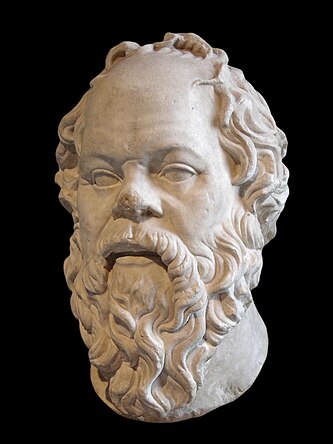
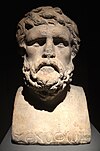
Socrates (Σωκράτης; c. 470 BC – 399 BC) was a classical Greek (Athenian) philosopher credited as one of the founders of Western philosophy. Through his portrayal in Plato's dialogues, Socrates has become renowned for his contribution to the field of ethics, and it is this Platonic Socrates who lends his name to the concepts of Socratic irony and the Socratic method, or elenchus. The latter remains a commonly used tool in a wide range of discussions, and is a type of pedagogy in which a series of questions is asked not only to draw individual answers, but also to encourage fundamental insight into the issue at hand.
Best Socrates Quotes
Shortest
Earliest
Explore our curated collection of the most famous and impactful Socrates quotes.

“Contentment is natural wealth; luxury, artificial poverty.”

“The man who eats with the greatest appetite has the least need of delicacies.”

“The being of all virtues, and chiefly of temperance, depends on the practice of them.”

“There is only one good, knowledge, and one evil, ignorance.
• Variant: The only good is knowledge and the only evil is ignorance.”
• Variant: The only good is knowledge and the only evil is ignorance.”
“You will know that the divine is so great and of such a nature that it sees and hears everything at once, is present everywhere, and is concerned with everything.”
“It is a disgrace to grow old through sheer carelessness before seeing what manner of man you may become by developing your bodily strength and beauty to their highest limit. But you cannot see that, if you are careless; for it will not come of its own accord.”

“Socrates: Shall we set down astronomy among the objects of study? Glaucon: I think so, to know something about the seasons, the months and the years is of use for military purposes, as well as for agriculture and for navigation. Socrates: It amuses me to see how afraid you are, lest the common herd of people should accuse you of recommending useless studies.”
“If I am to live longer, perhaps I must live out my old age, seeing and hearing less, understanding worse, coming to learn with more difficulty and to be more forgetful, and growing worse than those to whom I was once superior. Indeed, life would be unliveable, even if I did not notice the change. And if I see the change, how could life not be even more wretched and unpleasant?”

“Order and discipline are the most important things in an army, and without them it is impossible to have any other service of the troops than of a confused heap of stones, bricks, timber, and tiles; but when everything is in its due place, as in a building, when the foundations and the covering are made of materials that will not grow rotten, and which no wet can damage, such as are stones and tiles, and when the bricks and timber are employed in their due places in the body of the edifice, they altogether make a house, which we value among our most considerable enjoyments.”
“It is the example of the rider who wishes to become an expert horseman: "None of your soft-mouthed, docile animals for me," he says; "the horse for me to own must show some spirit" in the belief, no doubt, if he can manage such an animal, it will be easy enough to deal with every other horse besides. And that is just my case. I wish to deal with human beings, to associate with man in general; hence my choice of wife. I know full well, if I can tolerate her spirit, I can with ease attach myself to every human being else.”
“ἆρα, ἔφην, ὦ Ἰσχόμαχε, ἡ ἐρώτησις διδασκαλία ἐστίν; ἄρτι γὰρ δή, ἔφην ἐγώ, καταμανθάνω ᾗ με ἐπηρώτησας ἕκαστα: ἄγων γάρ με δι᾽ ὧν ἐγὼ ἐπίσταμαι, ὅμοια τούτοις ἐπιδεικνὺς ἃ οὐκ ἐνόμιζον ἐπίστασθαι ἀναπείθεις, οἶμαι, ὡς καὶ ταῦτα ἐπίσταμαι.
• Really, Ischomachus, I am disposed to ask: "Does teaching consist in putting questions?" Indeed, the secret of your system has just this instant dawned upon me. I seem to see the principle in which you put your questions. You lead me through the field of my own knowledge, and then by pointing out analogies to what I know, persuade me that I really know some things which hitherto, as I believed, I had no knowledge of.”
• Really, Ischomachus, I am disposed to ask: "Does teaching consist in putting questions?" Indeed, the secret of your system has just this instant dawned upon me. I seem to see the principle in which you put your questions. You lead me through the field of my own knowledge, and then by pointing out analogies to what I know, persuade me that I really know some things which hitherto, as I believed, I had no knowledge of.”
Socrates Quotes by Topic
Find exactly what you are looking for by browsing this categorized list of Socrates quotes by topic.
Socrates on Memorabilia (Xenophon) 8 quotes
““What of the man who is such a keen man of business that he has no leisure for anything but the selfish pursuit of gain?”
“We must avoid him too, I think.””
-100px.jpg)
Socrates on Consumerism 3 quotes
View all 3 quotes on Consumerism →Socrates on Life 3 quotes
“I believe that we cannot live better than in seeking to become better.”

Socrates on Sophist 3 quotes
“To offer one’s beauty for money to all comers is called prostitution; but we think it virtuous to become friendly with a lover who is known to be a man of honour. So is it with wisdom. Those who offer it to all comers for money are known as sophists, prostitutors of wisdom.”

Socrates on Goodness 2 quotes
View all 2 quotes on Goodness →What Socrates Said About Others
Discover personal opinions Socrates shared regarding contemporaries.
Socrates on Paul Valéry 14 quotes
View all 14 quotes on Paul Valéry →Socrates on Plato 4 quotes
“You want to know whether I can make a long speech, such as you are in the habit of hearing; but that is not my way.”

Socrates on Women
Socrates on Heraclitus
“The part I understand is excellent, and so too is, I dare say, the part I do not understand; but it needs a Delian diver to get to the bottom of it.”

Quotes About Socrates
Gain deeper perspective through quotes about Socrates from others.
Plato on Socrates 6 quotes
“I only wish that wisdom were the kind of thing that flowed ... from the vessel that was full to the one that was empty.”
Gorgias on Socrates
“It would be better for me... that multitudes of men should disagree with me rather than that I, being one, should be out of harmony with myself.”
Socrates' prayer on Socrates
Source on Socrates 66 quotes
“How singular is the thing called pleasure, and how curiously related to pain, which might be thought to be the opposite of it; for they never come to a man together, and yet he who pursues either of them is generally compelled to take the other. They are two, and yet they grow together out of one head or stem.”
Phaedo on Socrates 2 quotes
“He who has lived as a true philosopher has reason to be of good cheer when he is about to die, and that after death he may hope to receive the greatest good in the other world.”







Misattributed Quotes
Quotes mistakenly credited to Socrates
“The children now love luxury; they have bad manners, contempt for authority; they show disrespect for elders and love chatter in place of exercise. Children are now tyrants, not the servants of their households. They no longer rise when elders enter the room. They contradict their parents, chatter before company, gobble up dainties at the table, cross their legs, and tyrannize their teachers.”
“Prefer knowledge to wealth, for the one is transitory, and the other perpetual.”
“The really important thing is not to live, but to live well. And to live well meant, along with more enjoyable things in life, to live according to your principles.”
“True wisdom comes to each of us when we realize how little we understand about life, ourselves, and the world around us.”
“By all means, marry. If you get a good wife, you'll become happy; if you get a bad one, you'll become a philosopher.”
About Socrates
Socrates (Σωκράτης; c. 470 BC – 399 BC) was a classical Greek (Athenian) philosopher credited as one of the founders of Western philosophy. Through his portrayal in Plato's dialogues, Socrates has become renowned for his contribution to the field of ethics, and it is this Platonic Socrates who lends his name to the concepts of Socratic irony and the Socratic method, or elenchus. The latter remains a commonly used tool in a wide range of discussions, and is a type of pedagogy in which a series of questions is asked not only to draw individual answers, but also to encourage fundamental insight into the issue at hand.