Sita Ram Goel on Maharana Pratap
← Back to Sita Ram Goel Profile
“One may very well ask the purveyors of this puerile propaganda that if the record of Islam in medieval India was so bright and blameless, where is the need for this daily ritual of whitewashing it. Hindu heroes like Chandragupta Maurya, Samudragupta, Harihar, Bukka, Maharana Pratap, and Shivaji, to name only a few of the notables, have never needed any face-lift.”
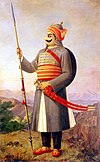
“Hindu society has been defended, during its days of distress, by such high-souled heroes as Chandragupta, Skandagupta, Vikramaditya, Yasodharman, Bapa Rawal, Jayapala, Bhojadeva, Prithiviraj, Prataparudra, Vir Pandya, Harihara and Rana Sanga.Hindu society has fought a long-drawn-out struggle for freedom against Islamic invaders under the leadership of such veterans as Maharana Pratap, Shivaji, Maharaja Surajmal, Banda Bairagi, Lokmanya Tilak, Veer Savarkar, Mahatma Gandhi, and Sardar Patel.”
“This was the Swadeshi Movement led by Sri Aurobindo. It was renascent India’s first experiment in mass mobilization. Powerful mantras such as svadeshI and svarAjya, first invoked by Maharshi Dayananda, came to the fore and fired the people’s imagination. The struggle against Western imperialism in all its forms including Christianity became linked with the earlier struggle against Islamic imperialism. Maharana Pratap, Shivaji, Guru Govind Singh and Banda Bairagi resumed their full stature as national heroes after having suffered an eclipse in the national memory.”
“The first need of the situation was a centre round which Hindus could rally, and from which Hindu resistance to the Islamic invasion could be directed. The effectiveness of such a centre was demonstrated first in Mewar under Maharana Pratap, secondly in the South under Vijayanagara, thirdly in Maharashtra under Shivaji, and lastly in the Punjab under Banda Bahadur. But these centres crystallised too late. A nationwide centre established earlier could have contained Islamic imperialism at the borders of Bharatavarsha, or defeated and driven it out from wherever it had secured a foothold. Chandragupta, Vikramaditya, and Skandagupta had headed such a centre, and saved the motherland by hurling back the barbarians as soon as they came.”
“I have never read Max Weber and do not know how he has arrived at the conclusion that “more tribals joined the Hindu mainstream as a result of the Muslim shock than the number of Hindus who were converted to Islam”. Perhaps he had in mind the people of Assam whom Bakhtyar Khalji and a few other Muslim invaders tried to subjugate, or the hill people all over our northern borders whom Muhammad Tughlaq tried to conquer but failed, or the Gonds who fought Akbar under Maharani Durgavati, or the Bhils who fought for freedom under Maharana Pratap, or the Mavlas who joined Shivaji at a later date. But the very fact that these so-called “tribals” fought spontaneously against the Muslim marauders rather than walk over to the winning side goes to prove that they shared a common culture with the rest of the natives.”
“It is this common consciousness of its history which prevents Hindu society from accepting the Mamluks, the Khaljis, the Tughlaqs, the Bahmanis, the Sharqis, the Sayyids, the Lodis, and the Mughals as native dynasties on par with the Mauryas, the Sungas, the Guptas, the Cholas, the Maukharis, the Pandyas, the Palas, the Rashtrakutas, the Yadavas, the Kaktiyas, the Hoysalas, the Sangamas, the Saluvas, the Marathas, the Sikhs, and the Jats. Hindu society can never concede that Jaypala Shahiya of Kabul, Maharani Nayakidevi of Gujarat, Prithiviraj Chauhan of Delhi, Jayachandra Gahadvad of Kanauj, Singhanadeva of Devagiri, Vikrama Pandya of Madura, Prolaya Nayak of Andhra, Harihar and Bukka and Krishnadevaraya of Vijayanagara, Maharanas Kumbha and Sanga and Pratap, Shivaji, Banda Bahadur, Maharajas Surajmal and Ranjit Singh, who resisted the Islamic invaders, were petty local chieftains conspiring for personal gains. Hindu society honours these heroes as freedom fighters against Islamic imperialism, in the same way as it honours its freedom fighters against British imperialism.”
“Coming to the period following Islamic invasions, Hindu society did not bother to remember the Arabs, the Ghaznavids, the Ghurids, the Mamluks, the Khaljis, the Tughlaqs, the Sayyads, the Lodis, and the Mughals. But it took pride in Bapa Raval who had humbled the Arabs; in Maharani Nayakidevi of Gujarat and Prithivi Raj Chauhan who had defeated Muhammad Ghuri again and again; in Gora and Badal who had rescued Rana Ratan Singh from the camp of Alauddin Khalji and then laid down their lives in defence of Padmini and her Chittor; in Harihara and Bukka who had founded the Vijayanagar Empire which stood like a rock against Islamic imperialism for more than two centuries; in Rana Sangram Singh who had crossed swords with Babur; in Maharana Pratap who had defied the mightiest Mughal in the midst of great adversity; in Durgadas Rathor who had despised the wrath of Aurangzeb in defence of his right to give refuge to a rebellious Mughal prince; in Chhatrapati Shivaji who devised a new diplomacy and innovated a new art of warfare which finally worsted the most powerful Muslim empire and rolled back the Islamic invasion; in Chhatrasal Bundela and Maharaja Surajmal who revived Hindu rule in the north; in Banda Bairagi who avenged the wrongs done by Muslim despots to Guru Arjun Deva, Guru Tegh Bahadur and Guru Gobind Singh; and in Maharaja Ranjit Singh who liberated the Punjab and the North-West Frontier Province from Islamic stranglehold.”