Link Copied!
Simone de Beauvoir Quotes (1908-1986)
Philosopher, Author
































About Simone de Beauvoir
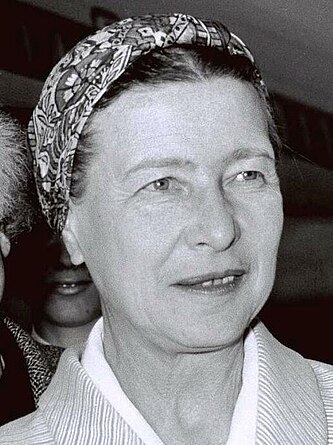
Simone Lucie Ernestine Marie Bertrand de Beauvoir (9 January 1908 – 14 April 1986) was a French author and existentialist philosopher. She is now most famous for her 1949 treatise The Second Sex Le Deuxième Sexe, a detailed analysis of women's oppression and a foundational tract of contemporary feminism, and her long personal relationship with Jean-Paul Sartre.
Best Simone de Beauvoir Quotes
Shortest
Earliest
Explore our curated collection of the most famous and impactful Simone de Beauvoir quotes.

“It is impossible to do anything for anyone.”



“I wish that every human life might be pure transparent freedom.”


“It is doubtless impossible to approach any human problems with a mind free from bias.”

“The present enshrines the past—and in the past all history has been made by men.”


“What has value in their eyes is never what is done for them; it's what they do for themselves.”
“There is only one good. And that is to act according to the dictates of one's conscience.”
“I tore myself away from the safe comfort of certainties through my love for truth — and truth rewarded me.”

“It was as though some stubborn god spent their time in an immutable and absurd balancing act between life and death, prosperity and poverty.”

“The Communists, following Hegel, speak of humanity and its future as of some monolithic individuality. I was attacking this illusion.”

“One's life has value so long as one attributes value to the life of others, by means of love, friendship, indignation and compassion.”

“One is not born a genius, one becomes a genius; and the feminine situation has up to the present rendered this becoming practically impossible.”
“I am incapable of conceiving infinity, and yet I do not accept finity. I want this adventure that is the context of my life to go on without end.”

“Since it is the Other within us who is old, it is natural that the revelation of our age should come to us from outside — from others. We do not accept it willingly.”

“Cooking is revelation and creation; and a woman can find special satisfaction in a successful cake or a flaky pastry, for not every one can do it: one must have the gift.”
“It's frightening to think that you mark your children merely by being yourself... It seems unfair. You can't assume the responsibility for everything you do — or don't do.”

“In itself, homosexuality is as limiting as heterosexuality: the ideal should be to be capable of loving a woman or a man; either, a human being, without feeling fear, restraint, or obligation.”

“We were two of a kind, and our relationship would endure as long as we did: but it could not make up entirely for the fleeting riches to be had from encounters with different people.”

“Society cares about the individual only in so far as he is profitable. The young know this. Their anxiety as they enter in upon social life matches the anguish of the old as they are excluded from it.”
“Woman is an existent who is called upon to make herself object; as subject she has an aggressive element in her sensuality which is not satisfied on the male body: hence the conflicts that her eroticism must somehow overcome.”
“Were we really more advanced than the alchemists of Carmona? We had brought to light certain facts that they were not aware of, we had organised them into the right order; but had we advanced even a step nearer to the mysterious heart of the universe?”


“It is for man to establish the reign of liberty in the midst of the world of the given. To gain the supreme victory, it is necessary, for one thing, that by and through their natural differentiation men and women unequivocally affirm their brotherhood.”

“From primitive times to our own, intercourse has always been considered a "service" for which the male thanks the woman by giving her presents or assuring her maintenance; but to serve is to give oneself a master; there is no reciprocity in this relation.”
“No woman should be authorized to stay at home to raise her children. Society should be totally different. Women should not have that choice, precisely because if there is such a choice, too many women will make that one. It is a way of forcing women in a certain direction.”

“Insects were scurrying about in the shade cast by the grass, and the lawn was a huge monotonous forest of thousands of little green blades, all equal, all alike, hiding the world from each other. Anguished, she thought, "I don't want to be just another blade of grass." ”

“For the first time in my life, I took part in a real battle between men. The dead did not come to life again, the vanquished fled in disorder; every thrust of my lance helped save Carmona. That day, I would have died with a smile on my lips, certain of having contributed to a triumphant future for my city.”
“Work almost always has a double aspect: it is a bondage, a wearisome drudgery; but it is also a source of interest, a steadying element, a factor that helps to integrate the worker with society. Retirement may be looked upon either as a prolonged holiday or as a rejection, a being thrown on to the scrap-heap.”

“You made me come to Paris. You pestered me to start living again. Well, now it's up to you to make my life livable. You mustn't let three whole days go by without coming to see me. … You wanted me to take notice of you. Now nothing else matters to me. I know you're alive and I feel emptiness inside me when you're away.”
“We must not believe, certainly, that a change in woman’s economic condition alone is enough to transform her, though this factor has been and remains the basic factor in her evolution; but until it has brought about the moral, social, cultural, and other consequences that it promises and requires, the new woman cannot appear.”
“[T]he Sahara was a spectacle as alive as the sea. The tints of the dunes changed according to the time of day and the angle of the light: golden as apricots from far off, when we drove close to them they turned to freshly made butter; behind us they grew pink; from sand to rock, the materials of which the desert was made varied as much as its tints.”
“To be gazed at is one danger; to be manhandled is another. Women as a rule are unfamiliar with violence, they have not been through the tussles of childhood and youth as have men; and now the girl is laid hold of, swept away in a bodily struggle in which the man is the stronger. She is no longer free to dream, to delay, to maneuver: she is in his power, at his disposal.”
“Even the children of Carmona were divided into two camps, and below the ramparts, among the brushwood and rocks, we battled with stones shouting "Long live the duke!" and others, "Down with the tyrant!" We fought viciously, but I was never satisfied with this game — the fallen enemy rose again, the dead came back to life. The day after a battle, victors and vanquished both found themselves unharmed.”
“In horror, in terror, she accepted the metamorphosis — gnat, foam, ant, until death. And it's only the beginning, she thought. She stood motionless, as if it were possible to play tricks with time, possible to stop it from following its course. But her hands stiffened against her quivering lips.
When the bells began to sound the hour she let out the first scream.”
When the bells began to sound the hour she let out the first scream.”

“All agree in recognising the fact that females exist in the human species; today as always they make up about one half of humanity. And yet we are told that femininity is in danger; we are exhorted to be women, remain women, become women. It would appear, then, that every female human being is not necessarily a woman; to be so considered she must share in that mysterious and threatened reality known as femininity.”
“The humanity of tomorrow will be living in its flesh and in its conscious liberty; that time will be its present and it will in turn prefer it. New relations of flesh and sentiment of which we have no conception will arise between the sexes; already, indeed, there have appeared between men and women friendships, rivalries, complicities, comradeships — chaste or sensual — which past centuries could not have conceived.”

“Toute oppression crée un état de guerre. Ce cas-ci ne fait pas exception. L'existant que l'on considère comme inessentiel ne peut manquer de prétendre rétablir sa souveraineté.
Aujourd'hui, le combat prend une autre figure; au lieu de vouloir enfermer l'homme dans un cachot, la femme essaie de s'en évader; elle ne cherche plus à l'entraîner dans les régions de l'immanence mais à émerger dans la lumière de la transcendance.”
Aujourd'hui, le combat prend une autre figure; au lieu de vouloir enfermer l'homme dans un cachot, la femme essaie de s'en évader; elle ne cherche plus à l'entraîner dans les régions de l'immanence mais à émerger dans la lumière de la transcendance.”
“But presently I began to bubble with happiness. No, my daughters' absence did not sadden me at all—quite the reverse. I could drive as fast or as slowly as I liked, go where I liked, stop when the whim took me. I made up my mind to spend the week wandering about. I get up as soon as it is light. The car is waiting for me in the street or in the courtyard like a faithful animal; it is wet with dew; I wipe its eyes, and full of delight I tear away through the growing sunlight.”

“The curse which lies upon marriage is that too often the individuals are joined in their weakness rather than in their strength, each asking from the other instead of finding pleasure in giving. It is even more deceptive to dream of gaining through the child a plenitude, a warmth, a value, which one is unable to create for oneself; the child brings joy only to the woman who is capable of disinterestedly desiring the happiness of another, to one who without being wrapped up in self seeks to transcend her own existence.”
“When an individual (or a group of individuals) is kept in a situation of inferiority, the fact is that he is inferior. But the significance of the verb to be must be rightly understood here; it is in bad faith to give it a static value when it really has the dynamic Hegelian sense of "to have become." Yes, women on the whole are today inferior to men; that is, their situation affords them fewer possibilities. The question is: should that state of affairs continue?
Many men hope that it will continue; not all have given up the battle.”
Many men hope that it will continue; not all have given up the battle.”
“His personal prestige, his qualities, his competence assure him a preponderant role however; since 1927 he has been above all the unchallenged specialist on peasant question. But the power he exercises is no more dictatorial than, for example, Roosevelt's was. New China's Constitution renders impossible the concentration of authority in one man's hands; the country is governed by a team whose members have been united through a long common struggle and by a close friendship.”
“When Sartre and I met not only did our backgrounds fuse, but also our solidity, our individual conviction that we were what we were made to be. In that framework we could not become rivals. Then, as the relationship between Sartre and me grew, I became convinced that I was irreplaceable in his life, and he in mine. In other words, we were totally secure in the knowledge that our relationship was also totally solid, again preordained, though, of course, we would have laughed at that word then. When you have such security it's easy not to be jealous. But had I thought that another woman played the same role as I did in Sartre's life, of course, I would have been jealous.”
“The fact that we are human beings is infinitely more important than all the peculiarities that distinguish human beings from one another; it is never the given that confers superiorities: "virtue", as the ancients called it, is defined at the level of "that which depends on us". In both sexes is played out the same drama of the flesh and the spirit, of finitude and transcendence; both are gnawed away by time and laid in wait for by death, they have the same essential need for one another; and they can gain from their liberty the same glory. If they were to taste it, they would no longer be tempted to dispute fallacious privileges, and fraternity between them could then come into existence.”
“It was said that I refused to grant any value to the maternal instinct and to love. This was not so. I simply asked that women should experience them truthfully and freely, whereas they often use them as excuses and take refuge in them, only to find themselves imprisoned in that refuge when those emotions have dried up in their hearts. I was accused of preaching sexual promiscuity; but at no point did I ever advise anyone to sleep with just anyone at just any time; my opinion on this subject is that all choices, agreements and refusals should be made independently of institutions, conventions and motives of self-aggrandizement; if the reasons for it are not of the same order as the act itself, then the only result can be lies, distortions and mutilations.”
“It is vain to apportion praise and blame. The truth is that if the vicious circle is so hard to break, it is because the two sexes are each the victim at once of the other and of itself. Between two adversaries confronting each other in their pure liberty, an agreement could be easily reached: the more so as the war profits neither. But the complexity of the whole affair derives from the fact that each camp is giving aid and comfort to the enemy; woman is pursuing a dream of submission, man a dream of identification. Want of authenticity does not pay: each blames the other for the unhappiness he or she has incurred in yielding to the temptations of the easy way; what man and woman loathe in each other is the shattering frustration of each one's own bad faith and baseness.”
“What should a society be, so that in his last years a man might still be a man?
The answer is simple: he would always have to have been treated as a man. By the fate that it allots to its members who can no longer work, society gives itself away — it has always looked upon them as so much material. Society confesses that as far as it is concerned, profit is the only thing that counts, and that its "humanism" is mere window-dressing. In the nineteenth century the ruling classes explicitly equated the proletariat with barbarism. The struggles of the workers succeeded in making the proletariat part of mankind once more. But only in so far as it is productive. Society turns away from the aged worker as though he belonged to another species. That is why the whole question is buried in a conspiracy of silence.”
The answer is simple: he would always have to have been treated as a man. By the fate that it allots to its members who can no longer work, society gives itself away — it has always looked upon them as so much material. Society confesses that as far as it is concerned, profit is the only thing that counts, and that its "humanism" is mere window-dressing. In the nineteenth century the ruling classes explicitly equated the proletariat with barbarism. The struggles of the workers succeeded in making the proletariat part of mankind once more. But only in so far as it is productive. Society turns away from the aged worker as though he belonged to another species. That is why the whole question is buried in a conspiracy of silence.”

“Self-knowledge is no guarantee of happiness, but it is on the side of happiness and can supply the courage to fight for it. Psychiatrists have told me that they give The Second Sex to their women patients to read, and not merely to intellectual women but to lower-middle-class women, to office workers and women working in factories. 'Your book was a great help to me. Your book saved me,' are the words I have read in letters from women of all ages and all walks of life.
If my book has helped women, it is because it expressed them, and they in their turn gave it its truth. Thanks to them, it is no longer a matter for scandal and concern. During these last ten years the myths that men created have crumbled, and many women writers have gone beyond me and have been far more daring than I. Too many of them for my taste take sexuality as their only theme; but at least when they write about it they now present themselves as the eye-that-looks, as subject, consciousness, freedom.”
If my book has helped women, it is because it expressed them, and they in their turn gave it its truth. Thanks to them, it is no longer a matter for scandal and concern. During these last ten years the myths that men created have crumbled, and many women writers have gone beyond me and have been far more daring than I. Too many of them for my taste take sexuality as their only theme; but at least when they write about it they now present themselves as the eye-that-looks, as subject, consciousness, freedom.”
“It is nonsense to assert that revelry, vice, ecstasy, passion, would become impossible if man and woman were equal in concrete matters; the contradictions that put the flesh in opposition to the spirit, the instant to time, the swoon of immanence to the challenge of transcendence, the absolute of pleasure to the nothingness of forgetting, will never be resolved; in sexuality will always be materialised the tension, the anguish, the joy, the frustration, and the triumph of existence. To emancipate woman is to refuse to confine her to the relations she bears to man, not to deny them to her; let her have her independent existence and she will continue none the less to exist for him also: mutually recognising each other as subject, each will yet remain for the other an other. The reciprocity of their relations will not do away with the miracles — desire, possession, love, dream, adventure — worked by the division of human beings into two separate categories; and the words that move us — giving, conquering, uniting — will not lose their meaning. On the contrary, when we abolish the slavery of half of humanity, together with the whole system of hypocrisy that it implies, then the 'division' of humanity will reveal its genuine significance and the human couple will find its true form.”

Simone de Beauvoir Quotes by Topic
Find exactly what you are looking for by browsing this categorized list of Simone de Beauvoir quotes by topic.
Simone de Beauvoir on Freedom 22 quotes
View all 22 quotes on Freedom →Simone de Beauvoir on Existence 10 quotes
View all 10 quotes on Existence →Simone de Beauvoir on Past 4 quotes
“We must not confuse the present with the past. With regard to the past, no further action is possible.”

Simone de Beauvoir on Oppression 3 quotes
“All oppressive regimes become stronger through the degradation of the oppressed.”

Simone de Beauvoir on Ethics 2 quotes
View all 2 quotes on Ethics →What Simone de Beauvoir Said About Others
Discover personal opinions Simone de Beauvoir shared regarding contemporaries.
Simone de Beauvoir on Women
“It is not in giving life but in risking life that man is raised above the animal; that is why superiority has been accorded in humanity not to the sex that brings forth but to that which kills.”
Simone de Beauvoir on Marquis de Sade
“To sympathize with Sade is to betray him. For it is our misery, subjection, and death that he desires; and every time we side with a child whose throat has been slit by a sex maniac, we take a stand against him. Nor does he forbid us to defend ourselves. He allows that a father may revenge or prevent, even by murder, the rape of his child. What he demands is that, in the struggle between irreconcilable existences, each one engage himself concretely. He approves of the vendetta, but not of the courts. We may kill, but we may not judge.”

Simone de Beauvoir on Politicians
“The politician follows the line of least resistance; it is easy to fall asleep over the unhappiness of others and to count it for very little; it is easier to throw a hundred men, ninety-seven of whom are innocent, into prison, than to discover the three culprits who are hidden among them; it is easier to kill a man than to keep a close watch on him; all politics makes use of the police, which officially flaunts its radical contempt for the individual and which loves violence for its own sake. The thing that goes by the name of political necessity is in part the laziness and brutality of the police. That is why it is incumbent upon ethics not to follow the line of least resistance; an act which is not destined, but rather quite freely consented to; it must make itself effective so that what was at first facility may become difficult.”

Quotes About Simone de Beauvoir
Gain deeper perspective through quotes about Simone de Beauvoir from others.
Joyce Antler Jewish Radical Feminism on Simone de Beauvoir
“France, where a number of prominent women, including Simone de Beauvoir (Ellen Willis's heroine as well as Shulamith Firestone's), risked imprisonment by publicly declaring, "I have had an abortion."”
Lisa Appignanesi on Simone de Beauvoir
“When I was growing up in the 60s, Simone de Beauvoir and Jean-Paul Sartre were a model couple, already legendary creatures, rebels with a great many causes, and leaders of what could be called the first postwar youth movement: existentialism — a philosophy that rejected all absolutes and talked of freedom, authenticity, and difficult choices. It had its own music and garb of sophisticated black which looked wonderful against a cafe backdrop. Sartre and De Beauvoir were its Bogart and Bacall, partners in a gloriously modern love affair lived out between jazz club, cafe and writing desk, with forays on to the platforms and streets of protest. Despite being indissolubly united and bound by ideas, they remained unmarried and free to engage openly in any number of relationships. This radical departure from convention seemed breathtaking at the time.”
Roxanne Dunbar-Ortiz on Simone de Beauvoir
“I finished the book and I lifted my eyes the pages to a different world. For several days thereafter, I mechanically carried out my chores while repeating the theses of The Second Sex: Femininity is neither natural nor innate, rather it is a condition of socialization that is based on, but not determined by, physiological differences. Male domination must then be explained by historical factors; in particular, the rise of private property and the state. A woman is created, not born. Dependency is the curse of woman. One sentence in particular became my mantra: Woman escapes complete dependency to the degree in which she escapes from the family.”

Sahar Khalifeh on Simone de Beauvoir
“(Who are some of the writers you enjoy reading and re-reading?) SK: Dostoevsky and Simone De Beauvoir. Since I was a young teenager, I started reading them and I never stopped...as for De Beauvoir, what a great writer and philosopher! Have you read The Mandarins? I read the novel at least five times. And what about The Second Sex? From that book, I learned how we become women, I mean how we became the other sex. Those two writers affected me deeply.”
Gerda Lerner on Simone de Beauvoir
“women's marginalization in the process of History-making has set them back intellectually and has kept them for far longer than was necessary from developing a consciousness of their collectivity in sisterhood, not motherhood. The cruel repetitiousness by which individual women have struggled to a higher level of consciousness, repeating an effort made a number of times by other women in previous centuries, is not only a symbol of women's oppression but is its actual manifestation. Thus, even the most advanced feminist thinkers, up to and including those in the early 20th century, have been in dialogue with the "great men" before them and have been unable to verify, test and improve their ideas by being in dialogue with the women thinkers before them...Simone de Beauvoir, in a passionate dialogue with Marx, Freud, Sartre and Camus, could go as far with a feminist critique of patriarchal values and institutions as it was possible to go when the thinker was male-centered. Had she truly engaged with Mary Wollstonecraft's thought, the works of Mary Astell, the Quaker feminists of the early 19th century, the mystical revisioners among the black spiritualists and the feminism of Anna Cooper, her analysis might have become woman-centered and therefore capable of projecting alternatives to the basic mental constructs of patriarchal thought. Her erroneous assertion that, "They [women] have no past, no history, no religion of their own," was not just an oversight and a flaw, but a manifestation of the basic limitations which have for millennia limited the power and effectiveness of women's thought.”



Misattributed Quotes
Quotes mistakenly credited to Simone de Beauvoir
“Each of us is responsible for everything and to every human being.”
About Simone de Beauvoir
Simone Lucie Ernestine Marie Bertrand de Beauvoir (9 January 1908 – 14 April 1986) was a French author and existentialist philosopher. She is now most famous for her 1949 treatise The Second Sex Le Deuxième Sexe, a detailed analysis of women's oppression and a foundational tract of contemporary feminism, and her long personal relationship with Jean-Paul Sartre.