Link Copied!
Sergei Prokofiev Quotes (1891-1953)
Composer
About Sergei Prokofiev
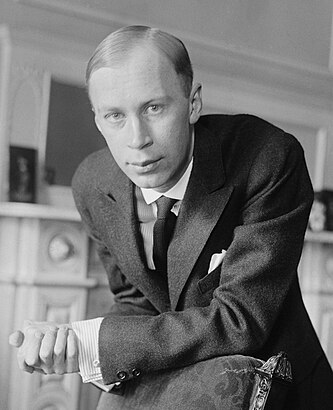
Sergei Sergeyevich Prokofiev (1891-04-27 N.S. or 1891-04-15 O.S. – 1953-03-05) was a Russian composer, pianist, and conductor who later worked in the Soviet Union. As the creator of acknowledged masterpieces across numerous music genres, he is regarded as one of the major composers of the 20th century.
Best Sergei Prokofiev Quotes
Shortest
Earliest
Explore our curated collection of the most famous and impactful Sergei Prokofiev quotes.
“This is my best work, but only because The Flaming Angel is my greatest.”

“In my view, the composer, just as the poet, the sculptor or the painter, is in duty bound to serve Man, the people. He must beautify human life and defend it. He must be a citizen first and foremost, so that his art might consciously extol human life and lead man to a radiant future. Such is the immutable code of art as I see it.”

“The time is past when music was written for a handful of aesthetes. Today vast crowds of people have come face to face with serious music and are waiting with eager impatience. Composers, take heed of this…But this does not mean that you must pander to this audience. Pandering always has an element of insincerity about it and nothing good ever came of that.”

“It seemed to me that had Haydn lived to our day he would have retained his own style while accepting something of the new at the same time. That was the kind of symphony I wanted to write: a symphony in the classical style. And when I saw that my idea was beginning to work, I called it the Classical Symphony.”
“The first was the classical line, which could be traced back to my early childhood and the Beethoven sonatas I heard my mother play. This line takes sometimes a neo-classical form (sonatas, concertos), sometimes imitates the 18th century classics (gavottes, the Classical symphony, partly the Sinfonietta). The second line, the modern trend, begins with that meeting with Taneyev when he reproached me for the “crudeness” of my harmonies. At first this took the form of a search for my own harmonic language, developing later into a search for a language in which to express powerful emotions (The Phantom, Despair, Diabolical Suggestion, Sarcasms, Scythian Suite, a few of the songs, op. 23, The Gambler, Seven, They Were Seven, the Quintet and the Second Symphony). Although this line covers harmonic language mainly, it also includes new departures in melody, orchestration and drama. The third line is toccata or the “motor” line traceable perhaps to Schumann’s Toccata which made such a powerful impression on me when I first heard it (Etudes, op. 2, Toccata, op. 11, Scherzo, op. 12, the Scherzo of the Second Concerto, the Toccata in the Fifth Concerto, and also the repetitive intensity of the melodic figures in the Scythian Suite, Pas d’acier[The Age of Steel], or passages in the Third Concerto). This line is perhaps the least important. The fourth line is lyrical; it appears first as a thoughtful and meditative mood, not always associated with the melody, or, at any rate, with the long melody (The Fairy-tale, op. 3, Dreams, Autumnal Sketch[Osenneye], Songs, op. 9, The Legend, op. 12), sometimes partly contained in the long melody (choruses on Balmont texts, beginning of the First Violin Concerto, songs to Akhmatova’s poems, Old Granny’s Tales[Tales of an Old Grandmother]). This line was not noticed until much later. For a long time I was given no credit for any lyrical gift whatsoever, and for want of encouragement it developed slowly. But as time went on I gave more and more attention to this aspect of my work. I should like to limit myself to these four “lines,” and to regard the fifth, “grotesque” line which some wish to ascribe to me, as simply a deviation from the other lines. In any case I strenuously object to the very word “grotesque” which has become hackneyed to the point of nausea. As a matter of fact the use of the French word “grotesque” in this sense is a distortion of the meaning. I would prefer my music to be described as “Scherzo-ish” in quality, or else by three words describing the various degrees of the Scherzo—whimsicality, laughter, mockery.”
Sergei Prokofiev Quotes by Topic
Find exactly what you are looking for by browsing this categorized list of Sergei Prokofiev quotes by topic.
Sergei Prokofiev on Piano Sonata No. 1 (Prokofiev) 4 quotes
“As a rule the publication of his first opus is a landmark for the composer, a sort of dividing line between his early work and his mature compositions. With me it was different: the Sonata No. 1, a naïve and simple little piece, marked the end of my early period; the new began with the Etudes, Op. 2.”
Sergei Prokofiev on Piano Sonata No. 3 (Prokofiev)
“It was [Piotr Petrovich [Pierre]] Souvchinsky who once recommended me to begin all my concerts with it.”
Sergei Prokofiev on Piano Sonata No. 2 (Prokofiev)
Sergei Prokofiev on Piano Sonata No. 4 (Prokofiev)
“Until now, I have been afraid that my finale had a chopped-off tail. Now it is clear to me that it is good, that the last buildup, if it is played properly, fully reveals the climax [the last appearance of the first theme] that concludes the Sonata and after which the end should come immediately.”
Sergei Prokofiev on Soviet Union
“In my view, the composer, just as the poet, the sculptor or the painter, is in duty bound to serve Man, the people. He must beautify human life and defend it. He must be a citizen first and foremost, so that his art might consciously extol human life and lead man to a radiant future. Such is the immutable code of art as I see it.”

Sergei Prokofiev on Piano Sonata No. 5 (Prokofiev)
“The Fifth Sonata, the Quintet and the Second Symphony, continuing from the Sarcasms through the Scythian Suite and Seven, They Are Seven, were the most chromatic of all my compositions. This was the effect of the Parisian atmosphere where complex patterns and dissonances were the accepted thing, and which fostered my predilection for complex thinking.”
Sergei Prokofiev on The Gambler (Prokofiev)
“I was planning a symphonic suite based on the music of The Gambler. But I could not make much headway with it. The close interweaving of the music and the text resulted in an intricate pattern from which it was hard to pick any thread for a single symphonic line. In the end I discarded the idea of a suite in favour of portraits of the individual characters. This, however, was not so simple either, inasmuch as the music of the different characters was scattered throughout the opera. I devised the following method: I took the score apart, picked out everything relating to a given character and spread the sheets out on the floor. Seated on a chair, I studied the pages for a long time until gradually the unrelated episodes began, as it were, to coalesce. This gave me sufficient concentrated material to work with.”
What Sergei Prokofiev Said About Others
Discover personal opinions Sergei Prokofiev shared regarding contemporaries.
Sergei Prokofiev on Anatoly Lyadov
“Anyone who dared to depart from the conventional path was bound to incur his [Lyadov's] wrath. Thrusting his hands into his pockets and swaying back and forth... , he [Lyadov] would say, ‘I cannot understand why you bother to study with me. Go to Richard Strauss, go to Debussy.’ He might as well have said, ‘Go to the devil.’”
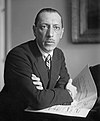
Sergei Prokofiev on Igor Stravinsky
“For my part I did not approve of Stravinsky's predilection for Bach's method — pseudo-Bachism — or rather, I did not approve adopting someone else's idiom and calling it one's own. True, I had written a Classical Symphony myself, but that was only a passing phase. With Stravinsky this 'Bachism' was becoming the basic line of his music.”
Sergei Prokofiev on Anna Yesipova
“At first we got along very well. Esipova even boasted outside the class that she had pupils who wrote sonatas (I completed Sonata, Op. 1, and played it to Esipova, who took it home and inserted pedaling). But before long trouble began. Esipova’s method of teaching was to try to fit everyone into a standard pattern. True, it was a very elaborate pattern, and if the pupil’s temperament coincided with her own, the results were admirable. But if the pupil happened to be of an independent cast of mind Esipova would do her best to suppress his individuality instead of helping to develop it. Moreover, I had great difficulty in ridding myself of careless playing, and the Mozart, Schubert and Chopin which she insisted on were somehow not in my line. At that period I was too preoccupied with the search for a new harmonic idiom to understand how anyone could care for the simple harmonies of Mozart.”

Quotes About Sergei Prokofiev
Gain deeper perspective through quotes about Sergei Prokofiev from others.
Anonymous reviewer on Sergei Prokofiev
“Mr. Prokofiev's pieces have been contributions not to the art of music, but to national pathology and pharmacopoeia. We do not refer particularly to the pianoforte solos composed and played by Mr. Prokofiev, for they, we are sure, invite their own damnation, because there is nothing in them to hold attention.They pursue no aesthetic purpose, strive for no recognizable ideal, proclaim no means for increasing the expressive potency of music. They are simply perverse. They die the death of abortions.”
Boris Berman on Sergei Prokofiev
“Within the vast, virtually limitless piano repertoire, the piano sonatas of Sergei Prokofiev occupy a special place. Apart from Alexander Scriabin early in the century, Prokofiev was the only major twentieth-century composer to pay such consistent attention to the form, … They are a constant presence in concert programs and are considered an indispensable part of the repertoire by almost every serious concert pianist.”
Igor Glebov on Sergei Prokofiev 3 quotes
“What is striking in Prokofiev’s playing is the outstandingly convincing expression and uncommon rhythmic plasticity.... One should especially note a very original use of accents. There is an endless range of them: from hardly audible and scarcely noticeable pushes to pricks and passing by stresses to temperamental and powerful strokes. The accent in Prokof iev’s performance becomes the most valuable shaping element, bringing sharpness, capriciousness, and a special dry spark to his playing. Regular metric stresses disappear behind rhythmically refined and dynamically rich accents. This makes the phrasing especially clear and intensely vital. . . . [Prokofiev’s] reserve does not imply dryness or indifference: Prokofiev knows how to control his emotions, but does not shy away from the touch ing, gentle lyricism. He is not interested in pompous pathos. He found something better: simplicity and naturalness....”
Reinhold Glière on Sergei Prokofiev
“[Prokofiev] played the piano with great ease and confidence, although his technique left much to be desired. He played carelessly and he did not hold his hands properly on the keyboard. His long fingers seemed very clumsy. Sometimes he managed rather diªcult passages with... facility but at other times he could not play a simple scale or an ordinary arpeggio.... Seryozha’s chief trouble was the incorrect hand position. Technically his playing was careless and inaccurate, his phrasing was poor and he paid little attention to detail.... I must say that he was rather obstinate.”
Yakov Milshtein on Sergei Prokofiev
“We encountered a pianist who played not only with the incredible will and rhythmic energy, but also with warmth, poetical finesse, and the ability to carry a melodic line flexibly and gently.... Those who think, according to an obscure tradition, that Prokofiev played in an angular, dry way, with incessant accents thrown around here and there, are mistaken. No! His playing was poetic, childishly innocent, astonishingly pure and modest.”
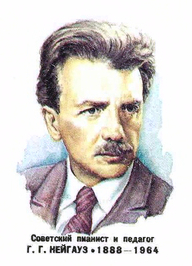
Heinrich Neuhaus on Sergei Prokofiev
“Energy, confidence, indomitable will, steel rhythm, powerful tone (some times even hard to bear in a small room), a peculiar “epic quality” that scrupulously avoided any suggestion of over-refinement or intimacy (there is none in his music either), yet withal a remarkable ability to convey true lyricism, poetry, sadness, reflection, an extraordinary human warmth, and feeling for nature... were... the principal traits of his pianism. His technique was truly phenomenal, impeccable.... He played quite differently at home than on the concert stage; it was as though he stepped on to the stage clothed not only physically but emotionally in formal dress.... Notwithstanding his outspoken contempt for what is known as “temperamental” performances, he had enough temperament to prevent his playing from sounding dry or emasculated. True, at times he played with such reserve that his performance amounted to a mere exposition; here is my material, he seemed to be saying, understand it and feel it as you please.... The ease (the result of confidence!) with which he tackled some of the most breathtaking passages was truly amazing; he did indeed seem to be “playing” in the literal, almost “sporty” sense of the word (no wonder his enemies called him the “football pianist”). The remarkable clarity and preciseness of the entire musical texture was based on supreme mastery of all the necessary technical media....”
David Oistrakh on Sergei Prokofiev
“What struck me about Prokofiev’s playing was its remarkable simplicity. Not a single superfluous gesture, not a single exaggerated expression of emotion, no striving for effect. The composer seemed to be saying, “I refuse to embellish my music in any way. Here it is. You may take it or leave it.” There was a sort of inner purity of purpose behind the whole performance that made an unforgettable impression. He played his Toccata with great inner force (while outwardly appearing perfectly calm and unmoved).... The tempestuous, defiant Prokofiev at [lyrical] moments became as touching as a child. The fact that Prokofiev could be poetic and moving came as a surprise to many.”

Lina Prokofieva on Sergei Prokofiev
“Many pianists got interested in his music only after they heard the composer’s performance—such as Borovsky, Horowitz, Gieseking, Rubinstein and many others.”
Sviatoslav Richter on Sergei Prokofiev
“I remember being struck by his way of playing virtually without any pedal. And his manner was so polished.”

About Sergei Prokofiev
Sergei Sergeyevich Prokofiev (1891-04-27 N.S. or 1891-04-15 O.S. – 1953-03-05) was a Russian composer, pianist, and conductor who later worked in the Soviet Union. As the creator of acknowledged masterpieces across numerous music genres, he is regarded as one of the major composers of the 20th century.