Link Copied!
Sengai Quotes (1750-1837)
Painter
About Sengai
Sengai Gibon (仙厓 義梵, 1750 - 1837) was a Japanese monk of the Rinzai school, accomplished calligrapher and painter. He was known for his controversial teachings and writings, as well as for his lighthearted sumi-e paintings.
Best Sengai Quotes
Shortest
Earliest
Explore our curated collection of the most famous and impactful Sengai quotes.
“Young bride
Be alive till they say to you
Die! Die!”
Be alive till they say to you
Die! Die!”
“If you say, 'Come back later',
He will speedily come to snatch you away.
Say rather, 'I shall not be in till I'm ninety-nine'".”
He will speedily come to snatch you away.
Say rather, 'I shall not be in till I'm ninety-nine'".”
“He who comes knows only his coming,
He who goes knows only his end.
To be saved from the chasm,
Why cling to the cliff?
Clouds floating low
Never know where the breezes will blow them.”
He who goes knows only his end.
To be saved from the chasm,
Why cling to the cliff?
Clouds floating low
Never know where the breezes will blow them.”
Quotes About Sengai
Gain deeper perspective through quotes about Sengai from others.
Quote in on Sengai
“Sengai Gibon (1750-1837) was an artistic Zen monk of importance, who took "a transcendental view of things that are relative and limited. One eye was turned deeply inward, while the other looked out with concern to catch the fleeting shadows of our earthly life."”
Zenshin Florence Caplow on Sengai
“In 1837, when Sengai Gibon was asked by one of his students if he had anything to say before passing away, he replied, “I don't want to die."
His pupils, astounded to hear this, asked, "What was that you said?"
"I really don't want to die," repeated Sengai. (He was eighty-eight).
Yet an elaborate dead poet was recorded.”
Art of Perceptual Experience: Pure Abstraction and Alternative Minimalism on Sengai 2 quotes
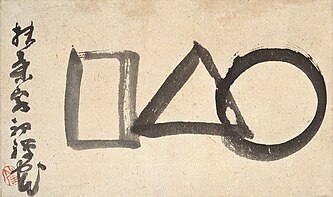
“Suzuki often cited the work of Japanese Zen monk Sengai Gibon (1750–1837), whose painting Circle, Triangle, and Square he saw as the embodiment of the universe. Suzuki interpreted Sengai’s three fundamental forms as geometries of formlessness and infinity, which underscored his own view of emptiness as the essence of Zen enlightenment. This scroll has fascinated people ever since. Rather than a single level of black or gray, the ink tones keep changing. The forms overlap just a bit, suggesting interconnections between these fundamental shapes.”
About Sengai
Sengai Gibon (仙厓 義梵, 1750 - 1837) was a Japanese monk of the Rinzai school, accomplished calligrapher and painter. He was known for his controversial teachings and writings, as well as for his lighthearted sumi-e paintings.