Ross Perot on Roy Benavidez
← Back to Ross Perot Profile
“The U.S. military does not just pin Medals of Honor on its heroes. Their actions have to be written up, documented, and passed through an appropriately difficult and skeptical review process. Because of the sensitive nature of the Green Berets' reconnaissance mission in Cambodia, Roy's medal did not come quickly, and as a result he became the last warrior of the Vietnam era to receive this great honor. That gave many of us the opportunity to enjoy an especially memorable day when President Reagan hung the medal around the neck of this great Mexican-Indian-American hero. As a fellow Texan, I have known about and admired Roy's courage and his fulfillment of the American dream. I was delighted to be asked to write the foreword for his inspirational, truly American story. It is one he tells to groups around the country- to veterans, to the military, and especially to future Medal of Honor recipients in the ranks of the less fortunate children of America. We remain very proud of him and his devotion to our country and his fellow soldiers. I am pleased to salute him as an American.”
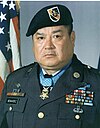
“February 24, 1981, was a special day in the life of Master Sergeant Roy Benavidez. On that day, the nation watched proudly as this brave soldier was awarded the Medal of Honor by President Ronald Reagan, a recognition given only to very special service members who have displayed courage well beyond that expected of our citizens. I find Roy's life one with which I can empathize and one that should make all Americans proud of the opportunities America offers to those strong enough to seize the chance. Roy's is a classic study of success in America- born poor in South Texas, an orphan harassed for his Mexican-Indian ancestry. As a boy, Roy was helped by his relatives and his community. As a young man, he found the U.S. Army the perfect place to exhibit his burning desire to contribute to the country he loved despite his difficult beginning. Sent to Vietnam as an adviser, he became known as "Tango Mike/Mike," a radio call sign his fellow soldiers made up for "That mean Mexican." He was mean in the best sense: tough and burning to fight America's and his unit's designated enemies. Roy soon earned a reputation for courage that bordered on recklessness, and he was wounded so badly that army doctors said he would be paralyzed for life. They didn't reckon with Tango Mike/Mike.”
“After months of grueling and determined rehabilitation, Roy Benavidez not only could walk, but qualified for the elite Army Special Forces- the Green Berets. He was soon back in action in Southeast Asia, on the Vietnam-Cambodian border. It was here that he rose to the challenge that made him a respected member of a very special group of heroes. On the morning of May 2, 1968, twelve soldiers from his unit became trapped during a special reconnaissance mission in Cambodia that had been authorized under special presidential orders. This time, the troops were surrounded by a North Vietnamese regiment. Three helicopters tried to get them out but were met with such heavy fire that they were unable to land. It appeared we would lose those brave soldiers- Roy's friends. Guess who volunteered to climb into a helicopter to go help them? Tango Mike/Mike was on the way. The rest is American history. Sergeant Benavidez and a small band of heroes came to the rescue. Despite numerous wounds- he was shot five times, riddled with shrapnel, and bayoneted and clubbed during hand-to-hand combat- Roy returned again and again to lead the wounded survivors to the rescue chopper and retrieve the bodies of his dead comrades. In a final act of patriotism, he pushed his bullet-ridden body back to the ambushed soldiers' highly classified documents and electronic gear and destroyed them to keep them out of enemy hands. Only then did he allow himself to be pulled into the helicopter.”