Link Copied!
Roland Barthes Quotes (1915-1980)
Philosopher
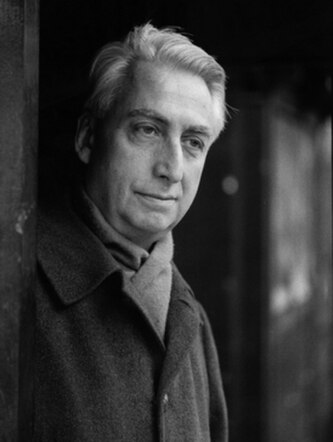



About Roland Barthes
Roland Barthes (November 12, 1915 – March 25, 1980) was a French literary critic, literary and social theorist, philosopher, and semiotician.
Best Roland Barthes Quotes
Shortest
Earliest
Explore our curated collection of the most famous and impactful Roland Barthes quotes.

“The bourgeoisie is defined as the social class which does not want to be named.”

“By reducing any quality to quantity, myth economizes intelligence: it understands reality more cheaply.”

“The bourgeoisie hides the fact that it is the bourgeoisie and thereby produces myth; revolution announces itself openly as revolution and thereby abolishes myth.”
“The petit-bourgeois is a man unable to imagine the Other. If he comes face to face with him, he blinds himself, ignores and denies him, or else transforms him into himself.”
“The politician being interviewed clearly takes a great deal of trouble to imagine an ending to his sentence: and if he stopped short? His entire policy would be jeopardized!”
“Bourgeois norms are experienced as the evident laws of a natural order—the further the bourgeois class propagates its representations, the more naturalized they become.”
“The Text is not a definitive object.
• Variant translation: The Text is not to be thought of as an object that can be computed. It would be futile to try to separate out materially works from texts.”
• Variant translation: The Text is not to be thought of as an object that can be computed. It would be futile to try to separate out materially works from texts.”

“Statistically, myth is on the right. There, it is essential, well-fed, sleek, expensive, garrulous, it invents itself ceaselessly. It takes hold of everything, all aspects of the law, of morality, of aesthetics, of diplomacy, of household equipment, of Literature, of entertainment.”

“La forme bâtarde de la culture de masse est la répétition honteuse: on répète les contenus, les schèmes idéologiques, le gommage des contradictions, mais on varie les formes superficielles: toujours des livres, des émissions, des films nouveaux, des faits divers, mais toujours le même sens.”
“Encratic language (the language produced and spread under the protection of power) is statutorily a language of repetition; all official institutions of language are repeating machines: schools, sports, advertising, popular songs, news, all continually repeat the same structure, the same meaning, often the same words.”

“The discourse on the Text should itself be nothing other than text, research, textual activity, since the Text is that social space which leaves no language safe, outside, nor any subject of the enunciation in position as judge, master, analyst, confessor, decoder. The theory of the Text can coincide only with a practice of writing.”

“The Text is plural. Which is not simply to say that it has several meanings, but that it accomplishes the very plural of meaning: an irreducible (and not merely an acceptable) plural. The Text is not a co-existence of meanings but a passage, an overcrossing; thus it answers not to an interpretation, even a liberal one, but to an explosion, a dissemination.”
“A work has two levels of meaning: literal and concealed.
A Text, on the other hand is engaged in a movement … a deferral … a dilation of meaning … the play of signification.
Metonymy — the association of part to whole — characterized the logic of the Text.
In this sense the Text is "radically symbolic" and lacks closure.
• Variant translation: The Text can be approached, experienced, in reaction to the sign. The work closes on a signified. There are two modes of signification which can be attributed to this signified: either it is claimed to be evident and the work is then the object of a literal science, of philology, or else it is considered to be secret, ultimate, something to be sought out, and the work then falls under the scope of a hermeneutics, of an interpretation”
Roland Barthes Quotes by Topic
Find exactly what you are looking for by browsing this categorized list of Roland Barthes quotes by topic.
Roland Barthes on Price
“By reducing any quality to quantity, myth economizes intelligence: it understands reality more cheaply.”
Roland Barthes on Alienation
Roland Barthes on Car
“I think cars today are almost the exact equivalent of the great Gothic cathedrals. I mean the supreme creation of an era, conceived with passion by unknown artists, and consumed in image if not in usage by a whole population which appropriates them as a purely magical object.”

What Roland Barthes Said About Others
Discover personal opinions Roland Barthes shared regarding contemporaries.
Roland Barthes on Greta Garbo
“Garbo still belongs to that moment in cinema when capturing the human face still plunged audiences into the deepest ecstasy, when one literally lost oneself in a human image as one would in a philtre, when the face represented a kind of absolute state of the flesh, which could be neither reached nor renounced.”

Roland Barthes on Historian
“What really happens is that the author discards the human persona but replaces it by an 'objective¿ one; the authorial subject is as evident as ever, but it has become an objective subject … At the level of discourse objectivity, or the absence of any clues to the narrator, turns out to be particular form of fiction, where the historian tries to give the impression that the referent is speaking for itself.”
Quotes About Roland Barthes
Gain deeper perspective through quotes about Roland Barthes from others.
Chela Sandoval on Roland Barthes
“Barthes's discovery and articulation of the "new" liberatory category of perception and deciphering, semiotic-mythology, belongs to the praxis of his heroic mythologist, alone. This unfortunate theoretical strategy makes the articulation of a coalitional consciousness in social struggle impossible to imagine or enact. ... His terminologies appropriate the technologies of the oppressed for use by academic classes.”

Zadie Smith on Roland Barthes

About Roland Barthes
Roland Barthes (November 12, 1915 – March 25, 1980) was a French literary critic, literary and social theorist, philosopher, and semiotician.