Link Copied!
Roger Wolcott Sperry Quotes (1913-1994)
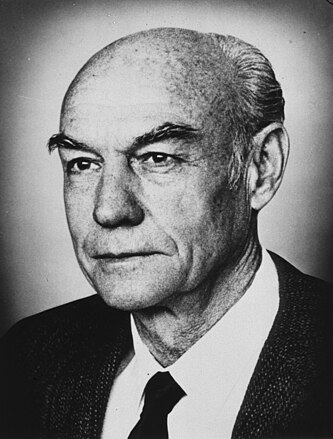
About Roger Wolcott Sperry
Roger Wolcott Sperry (20 August 1913 – 17 April 1994) was a neuropsychologist, neurobiologist and pioneer in the sciences of consciousness who, together with David H. Hubel and Torsten Wiesel, won the 1981 Nobel Prize in Medicine, for his independent work in split-brain research.
Best Roger Wolcott Sperry Quotes
Shortest
Earliest
Explore our curated collection of the most famous and impactful Roger Wolcott Sperry quotes.
“Futurists and common sense concur that a substantial change, worldwide, in life-style and moral guidelines will soon become an absolute necessity.”
“When the brain is whole, the unified consciousness of the left and right hemispheres adds up to more than the individual properties of the separate hemispheres.”

“To see a promising solution to a dilemma and then just leave it to questionable development at its own pace without trying to aid its implementation would seem a dereliction.”
“What is needed to break the vicious spiral is a world-wide change in attitudes, values, and social policy. As Einstein put it, "We need a substantially new manner of thinking if mankind is to survive."”
“The centermost processes of the brain with which consciousness is presumably associated are simply not understood. They are so far beyond our comprehension that no one I know of has been able to imagine their nature.”
“The cells and fibers of the brain must carry some kind of individual identification tags, presumably cytochemical in nature, by which they are distinguished one from another almost, in many regions, to the level of the single neurons.”

“'''The grand design of nature perceived broadly in four dimensions, including the forces that move the universe and created man, with special focus on evolution in our own biosphere, is something intrinsically good that it is right to preserve and enhance, and wrong to destroy and degrade.”
“Unlike other aspects of cognitive function, emotions have never been readily confinable to one hemisphere. Though generated by lateralized input, the emotional effects tend to spread rapidly to involve both hemispheres, apparently through crossed fiber systems in the undivided brain stem.”
“There probably is no more important quest in all science than the attempt to understand those very particular events in evolution by which brains worked out that special trick that has enabled them to add to the cosmic scheme of things: color, sound, pain, pleasure, and all the other facets of mental experience.”

“Cognitivism bridges the chasm between what the writer C. P. Snow has called the "two cultures" — the widening gap between the world view of the scientist and the humanist. The Caltech philosopher W. T. Jones has called this the crisis of contemporary culture.”
“The new way of thinking, spawned by the cognitive revolution, shows strong promise ... Reversing previous doctrine in science, the new paradigm affirms that the world we live in is driven not solely by mindless physical forces but, more crucially, by subjective human values. Human values become the underlying key to world change.”

“The objective psychologist, hoping to get at the physiological side of behavior, is apt to plunge immediately into neurology trying to correlate brain activity with modes of experience ... The result in many cases only accentuates the gap between the total experience as studied by the psychologist and neural activity as analyzed by the neurologist.”

“With few exceptions, the bulk of the collected lesion evidence up through the 1950s into the early '60s converged to support the picture of a leading, more highly evolved and intellectual left hemisphere and a relatively retarded right hemisphere that by contrast, in the typical righthander brain, is not only mute and agraphic but also dyslexic, word-deaf and apraxic, and lacking generally in higher cognitive function.”

“It seems important that the social value factor be more generally recognized as a powerful causal agent in its own right and something to be dealt with directly as such. No more critical task can be projected for the 1970s than that of seeking for civilized society a new, elevated set of value guidelines more suited to man's expanded numbers and new powers over nature, a frame of reference for value priorities that will act to secure and conserve our world instead of destroying it.”
“Any model or description that leaves out conscious forces ... is bound to be sadly incomplete and unsatisfactory ... This scheme is one that puts mind back over matter, in a sense, not under or outside or beside it. It is a scheme that idealizes ideas and ideals over physical and chemical interactions, nerve impulse traffic, and DNA. It is a brain model in which conscious mental psychic forces are recognized to be the crowning achievement of some five hundred million years or more of evolution.”
“The former scope of science, its limitations, world perspectives, views of human nature, and its societal role as an intellectual, cultural and moral force all undergo profound change. Where there used to be a chasm and irreconcilable conflict between the scientific and the traditional humanistic views of man and the world, we now perceive a continuum. A unifying new interpretative framework emerges with far reaching impact not only for science but for those ultimate value-belief guidelines by which mankind has tried to live and find meaning.”

“I think time will show that the new approach, emphasizing emergent "macro" control, is equally valid in all the physical sciences, and that the behavioral and cognitive disciplines are leading the way to a more valid framework for all science. Although the theoretic changes make little difference in physics, chemistry, molecular biology, and so on, they are crucial for the behavioral, social, and human sciences. They don't change the analytic, reductive methodology, just the interpretations and conclusions. There seems little to lose, and much to gain.”
“The time has passed when nations should be allowed to do as they individually wish with regard to global matters, each striving solely in its own interests, with the more powerful now able to destroy all humanity and more.
For the common good, we need to frame and abide by a higher system of law and justice, designed with less national, more godlike, perspectives for the preservation and welfare of the biosphere as a whole.
The problems of setting up and administering an effective, international force of this kind can hardly be more grave, formidable or insoluble than those we encounter on any alternative course.”
“Earlier contentions that the right hemisphere is not even conscious largely gave way by the mid seventies to an intermediate position conceding that the mute hemisphere may be conscious at some lower elemental levels, but claiming that it lacks the higher, reflective, self-conscious kind of inner awareness that is special to the human mind and is needed, so it is said, to qualify the right conscious system as a "self' or "person". Self awareness in particular is reported, on the basis of mirror tests mainly, to be a predominantly human attribute and is rated by developmental as well as by evolutionary standards to be a highly advanced phase of conscious awareness.”

“One of the more important things to come out of the split-brain work, as an indirect spin-off, is a revised concept of the nature of consciousness and its fundamental relation to brain processing. The key development here is a switch from prior non-causal, parallelist views to a new causal, or "interactionist" interpretation that ascribes to inner experience an integral causal control role in brain function and behavior. In effect, and without resorting to dualist views, the mental forces and properties of the conscious mind are restored to the brain of objective science from which they had long been excluded on materialist-behaviorist principles.”
“I have never been entirely satisfied with the materialistic or behavioristic thesis that a complete explanation of brain function is possible in purely objective terms with no reference whatever to subjective experience; i.e., that in scientific analysis we can confidently and advantageously disregard the subjective properties of the brain process. I do not mean we should abandon the objective approach or repeat the errors of the earlier introspective era. It is just that I find it difficult to believe that the sensations and other subjective experiences per se serve no function, have no operational value and no place in our working models of the brain.”
“It is mutual fear and distrust that mostly generate world tensions and these can be traced in no small measure, like other root causes of worsening world conditions, to different people's conflicting and often intolerant, value-belief differences ... Whereas in the past science did little, if anything, to remedy this situation and in some ways made things worse, our reformed "macro-determinist" science that includes consciousness and subjective values ... provides common universal ethical foundations on which all nations could work to build a World Government or at least a World Security System to help control nuclear developments and other global threats that require international collaboration.”
“Cognitive introspective psychology and related cognitive science can no longer be ignored experimentally, or written off as "a science of epiphenomena", nor either as something that must, in principle, reduce eventually to neurophysiology. The events of inner experience, as emergent properties of brain processes, become themselves explanatory causal constructs in their own right, interacting at their own level with their own laws and dynamics. The whole world of inner experience (the world of the humanities) long rejected by 20th century scientific materialism, thus becomes recognized and included within the domain of science.”
Roger Wolcott Sperry Quotes by Topic
Find exactly what you are looking for by browsing this categorized list of Roger Wolcott Sperry quotes by topic.
Roger Wolcott Sperry on Pattern 2 quotes
“When we focus consciously on an object — and create a mental image for example — it's not because the brain pattern is a copy or neural representation of the perceived object, but because the brain experiences a special kind of interaction with that object, preparing the brain to deal with it. I maintained that an identical feeling or thought on two separate occasions did not necessarily involve the identical nerve cells each time. Instead, it is the operational impact of the neural activity pattern as a whole that counts, and this depends on context — just as the word "lead" can mean different things, depending on the rest of the sentence.”

Roger Wolcott Sperry on Mental image 2 quotes
“When we focus consciously on an object — and create a mental image for example — it's not because the brain pattern is a copy or neural representation of the perceived object, but because the brain experiences a special kind of interaction with that object, preparing the brain to deal with it. I maintained that an identical feeling or thought on two separate occasions did not necessarily involve the identical nerve cells each time. Instead, it is the operational impact of the neural activity pattern as a whole that counts, and this depends on context — just as the word "lead" can mean different things, depending on the rest of the sentence.”
Roger Wolcott Sperry on Futures studies
“Futurists and common sense concur that a substantial change, worldwide, in life-style and moral guidelines will soon become an absolute necessity.”
Roger Wolcott Sperry on Scientific modelling
“Any model or description that leaves out conscious forces … is bound to be sadly incomplete and unsatisfactory … This scheme is one that puts mind back over matter, in a sense, not under or outside or beside it. It is a scheme that idealizes ideas and ideals over physical and chemical interactions, nerve impulse traffic, and DNA. It is a brain model in which conscious mental psychic forces are recognized to be the crowning achievement of some five hundred million years or more of evolution.”

Roger Wolcott Sperry on Methodology
“I think time will show that the new approach, emphasizing emergent "macro" control, is equally valid in all the physical sciences, and that the behavioral and cognitive disciplines are leading the way to a more valid framework for all science. Although the theoretic changes make little difference in physics, chemistry, molecular biology, and so on, they are crucial for the behavioral, social, and human sciences. They don't change the analytic, reductive methodology, just the interpretations and conclusions. There seems little to lose, and much to gain.”

Roger Wolcott Sperry on Ideas
“In the brain model proposed here, the causal potency of an idea, or an ideal, becomes just as real as that of a molecule, a cell, or a nerve impulse. Ideas cause ideas and help evolve new ideas. They interact with each other and with other mental forces in the same brain, in neighboring brains, and, thanks to global communication, in far distant, foreign brains. And they also interact with the external surroundings to produce, in toto a burstwise advance in evolution that is far beyond anything to hit the evolutionary scene yet, including the emergence of the living cell.”

Roger Wolcott Sperry on Cognitive psychology
“Cognitive introspective psychology and related cognitive science can no longer be ignored experimentally, or written off as "a science of epiphenomena", nor either as something that must, in principle, reduce eventually to neurophysiology. The events of inner experience, as emergent properties of brain processes, become themselves explanatory causal constructs in their own right, interacting at their own level with their own laws and dynamics. The whole world of inner experience (the world of the humanities) long rejected by 20th century scientific materialism, thus becomes recognized and included within the domain of science.”

Roger Wolcott Sperry on Cognitive science
“Cognitive introspective psychology and related cognitive science can no longer be ignored experimentally, or written off as "a science of epiphenomena", nor either as something that must, in principle, reduce eventually to neurophysiology. The events of inner experience, as emergent properties of brain processes, become themselves explanatory causal constructs in their own right, interacting at their own level with their own laws and dynamics. The whole world of inner experience (the world of the humanities) long rejected by 20th century scientific materialism, thus becomes recognized and included within the domain of science.”

Roger Wolcott Sperry on Neuroscience
“As a brain researcher, I'd started out simply accepting the strictly objective principles of the behaviorist position. In the 1950s and early 1960s, all respectable neuroscientists thought in these terms. In those days, we wouldn't have been caught dead implying that consciousness or subjective experience can affect physical brain processing. My first break with this thinking — although I certainly didn't see it that way at the time — came in a 1952 discussion of mind-brain theory in which I proposed a fundamentally new way of looking at consciousness. In it, I suggested that when we focus consciously on an object — and create a mental image for example — it's not because the brain pattern is a copy or neural representation of the perceived object, but because the brain experiences a special kind of interaction with that object, preparing the brain to deal with it. I maintained that an identical feeling or thought on two separate occasions did not necessarily involve the identical nerve cells each time. Instead, it is the operational impact of the neural activity pattern as a whole that counts, and this depends on context — just as the word "lead" can mean different things, depending on the rest of the sentence.”

Quotes About Roger Wolcott Sperry
Gain deeper perspective through quotes about Roger Wolcott Sperry from others.
Theodore J. Voneida on Roger Wolcott Sperry
“Sperry's thinking about subjective experience, consciousness, the mind, and human values makes a powerful plea for a new scientific examination of ethics in the workings of consciousness. These ideas were crystallized in his paper "The Impact and Promise of the Cognitive Revolution" (1993).”
Editorial introduction on Roger Wolcott Sperry
“The impact of Sperry's philosophy, similar to that of his scientific discoveries previously, has now transcended the boundaries of science and reaches into human awareness worldwide. Dr. Robert Muller, former Assistant Secretary General of the United Nations, for instance, is deeply impressed by, and actively promotes, Sperry's work — He fully recognizes the significance of the neuroscientist's theory of emergence and downward causation, which transcends dualism and reductionism, leads in an unbroken continuum from atoms to subjective experience, and describes each newly emergent phenomenon in the universe as an entity in its own right with laws and properties that never before existed. Such new emergents (which disappear in reductionist thinking) affect everything else on earth, including the elements that created them (downward causation) but most importantly the future quality of evolution. Values, thus — as emergents of brain function — are recognized as the most powerful determinants on earth, even in the world of science.”
Colin Wilson on Roger Wolcott Sperry
“People who had damage to the right cerebral hemisphere were unable to recognise simple patterns, or enjoy music, but they could still speak normally. People with left-brain damage were able to recognise patterns, but their speech was impaired. Obviously, then, the left deals with language, and you would expect a split-brain patient to be unable to read with his right eye (connected, remember, to the opposite side of the brain). Sperry's patient was also unable to write anything meaningful (i.e., complicated) with his left hand. They noticed another oddity. if the patient bumped into something with his left side, he did not notice. And the implications were very odd indeed. Not only did the split-brain operation give the patient two separate minds; it also seemed to restrict his identity, or ego, to the left side. When they placed an object in his left hand, and asked him what he was holding, he had no idea. Further experiments underlined the point. If a split-brain patient is shown two different symbols -- say a circle and a square -- with each eye, and is asked to say what he has just seen, he replies, 'A square'. Asked to draw with his left hand what he has seen, and he draws a circle. Asked what he has just drawn, he replies: 'A square'. And when one split-brain patient was shown a picture of a nude male with the right-brain, she blushed; asked why she was blushing, she replied truthfully: 'I don't know'. The implications are clearly staggering. The person you call 'you' lives in the left side of your brain. And a few centimeters away there is another person, a completely independent identity. Where language is concerned, this other person is almost an imbecile. In other respects, he is more competent than the inhabitant of the left-brain; for example, he can make a far more accurate perspective drawing of a house. In effect, the left-brain person is a scientist, the right-brain an artist.”

About Roger Wolcott Sperry
Roger Wolcott Sperry (20 August 1913 – 17 April 1994) was a neuropsychologist, neurobiologist and pioneer in the sciences of consciousness who, together with David H. Hubel and Torsten Wiesel, won the 1981 Nobel Prize in Medicine, for his independent work in split-brain research.