Roger Ebert on Groundhog Day (film)
← Back to Roger Ebert Profile
“Formula comedies are a dime a dozen. Those based on an original idea are more rare, and "Groundhog Day," apart from everything else, is a demonstration of the way time can sometimes give us a break. Just because we're born as SOBs doesn't mean we have to live that way.”
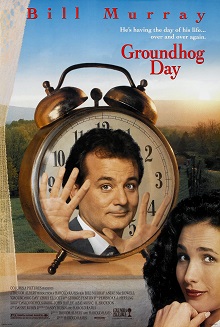
“Groundhog Day is a film that finds its note and purpose so precisely that its genius may not be immediately noticeable. It unfolds so inevitably, is so entertaining, so apparently effortless, that you have to stand back and slap yourself before you see how good it really is. Certainly I underrated it in my original review; I enjoyed it so easily that I was seduced into cheerful moderation. But there are a few films, and this is one of them, that burrow into our memories and become reference points. When you find yourself needing the phrase This is like "Groundhog Day" to explain how you feel, a movie has accomplished something.”
“A long article in the British newspaper the Independent says "Groundhog Day" is "hailed by religious leaders as the most spiritual film of all time." Perhaps not all religious leaders have seen anything by Bergman, Bresson, Ozu and Dreyer, but never mind: They have a point, even about a film where the deepest theological observation is, "Maybe God has just been around a long time and knows everything." What amazes me about the movie is that Murray and Ramis get away with it. They never lose their nerve. Phil undergoes his transformation but never loses his edge. He becomes a better Phil, not a different Phil. The movie doesn't get all soppy at the end. There is the dark period when he tries to kill himself, the reckless period when he crashes his car because he knows it doesn't matter, the times of despair. We see that life is like that. Tomorrow will come, and whether or not it is always Feb. 2, all we can do about it is be the best person we know how to be. The good news is that we can learn to be better people. There is a moment when Phil tells Rita, "When you stand in the snow, you look like an angel." The point is not that he has come to love Rita. It is that he has learned to see the angel.”