Robert T. Bakker on Hadrosaurs
← Back to Robert T. Bakker Profile
“No living reptile has cheeks. But no living reptile has grinding teeth anything remotely resembling those of a duckbill. If the duckbills could have evolved such unreptilian teeth, why couldn't they have evolved unreptilian teeth?”
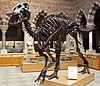
“There may be some ground for believing that brontosaurs ate... soft foods. If the possibility of gizzard stones is ignored, the brontosaurs' dentition does seem little equipped to deal with meals of tougher plants. But there are no ground whatsoever for believing it of duckbills. The mouth of a duckbill dinosaur contained one of the efficient cranial Cusinarts in land-vertebrate history. Duckbill teeth and jaws were incomparable grinders, designed to cope with foods right inside the duckbill's oral compartment.”
“The sum of evolutionary evidence is thoroughly damning. In nearly every modification of the evolutionary process made in the duckbills as they developed from their dryosaur ancestors, the duckbills suffered a diminution of their swimming potential. Their fore- and hind paws became shorter and more compact, not longer and more widely spread. Their tails got weaker and stiffer. Far from being the best, the duckbills must have been the clumsiest and slowest swimmers in all the Dinosauria. If pressed, they probably could paddle slowly from one riverbanck to another. The central theme of their bodily evolution was indeed specialized - orthodox theory was right on that point - but the direction of specialization was landward. These dinosaurs were specialized for a totally terrestrial existence.”
“Duckbills were supposedly croc-style swimmers, moving by strong, easy, side-to-side flexures of their tail. Therefore, the optimal design would feature vertical tail spines. But duckbill spines all slanted strongly backward, exactly as in land-living lizards, not in swimmers. Another problem in the duckbill's swimming equipment lies in the profile of the tail. The deepest part of the croc's tail is close to the end, because the end swings through a wider arc than does the base in moving side to side. Thus the tail is deepest where it can do the most good in pushing against the water. All powerful tail-scullers have such deep tail ends. But duckbill tails were deepest at the hips and become progressively narrower from top-to-bottom toward the tip - another caudal feature nearly totally maladapted for its primary function.”