Link Copied!
Robert Musil Quotes (1880-1942)
Writer
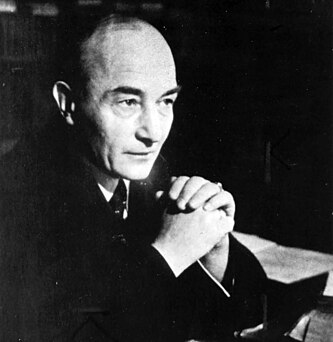

About Robert Musil
Robert Mathias Edler von Musil (6 November 1880 – 15 April 1942) was an Austrian writer. His unfinished long novel The Man Without Qualities is generally considered to be one of the most important modernist novels.
Best Robert Musil Quotes
Shortest
Earliest
Explore our curated collection of the most famous and impactful Robert Musil quotes.
“Mathematics is the bold luxury of pure reason, one of the few that remain today.”
“[T]he restricting of intellectual and spiritual needs to the mania of progress...”

“Wir haben nicht zuviel Verstand und zu wenig Seele, sondern wir haben zu wenig Verstand in den Fragen der Seele.”
“In their field they [mathematicians] do what we ought to be doing in ours. Therein lies the significant lesson … of their existence. They are an analogy for the intellectual of the future.”

“With its claims to profundity, boldness and originality, thinking still limits itself provisionally to the exclusively rational and scientific. … As soon as it lays hold of the feelings, it becomes spirit.”
“For what do we do on the Last Day, when the works of humankind are weighted, with three treatises on formic acid, or even thirty? On the other hand, what do we know about the Last Day, if we don't even know what can be done with formic acid between now and then?”
“Believe me, what makes the human being truly free, and what takes away his freedom, what gives him true bliss and what destroys it, isn't subject to 'progress'--it is something every genuinely alive person knows perfectly well in his own heart, if he will just listen to it!”
“Ich bin nicht nur überzeugt, dass das, was ich sage, falsch ist, sondern auch das, was man dagegen sagen wird. Trotzdem muss man anfangen, davon zu reden. Die Wahrheit liegt bei einem solchen Gegenstand nicht in der Mitte, sondern rundherum wie ein Sack, der mit jeder neuen Meinung, die man hineinstopft, seine Form ändert, aber immer fester wird!”

“At home these men’s works [Kant, Schiller, Goethe] were kept in the bookcase with the green glass panes in Papa’s study, and Törless knew this bookcase was never opened except to display its contents to a visitor. It was like the shrine of some divinity to which one does not readily draw nigh and which one venerates only because one is glad that thanks to its existence there are certain things one need no longer bother about.”
“There is nothing more deplorable than those skeptics and reformers, liberal priests and humanistically-oriented scholars, who moan about “soullessness,” “barren materialism,” what is “unsatisfying in mere science,” and the “cold play of atoms,” and renounce intellectual precision, which is for them only a slight temptation. Then, with the help of some alleged “emotional knowledge” to satisfy the feelings, and with the “necessary” harmony and rounding-out of the world picture, all they invent is some universal spirit: a world-soul, or a God, who is nothing more than the world of the academic petite bourgeoisie which gives rise to him; at best, an oversoul who reads the newspaper and demonstrates a certain appreciation of social questions.”

“To pass freely through open doors, it is necessary to respect the fact that they have solid frames. This principle, by which the old professor had always lived is simply a requisite of the sense of reality. But if there is a sense of reality, and no one will doubt that it has its justification for existing, then there must also be something we can call a sense of possibility. Whoever has it does not say, for instance: Here this or that has happened, will happen, must happen; but he invents: Here this or that might, could, or ought to happen. If he is told that something is the way it is, he will think: Well, it could probably just as well be otherwise. So the sense of possibility could be defined outright as the ability to conceive of everything there might be just as well, and to attach no more importance to what is than to what is not.”
“If there is a sense of reality, there must also be a sense of possibility. To pass freely through open doors, it is necessary to respect the fact that they have solid frames. This principle, by which the old professor had lived, is simply a requisite of the sense of reality. But if there is a sense of reality, and no one will doubt that it has its justifications for existing, then there must also be something we can call a sense of possibility. Whoever has it does not say, for instance: Here this or that has happened, will happen, must happen; but he invents: Here this or that might, could, or ought to happen. If he is told that something is the way it is, he will think: Well, it could probably just as well be otherwise. So the sense of possibility could be defined outright as the ability to conceive of everything there might be just as well, and to attach no more importance to what is than to what is not.”

“If someone were to discover, for instance, that under hitherto unobserved circumstances stones were able to speak, it would take only a few pages to describe and explain so earth-shattering a phenomenon. On the other hand, one can always write yet another book about positive thinking, and this is far from being of only academic interest, since it involves a method that makes it impossible ever to arrive at a clear resolution of life's most important questions. Human activities might be graded by the quantity of words required: the more words, the worse their character. All the knowledge that has led our species from wearing animal skins to people flying, complete with proofs, would fill a handful of reference books, but a bookcase the size of the earth would not suffice to hold all the rest, quite apart from the vast discussions that are conducted not with the pen but with the sword and chains. The thought suggests itself that we carry on our human business in a most irrational manner when we do not use those methods by which the exact sciences have forged ahead in such exemplary fashion.”

“His appearance gives no clue to what his profession might be, and yet he doesn't look like a man without a profession either. Consider what he's like: He always knows what to do. He knows how to gaze into a woman's eyes. He can put his mind to any question at any time. He can box. He is gifted, strong-willed, open-minded, fearless, tenacious, dashing, circumspect — why quibble, suppose we grant him all those qualities — yet he has none of them! They have made him what he is, they have set his course for him, and yet they don't belong to him. When he is angry, something in him laughs. When he is sad, he is up to something. When something moves him, he turns against it. He'll always see a good side to every bad action. What he thinks of anything will always depend on some possible context — nothing is, to him, what it is: everything is subject to change, in flux, part of a whole, of an infinite number of wholes presumably adding up to a super-whole that, however, he knows nothing about. So every answer he gives is only a partial answer, every feeling an opinion, and he never cares what something is, only 'how' it is — some extraneous seasoning that somehow goes along with it, that's what interests him.”
“Questions and answers click into each other like cogs of a machine. Each person has nothing but quite definite tasks. The various professions are concentrated at definite places. One eats while in motion. Amusements are concentrated in other parts of the city. And elsewhere again are the towers to which one returns and finds wife, family, gramophone, and soul. Tension and relaxation, activity and love are meticulously kept separate in time and are weighed out according to formulae arrived at in extensive laboratory work. If during any of these activities one runs up against a difficulty, one simply drops the whole thing; for one will find another thing or perhaps, later on, a better way, or someone else will find the way that one has missed. It does not matter in the least, but nothing wastes so much communal energy as the presumption that one is called upon not to let go of a definite personal aim. In a community with energies constantly flowing through it, every road leads to a good goal, if one does not spend too much time hesitating and thinking it over. The targets are set up at a short distance, but life is short too, and in this way one gets a maximum of achievement out of it. And man needs no more for his happiness; for what one achieves is what moulds the spirit, whereas what one wants, without fulfillment, only warps it. So far as happiness is concerned it matters very little what one wants; the main thing is that one should get it. Besides, zoology makes it clear that a sum of reduced individuals may very well form a totality of genius.”

Robert Musil Quotes by Topic
Find exactly what you are looking for by browsing this categorized list of Robert Musil quotes by topic.
Robert Musil on Mathematics 3 quotes
“Mathematics is the bold luxury of pure reason, one of the few that remain today.”
Robert Musil on Modernity
“Modernism is the attempt to permeate religion with middle-class reason.”

Robert Musil on Zoology
Robert Musil on Dialectic
“I am not only convinced that what I say is false, but also that what one might say against it is false. Despite this, one must begin to talk about it. In such a case the truth lies not in the middle, but rather all around, like a sack, which, with each new opinion one stuffs into it, changes its form, and becomes more and more firm.”
Robert Musil on Classics
“At home these men’s works [Kant, Schiller and Goethe] were kept in the bookcase with the green glass panes in Papa’s study, and Törless knew this bookcase was never opened except to display its contents to a visitor. It was like the shrine of some divinity to which one does not readily draw nigh and which one venerates only because one is glad that thanks to its existence there are certain things one need no longer bother about.”
Robert Musil on Books
“At home these men’s works [Kant, Schiller, Goethe] were kept in the bookcase with the green glass panes in Papa’s study, and Törless knew this bookcase was never opened except to display its contents to a visitor. It was like the shrine of some divinity to which one does not readily draw nigh and which one venerates only because one is glad that thanks to its existence there are certain things one need no longer bother about.”
Robert Musil on World Soul
“There is nothing more deplorable than those skeptics and reformers, liberal priests and humanistically-oriented scholars, who moan about “soullessness,” “barren materialism,” what is “unsatisfying in mere science,” and the “cold play of atoms,” and renounce intellectual precision, which is for them only a slight temptation. Then, with the help of some alleged “emotional knowledge” to satisfy the feelings, and with the “necessary” harmony and rounding-out of the world picture, all they invent is some universal spirit: a world-soul, or a God, who is nothing more than the world of the academic petite bourgeoisie which gives rise to him; at best, an oversoul who reads the newspaper and demonstrates a certain appreciation of social questions.”
Robert Musil on Precision
“There is nothing more deplorable than those skeptics and reformers, liberal priests and humanistically-oriented scholars, who moan about “soullessness,” “barren materialism,” what is “unsatisfying in mere science,” and the “cold play of atoms,” and renounce intellectual precision, which is for them only a slight temptation. Then, with the help of some alleged “emotional knowledge” to satisfy the feelings, and with the “necessary” harmony and rounding-out of the world picture, all they invent is some universal spirit: a world-soul, or a God, who is nothing more than the world of the academic petite bourgeoisie which gives rise to him; at best, an oversoul who reads the newspaper and demonstrates a certain appreciation of social questions.”
Robert Musil on Catholic Church
“It is impossible to enumerate how thoroughly Catholicism today is saturated by middle-class reasonableness; one need only recall how even baptism—once the most powerful expression of the church’s opposition to the state, a symbol of entry into a spiritual countercommunity, a mystical adoption, less the bearing of a name than being led by means of a name on the first steps of one’s inner way—is today bound up with middle-class record-keeping: with the identity card, the need for an enduring characterization resting on the firm distinctions of compelling reason; which means that being a person is made impossible by the “individual,” that incalculable spiritual and intellectual destiny that tears away the protective covering of the soul’s anonymity and drives it to mindlessly repetitious, merely defensive expenditures of energy and renders inaccessible to it everything it might do if it did not always first have to look after a person.”

Robert Musil on Baptism
“It is impossible to enumerate how thoroughly Catholicism today is saturated by middle-class reasonableness; one need only recall how even baptism—once the most powerful expression of the church’s opposition to the state, a symbol of entry into a spiritual countercommunity, a mystical adoption, less the bearing of a name than being led by means of a name on the first steps of one’s inner way—is today bound up with middle-class record-keeping: with the identity card, the need for an enduring characterization resting on the firm distinctions of compelling reason; which means that being a person is made impossible by the “individual,” that incalculable spiritual and intellectual destiny that tears away the protective covering of the soul’s anonymity and drives it to mindlessly repetitious, merely defensive expenditures of energy and renders inaccessible to it everything it might do if it did not always first have to look after a person.”
Robert Musil on Constantinian shift
“It is impossible to enumerate how thoroughly Catholicism today is saturated by middle-class reasonableness; one need only recall how even baptism—once the most powerful expression of the church’s opposition to the state, a symbol of entry into a spiritual countercommunity, a mystical adoption, less the bearing of a name than being led by means of a name on the first steps of one’s inner way—is today bound up with middle-class record-keeping: with the identity card, the need for an enduring characterization resting on the firm distinctions of compelling reason; which means that being a person is made impossible by the “individual,” that incalculable spiritual and intellectual destiny that tears away the protective covering of the soul’s anonymity and drives it to mindlessly repetitious, merely defensive expenditures of energy and renders inaccessible to it everything it might do if it did not always first have to look after a person.”

About Robert Musil
Robert Mathias Edler von Musil (6 November 1880 – 15 April 1942) was an Austrian writer. His unfinished long novel The Man Without Qualities is generally considered to be one of the most important modernist novels.