Link Copied!
Robert Heilbroner Quotes (1919-2005)

About Robert Heilbroner
Robert Heilbroner (March 24, 1919 – January 4, 2005) was an American economist and historian of economic thought.
Best Robert Heilbroner Quotes
Shortest
Earliest
Explore our curated collection of the most famous and impactful Robert Heilbroner quotes.
“Nobody wanted this commercialization of life.”


“The total amount of electric power generated by India would not suffice to light up New York City.”
“The distribution of wealth, therefore, depends on the laws and customs of society.”

“He who enlists a man's mind wields a power even greater than the sword or the scepter.”
“But like Marx, Veblen badly underestimated the capacity of a democratic system to correct its own excesses.”
“But while Ricardo, the economist, walked like a god (although he was a modest and retiring person), Malthus was relegated to a lower status.”

“If an economy in the doldrums could drift indefinitely, the price of government inaction might be graver by far than the consequences of bold unorthodoxy.”

“But despite the clarion words of the Manifesto, the demonic note was not a call for a revolution of communism; it was a cry born only of frustration and despair.”

“To one American family out of four, the idea of capitalism as a benign system of comfort, dignity, and personal advance is only a myth, or worse, a bitter mockery.”

“For it is certain that the future will bring realities for which our traditional optimism fails to prepare us and against which our economic momentum fails to arm us.”

“Today and over the foreseeable future,traditional capitalism throughout most of the world has been thrown on a defensive from which it is doubtful that it can never recover.”
“The rise of the welfare state, on the one hand, and of the military bureaucracy, on the other, are instances of the manner in which technology is enforcing a socialization of life.”

“In the end the question is: Who is to be master, man or his machines? As long as the control over technology rests primarily on economic calculation, the victor is not likely to be man.”

“In the periods of crisis, the bigger firms absorb the smaller ones, and when the industrial monsters eventually go down, the wreckage is far greater than when the little enterprises buckle.”


“It is one of the dangerous self-deceptions of our society to pretend that mechanisms of control do not really exist, and to maintain, without qualification, that we are an economically "free" people.”
“For one who has read the works of Marx it is frightening to look back at the grim determination with which so many nations steadfastly hewed to the very course which he insisted would lead to their undoing.”
Robert Heilbroner Quotes by Topic
Find exactly what you are looking for by browsing this categorized list of Robert Heilbroner quotes by topic.
Robert Heilbroner on Economic growth
“The secret to economic growth lay in the fact that that each generation attacked Nature not only with its own energies and resources, but with the heritage of equipment accumulated by its forebears.”
Robert Heilbroner on New Deal
“Even today-in blithe disregard to his actual philosophy- Smith is generally regarded as a conservative economist, whereas in fact, he is more avowedly hostile to the motives of businessman then most New Deal economists.”

Robert Heilbroner on Division of labor
“There is hardly any need to point out how infinitely more complex present-day production methods are than those of the eighteenth century. Smith, for all his disclaimers, was sufficiently impressed with a small factory of ten people to write about it; what would he have thought of one employing ten thousand! But the great gift of the division of labor is not its complexity—indeed it simplifies most toil. Its advantage lies in its capacity to increase what Smith calls “that universal opulence which extends itself to the lowest ranks of the people.” That universal opulence of the eighteenth century looks like a grim existence from our modern vantage point. But if we view the matter in its historical perspective, if we compare the lot of the workingman in eighteenth-century England with that of his predecessor a century or two before, it is clear that, mean as his existence was, it constituted a considerable advance.”

Robert Heilbroner on Market
“And today? Does the competitive market mechanism still operate? This is not a question to which it is possible to give a simple answer. The nature of the market has changed vastly since the eighteenth century. We no longer live in a world of atomistic competition in which no man can afford to swim against the current. Today’s market mechanism is characterized by the huge size of its participants: giant corporations and strong labor unions obviously do not behave as if they were individual proprietors and workers. Their very bulk enables them to stand out against the pressures of competition, to disregard price signals, and to consider what their self-interest shall be in the long run rather than in the immediate press of each day’s buying and selling. That these factors have weakened the guiding function of the market mechanism is apparent. But for all the attributes of modern-day economic society, the great forces of self-interest and competition, however watered down or hedged about, still provide basic rules of behavior that no participant in a market system can afford to disregard entirely. Although the world in which we live is not that of Adam Smith, the laws of the market can still be discerned if we study its operations.”
What Robert Heilbroner Said About Others
Discover personal opinions Robert Heilbroner shared regarding contemporaries.
Robert Heilbroner on Adam Smith 8 quotes
“Perhaps no economist will ever again so utterly encompass his age as Adam Smith. Certainly none was ever so serene, so devoid of contumacy, so penetratingly critical without rancor, and so optimistic without being utopian.”

Robert Heilbroner on Karl Marx 2 quotes
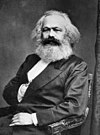
“But had Marx not lived there would have been other socialists and other prophets of a new society.”
Robert Heilbroner on Thomas Robert Malthus
“In 1860, sixty-three per cent of the couples married in Great Britain had families of four or more children; in 1925 only twenty per cent had more than four.”

Robert Heilbroner on Ludwig von Mises
“It turns out, of course, that Mises was right. The Soviet system has long been dogged by a method of pricing that produced grotesque misallocations of effort. The difficulties were not so visible in the early days of Soviet industrialization or in the post-Second World War reconstruction period. The dams and mills and entire new cities of the nineteen-thirties astonished the world, as did the Chinese Great Leap Forward of the nineteen-fifties, which performed similar miracles from a still lower base. But those undertakings, like the building of the Pyramids or the Great Wall, depended less on economic coordination than on the political capacity for marshalling vast labor forces. Inefficiency set in when projects had to be joined into a complex whole – a process that required knowing how much things should cost. As Mises foresaw, setting prices became a hopeless problem, because the economy never stood still long enough for anyone to decide anything correctly.”

Robert Heilbroner on William Godwin
“What is striking about the population question to our modern eyes is not whether England actually was or was not in danger of petering out as a nation. In retrospect, what is interesting is how harmonious either view of the population problem was with a vision that puts its faith in natural law, reason, and progress. Was the population declining? Then it should be encouraged to grow, as it “naturally” would under the benign auspices of the laws that Adam Smith had shown to be the guiding principles of a free market economy. Was the population growing? All to the good, since everyone agreed that a growing population was a source of national wealth. No matter which way one cut the cake, the result was favorable to an optimistic prognosis for society; or, to put it differently, there was nothing in the population question, as it was understood, to shake men’s faith in their future. Perhaps no one summed up this optimistic outlook so naively and completely as William Godwin. Godwin, a minister and pamphleteer, looked at the heartless world about him and shrank back in dismay. But he looked into the future and what he saw was good. In 1793 he published Political Justice, a book that excoriated the present but gave promise of a distant future in which “there will be no war, no crime, no administration of justice, as it is called, and no government. Besides this there will be no disease, anguish, melancholy, or resentment.” What a wonderful vision! It was, of course, highly subversive, for Godwin’s utopia called for complete equality and for the most thoroughgoing anarchic communism: even the property contract of marriage would be abolished. But in view of the high price of the book (it sold for three guineas) the Privy Council decided not to prosecute the author, and it became the fashion of the day in the aristocratic salons to discuss Mr. Godwin’s daring ideas.”

About Robert Heilbroner
Robert Heilbroner (March 24, 1919 – January 4, 2005) was an American economist and historian of economic thought.