Link Copied!
Robert Grosseteste Quotes (1175-1253)
Philosopher, Poet, Scientist
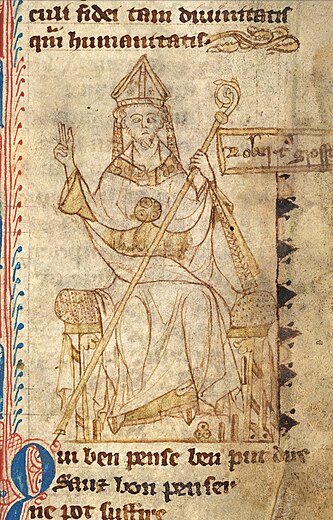

About Robert Grosseteste
Robert Grosseteste (c. 1175 – 1253) was an English statesman, scholastic philosopher, theologian, scientist, pastor, poet, educator and Bishop of Lincoln, Province of Canterbury, England. From about 1220 to 1235 he wrote a host of scientific treatises and was an early supporter of what was to become the scientific method. Roger Bacon expressed his indebtedness to the work of Grosseteste and A.C. Crombie describes him as "the real founder of the tradition of scientific thought in medieval Oxford..."
Best Robert Grosseteste Quotes
Shortest
Earliest
Explore our curated collection of the most famous and impactful Robert Grosseteste quotes.
“The head is borne towards the heavens and has two lights, as it were the sun and moon.”

“The diligent investigator of natural phenomena can give the causes of all natural effects... by the rules and roots and foundations given from the power of geometry.”
“Power from natural agents may go by a short line, and then in its activity greater... But if by a straight line then its action is stronger and better, as Aristotle says in Book V of the Physics, because nature operates in the shortest way possible. But the straight line is the shortest of all, as he says in the same place.”
“The consideration of lines, angles and figures is of the greatest utility since it is impossible for natural philosophy to be known without them... All causes of natural effects have to be given through lines, angles and figures, for otherwise it is impossible for the reason why (propter quid) to be known in them.”
“This part of optics, when well understood, shows us how we may make things a very long distance off appear as if placed very close, and large near things appear very small, and how we may make small things placed at a distance appear any size we want, so that it may be possible for us to read the smallest letters at incredible distances, or to count sand, or seed, or any sort of minute objects.”
“The highest part of the human soul, which is called the intelligence and which is not the act of any body and does not need for its proper operation a corporeal instrument—this intelligence, if it were not obscured and weighed down by the mass of the body, would itself have complete knowledge from the irradiation received from the superior light without the help of sense, just as it will have when the soul is drawn forth from the body, and as perhaps those people have who are free from the love and the imaginings of corporeal things.”
“I say that it is possible to have some knowledge without the help of the senses. For in the Divine Mind all knowledge exists from eternity, and not only is there in it certain knowledge of universals but also of all singulars. ...Similarly, intelligence receiving irradiation from the primary light see all knowable things, both universal and singulars, in the primary light itself. Moreover, the Divine Mind, in the reflection of its intelligence upon Itself, knows the very things which come after Itself, because it is itself their cause. Therefore, those who are without any senses have true knowledge.”

“That is better and more valuable which requires fewer, other circumstances being equal, just as that demonstration is better, other circumstances being equal, which necessitates the answering of a smaller number of questions for a perfect demonstration or requires a smaller number of suppositions and premises from which the demonstration proceeds. For if one thing were demonstrated from many and another thing from fewer equally known premisses, clearly that is better which is from fewer because it makes us know quickly, just as a universal demonstration is better than particular because it produces knowledge from fewer premises. Similarly in natural science, in moral science, and in metaphysics the best is that which needs no premisses and the better that which needs the fewer, other circumstances being equal.”
“Because the purity of the eye of the soul is obscured and weighed down by the corrupt body, all the powers of this rational soul born in man are laid hold of by the mass of the body and cannot act and so in a way are asleep. Accordingly, when in the process of time the senses act through many interactions of sense with sensible things, the reasoning is awakened mixed with these very sensible things and is borne along in the senses to the sensible things as in a ship. But the functioning reason begins to divide and separately consider what in sense were confused. ...But the reasoning does not know this to be actually universal except after it has made this abstraction from many singulars, and has reached one and the same universal by its judgement taken from many singulars.”
“I hold that the first form of a body is the first corporeal mover. But this is light, which as it multiplies itself and expands without the body of matter moving with it, makes its passage instantaneously through the transparent medium and is not motion but a state of change. But, indeed, when light is expanding itself in different directions it is incorporated with matter, if the body of matter extends with it, and it makes a rarefaction or augmentation of matter; for when light is itself charged with the body of matter, it produces condensation or rarefaction. So when light generates itself in one direction drawing matter with it, it produces local motion; and when light within matter is sent out and what is outside is sent in, it produces qualitative change. From this it is clear that corporeal motion is a multiplicative power of light, and this is a corporeal and natural appetite.”

“The experimental universal is acquired by us, whose mind's eye is not purely spiritual, only through the help of the senses. For when the senses several times observe two singular occurrences, of which one is the cause of the other or is related to it in some other way, and they do not see the connection between them... And from this perception repeated again and again and stored in memory, and from the sensory knowledge from which the perception is built up, the functioning of the reasoning begins. The functioning reason therefore begins to wonder and to consider whether things really are as the sensible recollection says, and these two lead the reason to experiment... But when he has administered many times with the sure exclusion of all other things [that could be mistaken for the cause]... then there is formed in the reason this universal... and this is the way in which it comes from sensation to a universal experimental principle.”
“And since the proportions of the human voice and the gesticulations of the human body are regulated by the same modulation as that by which sound and the motion of other bodies are, musical thought is subalternated not only to the harmony of human voice and gesticulation, but also of instruments and of those whose delectation consist in motion or sound and with these the harmony of the celestial and non-celestial. And since the concordance of times and the composition and harmony of the lower world and of all things composed of four elements come from celestial motions, and, moreover, since it is necessary to find the harmony of causes in their effects, the study of music also extends to knowing the proportions of times and the constitution of the elements of the lower world, and even the composition of all the elements.”
“One cause, in so far as it is one, is productive of only one effect. I do not rule out several efficient causes of which one is nearer and another more remote in the same order. Thus when I say simply 'animal', I do not exclude another substance or particular substance. Hence motion, in so far as it is one, is productive of only one effect. But motion is present in every body from an intrinsic principle which is called natural. Therefore an efficient cause simply proportional to the motion is present in all bodies. But nothing is present in common in every body except primitive matter and primitive form and magnitude, which necessarily follows from these two, and whatever is entailed by magnitude as such, as position and shape. But simply through magnitude a body does not receive motion, as is clear enough when Aristotle shows that everything that moves is divisible, not, therefore, simply because of magnitude or something entailed by magnitude is a body productive of motion. Nor is primitive matter productive of motion, because it is itself passive. It is therefore necessary that motion follow simply from the primitive form as from an efficient cause.”

“Ostensive demonstration is that which concludes directly to that which is in question. Reduction ad impossibile is that which, when something the opposite of that which is in question has been assumed, concludes with some other proposition directly to a known and manifest impossibility, from the opposite of which the investigator is led back to the original proposition in question. But there is a difference between ostensive demonstration and reduction ad impossibile, because the former proves from things prior in the order of nature but the latter from things posterior in the order of nature. When things prior in nature are better known in the intellect of the person making the demonstration the process is carried out ostensively; but when posterior things are better known to his intellect then the demonstration is carried out per impossibile... in demonstration carried out per impossibile the showing of the original thing in question is carried out by means of things posterior to it in the order of nature... And there is in the contrary, falsely supposed in predicate of subject, a connecting term by which something is implied to be which impossible in the nature of things.”
“The first corporeal form, which some call corporeity, I hold to be light. For light of its own nature diffuses itself in all directions, so that from a point of light a sphere of light of any size may be instantly generated, provided an opaque body does not get in the way. Corporeity is what necessarily follows the extension of matter in three dimensions, since each of these, that is corporeity and matter, is a substance simple in itself and lacking all dimensions. But simple form in itself and in dimension lacking matter and dimension, it was impossible for it to become extended in every direction except by multiplying itself and suddenly diffusing itself in every direction and in its diffusion extending matter; since it is not possible for form to do without matter because it is not separable, nor can matter itself be purged of form. And, in fact, it is light, I suggest, of which this operation is part of the nature, namely, to multiply itself and instantaneously diffuse itself in every direction. Therefore, whatever it is that produces this operation is either light itself or something that produces this operation in so far as it participates in light, which produces it by its own nature. Corporeity is therefore either this light, or is what produces the operation in question and produces dimensions in matter in so far as it participates in this light itself and acts by virtue of this same light. But for the first form to produce dimensions in matter by virtue of a subsequent form is impossible. Therefore light is not the form succeeding this corporeity, but is this corporeity itself.”

Robert Grosseteste Quotes by Topic
Find exactly what you are looking for by browsing this categorized list of Robert Grosseteste quotes by topic.
Robert Grosseteste on Science
“That is better and more valuable which requires fewer, other circumstances being equal, just as that demonstration is better, other circumstances being equal, which necessitates the answering of a smaller number of questions for a perfect demonstration or requires a smaller number of suppositions and premises from which the demonstration proceeds. For if one thing were demonstrated from many and another thing from fewer equally known premisses, clearly that is better which is from fewer because it makes us know quickly, just as a universal demonstration is better than particular because it produces knowledge from fewer premises. Similarly in natural science, in moral science, and in metaphysics the best is that which needs no premisses and the better that which needs the fewer, other circumstances being equal.”

Quotes About Robert Grosseteste
Gain deeper perspective through quotes about Robert Grosseteste from others.
Roger Bacon on Robert Grosseteste 5 quotes
“The Greek and Hebrew he did not know sufficiently to translate them unassisted, but he had many assistants.”

Carl B. Boyer on Robert Grosseteste 2 quotes
“Robert Grosseteste... was born at the decisive moment when Greek and Arabic science became accessible in Latin versions.”
Robert de Brune on Robert Grosseteste
“I shall tell, as I have herd Of the byshop Saint Roberd; His tonaine is Grossteste, Of Lyncolne so seyth the geste: He loved moche to here the harpe, For mannes wit it makyth sharpe; Next hys chamber, besyde hys study Hys harper's chamber was fast the by. Many tymes, by nightes and dayes, He hadd solace of notes and layes. On asked hyme the reason why He had delyte in mynstrelsy; He answered hym in this manere Why he held the harpe so dere: The virtu of the harpe, through skyll and ryght, Will destrye the fendy's myght; And to the cros, by gode skeyl, Ys the harpe lykened well.”
A.C. Crombie on Robert Grosseteste 5 quotes
“Grosseteste's contribution was to emphasize the importance of falsification in the search for true causes and to develop the method of verification and falsification into a systematic method of experimental procedure.”
Dean on Robert Grosseteste
“[Grosseteste] far surpassed all the philosophers of his time, and outstripped all theologians in divine knowledge and doctrine. His most famous works remain to testify this to scholars of our day, and by virtue of his genius, which was wonderfully strengthened by divine grace, he might say 'I have more understanding than all my teachers.' But most of all did he excel in humility, simplicity, and sanctity, so that he passed his life in innocency, chastity, and purity.”
Edward I's on Robert Grosseteste
“[Grosseteste is] excelling in merits, illustrious for holiness of life, like the morning star discerned through a gap in the clouds, like a candle not put under a bushel, but on a candlestick, that all may see the light.”
Philip Fisher on Robert Grosseteste
“In the thirteenth century Robert Grosseteste wrote a book on the rainbow that began an outburst of European speculation parallel to the equally rich Arab work.”
Hugh G. Gauch on Robert Grosseteste
“Robert Grosseteste affirmed and refined Aristotle's inductive-deductive method, which he termed the Method of Resolution and Composition for its inductive and deductive components, respectively. But he added to Aristotle's methods of induction. His purposes were to verify true theories and to falsify false theories. Causal laws were suspected when certain phenomena were frequently correlated, but natural science sought robust knowledge of real causes, not accidental correlations. ...His approach used deduction to falsify proposed but defective inductions. ...Grosseteste's Method of Verification deduced consequences of a theory beyond its original application and then checked those predictions experimentally. His Method of Falsification eliminated bad theories by deducing implications known to be false. Grosseteste clearly understood that his optimistic view of induction required two metaphysical presuppositions about the nature of physical reality: the uniformity of nature and the principle of parsimony or simplicity. Without those presuppositions, there is no defensible method of induction in particular or method of science in general.”
Raymond L. Lee on Robert Grosseteste 2 quotes
“Although Grosseteste's science could be decidedly Aristotelian, he also was clearly an independent thinker. For example, Grosseteste viewed light as metaphysical phenomenon, holding that God created light as the universe's first, incipient material form, and that light subsequently diffused from a single point to create the natural world. There were several precedents for this Neoplatonic belief in light as the primeval manifestation of God, among them the writings of Saint Augustine. Thus for Grosseteste the study of light and optics was a means of understanding God's handiwork.”
Neil Lewis on Robert Grosseteste
“Grosseteste was deeply concerned with the detailed investigation of natural phenomena. It was the inspiration of this attitude of mind, together with Grosseteste's emphasis on the importance of mathematics, that was perhaps his chief legacy to thinkers in fourteenth-century Oxford who were developing the beginnings of a mathematical physics.”
Dr. Luard on Robert Grosseteste
“There is scarcely a character in English history whose fame has been more constant, both during and after his life, than Robert Grosseteste, Bishop of Lincoln from 1235 to 1253. As we find his advice sought universally during his lifetime, and his example spoken of as that which almost all the other prelates of his day followed, so was it also after his death. If threats from Rome and excommunications from Canterbury fell harmlessly upon him while alive, his example nerved others in subsequent years—as in the case of Sewal, Archbishop of York—to bear even worse attacks without giving way. And probably no one has had a greater influence upon English thought and English literature for the two centuries which followed his time; few books will be found that do not contain some quotations from Lincolniensis, 'the great clerk, Grostest.'”
About Robert Grosseteste
Robert Grosseteste (c. 1175 – 1253) was an English statesman, scholastic philosopher, theologian, scientist, pastor, poet, educator and Bishop of Lincoln, Province of Canterbury, England. From about 1220 to 1235 he wrote a host of scientific treatises and was an early supporter of what was to become the scientific method. Roger Bacon expressed his indebtedness to the work of Grosseteste and A.C. Crombie describes him as "the real founder of the tradition of scientific thought in medieval Oxford..."