Link Copied!
Rensis Likert Quotes (1903-1981)
King



About Rensis Likert
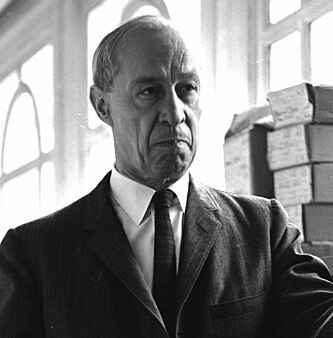
Rensis Likert (5 August 1903 – 3 September 1981) was an American administrator and organizational psychologist. His book New Patterns of Management (1961) is listed by Bedeian & Wren (2001) among "The 25 Most influential management books of the 20th century."
Best Rensis Likert Quotes
Shortest
Earliest
Explore our curated collection of the most famous and impactful Rensis Likert quotes.
“Interaction and decision making rely heavily on group processes.”
“The superior in one group is a subordinate in the next group, and so on through the organization.”
“As people acquire more education, their expectations rise as to the amount of responsibility, authority, and income they receive.”

“All component parts of any system of management must be consistent with each of the other parts and reflect the system's basic philosophy.”

“How best to organize the efforts of individuals to achieve desired objectives has long been one of the world's most important, difficult, and controversial problems.”
“To be effective in leading his own work group, a superior must be able to influence his own boss, that is he needs to be skilled both as a superior and as a subordinate.”
“As tasks become more varied and require greater training and skill, the relationship (between job attitudes and performance) appears to change progressively from the negative to positive.”

“Conflict is viewed as the active striving for one's own preferred outcome which, if attained, precludes the attainment by others of their own preferred outcome, thereby producing hostility.”
“Research reveal that managers achieving better performance (i.e., greater productivity, higher earnings, lower costs, etc. ) differ in leadership principles and practices from those achieving poorer performance.”
“[It remains to be seen whether the newer management theories, based as they are on research in industrial concerns, will be] equally applicable to other kinds of organized human activity, such as schools, voluntary organizations, unions, hospitals, governmental agencies, scientific and professional organizations, and the like.”

“The leadership and other processes of the organization must be such as to ensure a maximum probability that in all interactions and all interactions and all relationships with the organization each member will, in the light of his background, values, and expectations, view the experience as supportive and one which builds and maintains his sense of personal worth and importance.”
“A number of statistical assumptions are made in the application of his (Thurstone's) attitude scale e.g. that the scale values of the statements are independent of the attitude distribution of the readers who sort the statements assumptions which as Thurstone points out, cannot always be verified. The method is more over laborious. It seems legitimate to enquire whether it actually does its work better than the simple scales which may be employed and the same breath to ask also whether it is not possible to construct equally reliable scales without making unnecessary statistical assumptions.”
“The preceding analysis shows that a manager who has high performance goals and excellent job organization but who relies solely on economic needs and direct pressure to motivate his men is very likely to be to be disappointed by their achievements. The noneconomic motives must be used fully, along with the economic needs, to create high performance goals and establish the level of motivational forces which yield high productivity. Since the principle of supportive relationships and group methods of supervision enable a manager to make effective use of the noneconomic motives, some valuable insights can be obtained by examining how these managerial principles appear to affect the motivations, satisfactions, and behavior of the members of an enterprise. A substantial body of research findings demonstrates that the greater the loyalty of the members of a group toward the group, the greater is the motivation among the members to achieve the goals of the group, and the greater is the probability that the group will achieve its goals.”
“The management system of an organization must have compatible component parts if it is to function effectively. This conclusion has a very important implication; experiments in organizations must involve internally consistent changes. The traditional atomistic research design is not appropriate for experiments involving organizational theory or management systems. Every aspect of a management system is related to every other part and interacts with it.
The results obtained by altering a single variable or procedure while keeping all others the same usually will yield quite different results from those obtained when that variable is changed along with simultaneous and compatible changes in all other aspects of the management system. The true influence of altering one aspect of the system cannot be determined by varying it and it alone... In experiments involving organizational theory and management systems, therefore, a systems approach must be used. The organic integrity of each system must be maintained while experimental variations are being made.”
The results obtained by altering a single variable or procedure while keeping all others the same usually will yield quite different results from those obtained when that variable is changed along with simultaneous and compatible changes in all other aspects of the management system. The true influence of altering one aspect of the system cannot be determined by varying it and it alone... In experiments involving organizational theory and management systems, therefore, a systems approach must be used. The organic integrity of each system must be maintained while experimental variations are being made.”
Rensis Likert Quotes by Topic
Find exactly what you are looking for by browsing this categorized list of Rensis Likert quotes by topic.
Rensis Likert on Job performance 3 quotes
“[Each person] is a member of one or more functioning workgroups that have a high degree of group loyalty, effective skills of interaction and high performance goals.”

Rensis Likert on Group process
“Interaction and decision making relies heavily on group processes.”

Rensis Likert on Industrial and organizational psychology
“Conflict is viewed as the active striving for one's own preferred outcome which, if attained, precludes the attainment by others of their own preferred outcome, thereby producing hostility.”

Rensis Likert on Organizational theory
“The management system of an organization must have compatible component parts if it is to function effectively. This conclusion has a very important implication; experiments in organizations must involve internally consistent changes. The traditional atomistic research design is not appropriate for experiments involving organizational theory or management systems. Every aspect of a management system is related to every other part and interacts with it. The results obtained by altering a single variable or procedure while keeping all others the same usually will yield quite different results from those obtained when that variable is changed along with simultaneous and compatible changes in all other aspects of the management system. The true influence of altering one aspect of the system cannot be determined by varying it and it alone... In experiments involving organizational theory and management systems, therefore, a systems approach must be used. The organic integrity of each system must be maintained while experimental variations are being made.”

About Rensis Likert
Rensis Likert (5 August 1903 – 3 September 1981) was an American administrator and organizational psychologist. His book New Patterns of Management (1961) is listed by Bedeian & Wren (2001) among "The 25 Most influential management books of the 20th century."