Link Copied!
Rajendra Prasad Quotes (1884-1963)
President, Leader
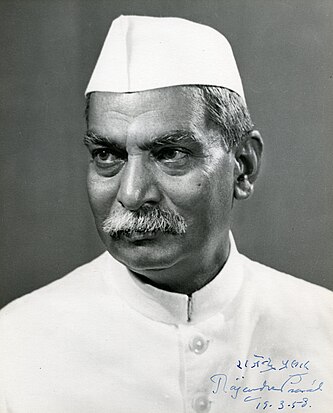


About Rajendra Prasad
Dr Rajendra Prasad (December 3, 1884 – February 28, 1963) was the first President of the Republic of India. An Indian political leader, lawyer by training, Prasad joined the Indian National Congress during the Indian independence movement and became a major leader from the region of Bihar.
Best Rajendra Prasad Quotes
Shortest
Earliest
Explore our curated collection of the most famous and impactful Rajendra Prasad quotes.
“There is no resting place for a nation or a people on their onward march.”
“We have got used to relying on precedents of England to such an extent that it seems almost sacrilegious to have a different interpretation even if our conditions and circumstances might seem to require a different interpretation.”

“Today, for the first time in our long and chequered history, we find the whole of this vast land... brought together under the jurisdiction of one constitution and one union which takes over responsibility for the welfare of more than 320 million men and women who inhabit it.”

“Honourable Members...I ask you, Members, to stand in your places to pay our tribute of respect to Quaid-e-Azam Mohammed Ali Jinnah, who by his grim determination and stead fast devotion was able to carve out and found Pakistan and whose passing away at this moment is an irreparable loss to all.”
“The Head of the State in the British Constitution is a Monarch and the Crown descends according to the rules of heredity. In India the Head of the State is an elected President who holds office for a term and can be removed for misconduct in accordance with the procedure laid down in the Constitution.”

“The executive power of the Union is vested in the President and shall be exercised by him either directly or through officers subordinate to him in accordance with the Constitution. The Supreme Command of the Defence forces of the Union is also vested in him and the exercise thereof shall be regulated by law.”
“Rajendra Prasad has not minced words in pinpointing the Muslim complicity in these riots. “‘Towards the later part of 1922 there occurred serious riots in Multan in which Hindu places of worship were desecrated, many Hindus were killed and many Hindu houses were looted and burnt. This was the first of a large number of communal riots which continued for several years and which occurred in almost all parts of the sountry.’’”

“In his reply to the above, dated 22 November, 1937, Dr. Rajendra Prasad wrote: “I entirely agree with you that no history is worth the name which suppresses or distorts facts. A historian who purposely does so under the impression that he thereby does good to his native country really harms it in the end. Much more so in the case of a country like ours which has suffered much on account of its national defects, and which must know and under- stand them to be able to remedy them.””

“Apart from what I have said, I have been worried by your suggestion that I should send for you and speak to you if I have anything to communicate rather than write. I am afraid this will stultify me in performing my constitutional duty to bring to the notice of the Government any matter which I desire to communicate to it in the way I consider best. I am afraid it may well begin a convention regarding the method of communication which will embarrass not only me but also my successors. I hope you will not mind my frankly expressing this fear which has been weighing on my mind and is responsible for the delay in replying to your letter.”

“Rajendra Prasad has frankly exposed the double standards adopted by the critics of Swami Shraddhananda : “‘The Shuddhi movement of Swami Shraddhananda has come in for a great deal of criticism both from the nationalists and Mussalmans. Whatever one may have to say about its opportuneness as that particular moment, it is difficult to understand how Christians and Mussalmans can object to it on merits. They are constantly engaged in proselytising mission and converting Hindus to their own faiths. If the Hindus on their side also start converting non-Hindus to their faith, it is no business of non-Hindus, specially if they are themselves engaged in the work of con- version, to object. The Hindus must have the same right of propagating their faith as others have.’’”
“Today, with the weapons of mass destruction at man’s disposal, the human race itself is in imminent danger of being destroyed. It is a far cry from vegetarianism to atomic or hydrogen bomb, but if you look at it, there is no escape from vegetarianism ultimately if we want to escape from the hydrogen bomb. Any integrated view of life as a whole will reveal to us the connection between the individual’s food and his behaviour towards others, and through a process of ratiocination which is not fantastic, we cannot but arrive at the conclusion that the only means of escaping the hydrogen bomb is to escape the mentality which has produced it, and the only way to escape that mentality is to cultivate respect for all life, life in all forms, under all conditions. It is only another name for vegetarianism.”

“Our constitution is comparatively a new constitution. It is based largely on the model of the British Constitution. As such it has history if not ancestry, which may well go back to centuries. It is being worked I venture to presume, successfully and to the satisfaction of all concerned although within the short period of 10 years, it has had to undergo not less than 7 amendments...The constitution is largely founded on the British Constitution. There are certain differences which are obvious. The British Constitution is a unitary constitution in which the Parliament is supreme, having no other authority sharing its power of legislation except such as may be delegated. Our constitution is a federal constitution in which the powers and functions of the Union Parliament and the State Legislatures are clearly defined and the one has no power or right to encroach upon the rights and powers reserved to the other.”

“Brothers and sisters, our religious books have mentioned Somnath Mandir as one of the twelve Jyotirlingas (the radiant representation of Lord Shiv). Hence, this temple happened to be the centre of religion, culture and wealth in ancient India and was known all around the world. However, although a centre of faith and worship can be demolished, its source can never wither away. And this is the reason why the flame of worship remained illuminated in the hearts of the Indian people despite the temple being vandalised. The dream of those people is now being met as the PRAN-PRATISTHA is being carried out in the presence of people who have come from different parts of the country. The Somnath temple stands today with its head held high proclaiming that one who is loved by the people, and for whom people carry faith and belief in their hearts can never be destroyed by anyone in this world. Come what may, this temple will stand erect till the time people carry faith for this temple in their heart. Today on this sacred and historic day, it is essential for us to understand this significant element of religion to understand further that there are many paths which can take one to the almighty. Unfortunately, this aspect of faith was not correctly recognised in many castes, cultures and communities which led to massive destructions and wars in the name of religion. History has taught us that religious intolerance only spreads hatred and disharmony. It is imperative for every person of this country to understand that we as a nation should always be tolerant of any caste, culture community or ideology and every religion should be properly respected. Keeping these objectives in mind, we have shaped our nation into a secular nation and have guaranteed equality to every religion of the country. On this holy day, we should learn from the PRAN-PRATISHTA of this Somnath Mandir, and all of us should vouch for the re-establishment of the dominance of India in terms of prosperity in the world. Our country was the industrial pioneer in ancient times, the products which were made here were exported all over the world. Our export was higher than the import, and thus India became a land of wealth. The gold and silver which are stored in the treasury of the developed nations were once stored in the temples of India. An example of which is the temple of Somnath. I think that this PRAN-PRATISHTA will only be completed on the day, we reclaim that dominance and do justice to the Somnath Mandir. Moreover, we should also strive to achieve the level of cultural brilliance which we had in the ancient times so that when people judge us by today's culture, they should know that we are still far better than them. Sardar Vallabhai Patel started this work of re-establishment. He played a vital role in uniting the fragmented states of India and wished in his heart that with that re-establishment, we should also re-establish this ancient heritage of India. God has fulfilled his dream today, but his vision will only be completed when India achieves the cultural glory which it had in the primitive era. LONG LIVE INDIA””

Rajendra Prasad Quotes by Topic
Find exactly what you are looking for by browsing this categorized list of Rajendra Prasad quotes by topic.
Rajendra Prasad on Vegetarianism
“Today, with the weapons of mass destruction at man's disposal, the human race itself is in imminent danger of being destroyed. It is a far cry from vegetarianism to atomic or hydrogen bomb, but if you look at it, there is no escape from vegetarianism ultimately if we want to escape from the hydrogen bomb. Any integrated view of life as a whole will reveal to us the connection between the individual's food and his behaviour towards others, and through a process of ratiocination which is not fantastic, we cannot but arrive at the conclusion that the only means of escaping the hydrogen bomb is to escape the mentality which has produced it, and the only way to escape that mentality is to cultivate respect for all life, life in all forms, under all conditions. It is only another name for vegetarianism.”
Rajendra Prasad on Somnath temple
“Brothers and sisters, our religious books have mentioned Somnath Mandir as one of the twelve Jyotirlingas (the radiant representation of Lord Shiv). Hence, this temple happened to be the centre of religion, culture and wealth in ancient India and was known all around the world. However, although a centre of faith and worship can be demolished, its source can never wither away. And this is the reason why the flame of worship remained illuminated in the hearts of the Indian people despite the temple being vandalised. The dream of those people is now being met as the PRAN-PRATISTHA is being carried out in the presence of people who have come from different parts of the country. The Somnath temple stands today with its head held high proclaiming that one who is loved by the people, and for whom people carry faith and belief in their hearts can never be destroyed by anyone in this world. Come what may, this temple will stand erect till the time people carry faith for this temple in their heart..... On this holy day, we should learn from the PRAN-PRATISHTA of this Somnath Mandir, and all of us should vouch for the re-establishment of the dominance of India in terms of prosperity in the world. ... I think that this PRAN-PRATISHTA will only be completed on the day, we reclaim that dominance and do justice to the Somnath Mandir. Moreover, we should also strive to achieve the level of cultural brilliance which we had in the ancient times so that when people judge us by today's culture, they should know that we are still far better than them. Sardar Vallabhai Patel started this work of re-establishment. He played a vital role in uniting the fragmented states of India and wished in his heart that with that re-establishment, we should also re-establish this ancient heritage of India. God has fulfilled his dream today, but his vision will only be completed when India achieves the cultural glory which it had in the primitive era. LONG LIVE INDIA””

Quotes About Rajendra Prasad
Gain deeper perspective through quotes about Rajendra Prasad from others.
Source on Rajendra Prasad 7 quotes
“He was a key campaigner in the nationalist movement of Mahatma Gandhi, along with India's interim Prime Minister, Pandit Jawaharlal Nehru.”
Former Indian bureaucrat on Rajendra Prasad
“Nehru had advised Prasad against going to Somnath. He felt that this would be against the tenets of secularism.”
RNP Singh’s book – “Nehru on Rajendra Prasad
“When it was announced that Rajendra Prasad was attending the inauguration of the Somnath Temple, Jawaharlal vehemently protested against his going to Somnath. But Rajendra Prasad kept his promise.”
In on Rajendra Prasad 12 quotes
“He was the first President of India after country attained Indiasfreedom. He was considered the saint president of our country.”
Mahatma Gandhi’s observations when he [Rajendra Prasad]] volunteered on Rajendra Prasad
Gandhi recalling on the part played by them on Rajendra Prasad
“He [Rajan Babu] and Brij Kishore Babu were a matchless pair. Their devotion made it impossible for me to take a single step without their help.”
Pandit Nehru in on Rajendra Prasad
“We often commit mistakes. Our steps falter, our tongues falter and slip and [but] he who had no occasion to withdraw what he once said or was undone what he once did.”
Comment of Sardar Patel at the Ramgarh Session of Congress on Rajendra Prasad
“He is like an X-Ray plant”
Chester Bowles on Rajendra Prasad
“He was simple living follower of Gandhi who spent many years in British jails fighting non-violently for Indians freedom. He had a big walrus like mustache and his magnificent face always seemed to be holding back a smile at the strange twist of history which took him from the British viceroy’s jail into the Viceroy’s own palace with the Viceroy’s own bodyguard. He was such a warm and unostentatious person that the great long halls and chambers must have seemed oppressive and unnatural.”

Rabindranath Tagore on Rajendra Prasad
“I feel assured in my mind that your personality will help to soothe the injured souls and bring peace and unity into an atmosphere of mistrust and chaos.”

P.Mohan in on Rajendra Prasad
“It is a matter of genuine pleasure for us to know that during the period of incarceration in the jail your mind was directed towards enriching the literary wealth of the country. The Pathshala Press as you are aware is serving the cause of the Pathshala and the community. It has therefore its first claim on you, and I am confident you will honour us by allowing it the privilege of printing and publishing your works”
T Prakasam on Rajendra Prasad
“The national government will be formed if not today some time later. You and other members of the Working Committee and Maulana Azad as its President and Mahatma Gandhi as controller have given the best possible lead and placed the country on a sound footing in every respect. The truth about the Congress position and the Muslim League claim has been made known not only to Britain but also to the whole world.”
About Rajendra Prasad
Dr Rajendra Prasad (December 3, 1884 – February 28, 1963) was the first President of the Republic of India. An Indian political leader, lawyer by training, Prasad joined the Indian National Congress during the Indian independence movement and became a major leader from the region of Bihar.