Link Copied!
Pope Leo X Quotes (1475-1521)
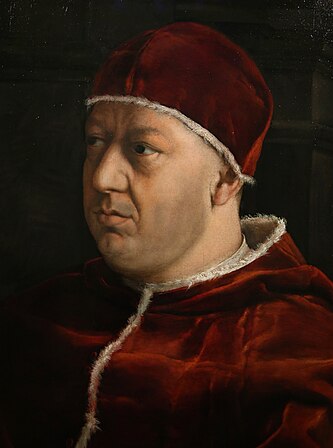
About Pope Leo X
Pope Leo X (born Giovanni di Lorenzo de' Medici, 11 December 1475 - 1 December 1521) was head of the Roman Catholic Church and ruler of the Papal States from 9 March 1513 to his death in 1521.
Best Pope Leo X Quotes
Shortest
Earliest
Explore our curated collection of the most famous and impactful Pope Leo X quotes.
“Arise, O Lord, and judge your own cause. Remember your reproaches to those who are filled with foolishness all through the day. Listen to our prayers, for foxes have arisen seeking to destroy the vineyard whose winepress you alone have trod.”

“Give heed to the cause of the holy Roman Church, mother of all churches and teacher of the faith, whom you by the order of God, have consecrated by your blood. Against the Roman Church, you warned, lying teachers are rising, introducing ruinous sects, and drawing upon themselves speedy doom. Their tongues are fire, a restless evil, full of deadly poison. They have bitter zeal, contention in their hearts, and boast and lie against the truth.”

“No one of sound mind is ignorant how destructive, pernicious, scandalous, and seductive to pious and simple minds these various errors are, how opposed they are to all charity and reverence for the holy Roman Church who is the mother of all the faithful and teacher of the faith; how destructive they are of the vigor of ecclesiastical discipline, namely obedience. This virtue is the font and origin of all virtues and without it anyone is readily convicted of being unfaithful.
Therefore we, in this above enumeration, important as it is, wish to proceed with great care as is proper, and to cut off the advance of this plague and cancerous disease so it will not spread any further in the Lord's field as harmful thorn-bushes.”
Therefore we, in this above enumeration, important as it is, wish to proceed with great care as is proper, and to cut off the advance of this plague and cancerous disease so it will not spread any further in the Lord's field as harmful thorn-bushes.”
“Therefore let Martin himself and all those adhering to him, and those who shelter and support him, through the merciful heart of our God and the sprinkling of the blood of our Lord Jesus Christ by which and through whom the redemption of the human race and the upbuilding of holy mother Church was accomplished, know that from our heart we exhort and beseech that he cease to disturb the peace, unity, and truth of the Church for which the Savior prayed so earnestly to the Father. Let him abstain from his pernicious errors that he may come back to us. If they really will obey, and certify to us by legal documents that they have obeyed, they will find in us the affection of a father's love, the opening of the font of the effects of paternal charity, and opening of the font of mercy and clemency.
We enjoin, however, on Martin that in the meantime he cease from all preaching or the office of preacher...”
We enjoin, however, on Martin that in the meantime he cease from all preaching or the office of preacher...”
“Some, putting aside her true interpretation of Sacred Scripture, are blinded in mind by the father of lies. Wise in their own eyes, according to the ancient practice of heretics, they interpret these same Scriptures otherwise than the Holy Spirit demands, inspired only by their own sense of ambition, and for the sake of popular acclaim, as the Apostle declares. In fact, they twist and adulterate the Scriptures. As a result, according to Jerome, "It is no longer the Gospel of Christ, but a man's, or what is worse, the devil's."
Let all this holy Church of God, I say, arise, and with the blessed apostles intercede with almighty God to purge the errors of His sheep, to banish all heresies from the lands of the faithful, and be pleased to maintain the peace and unity of His holy Church.
For we can scarcely express, from distress and grief of mind, what has reached our ears for some time by the report of reliable men and general rumor; alas, we have even seen with our eyes and read the many diverse errors.”
“With the advice and consent of these our venerable brothers, with mature deliberation on each and every one of the above theses, and by the authority of almighty God, the blessed Apostles Peter and Paul, and our own authority, we condemn, reprobate, and reject completely each of these theses or errors as either heretical, scandalous, false, offensive to pious ears or seductive of simple minds, and against Catholic truth. By listing them, we decree and declare that all the faithful of both sexes must regard them as condemned, reprobated, and rejected….We restrain all in the virtue of holy obedience and under the penalty of an automatic major excommunication....
Moreover, because the preceding errors and many others are contained in the books or writings of Martin Luther, we likewise condemn, reprobate, and reject completely the books and all the writings and sermons of the said Martin, whether in Latin or any other language, containing the said errors or any one of them; and we wish them to be regarded as utterly condemned, reprobated, and rejected. We forbid each and every one of the faithful of either sex, in virtue of holy obedience and under the above penalties to be incurred automatically, to read, assert, preach, praise, print, publish, or defend them. They will incur these penalties if they presume to uphold them in any way, personally or through another or others, directly or indirectly, tacitly or explicitly, publicly or occultly, either in their own homes or in other public or private places.”
Moreover, because the preceding errors and many others are contained in the books or writings of Martin Luther, we likewise condemn, reprobate, and reject completely the books and all the writings and sermons of the said Martin, whether in Latin or any other language, containing the said errors or any one of them; and we wish them to be regarded as utterly condemned, reprobated, and rejected. We forbid each and every one of the faithful of either sex, in virtue of holy obedience and under the above penalties to be incurred automatically, to read, assert, preach, praise, print, publish, or defend them. They will incur these penalties if they presume to uphold them in any way, personally or through another or others, directly or indirectly, tacitly or explicitly, publicly or occultly, either in their own homes or in other public or private places.”
“In virtue of our pastoral office committed to us by the divine favor we can under no circumstances tolerate or overlook any longer the pernicious poison of the above errors without disgrace to the Christian religion and injury to orthodox faith. Some of these errors we have decided to include in the present document; their substance is as follows:
It is a heretical opinion, but a common one, that the sacraments of the New Law give pardoning grace to those who do not set up an obstacle.
To deny that in a child after baptism sin remains is to treat with contempt both Paul and Christ.
The inflammable sources of sin, even if there be no actual sin, delay a soul departing from the body from entrance into heaven.
To one on the point of death imperfect charity necessarily brings with it great fear, which in itself alone is enough to produce the punishment of purgatory, and impedes entrance into the kingdom.
That there are three parts to penance: contrition, confession, and satisfaction, has no foundation in Sacred Scripture nor in the ancient sacred Christian doctors.
Sins are not forgiven to anyone, unless when the priest forgives them he believes they are forgiven; on the contrary the sin would remain unless he believed it was forgiven; for indeed the remission of sin and the granting of grace does not suffice, but it is necessary also to believe that there has been forgiveness.
By no means can you have reassurance of being absolved because of your contrition, but because of the word of Christ: "Whatsoever you shall loose, etc." Hence, I say, trust confidently, if you have obtained the absolution of the priest, and firmly believe yourself to have been absolved, and you will truly be absolved, whatever there may be of contrition.
Excommunications are only external penalties and they do not deprive man of the common spiritual prayers of the Church.
Christians must be taught to cherish excommunications rather than to fear them.
The Roman Pontiff, the successor of Peter, is not the vicar of Christ over all the churches of the entire world, instituted by Christ Himself in blessed Peter.
The word of Christ to Peter: "Whatsoever you shall loose on earth," etc., is extended merely to those things bound by Peter himself.
It is certain that it is not in the power of the Church or the pope to decide upon the articles of faith, and much less concerning the laws for morals or for good works.
If the pope with a great part of the Church thought so and so, he would not err; still it is not a sin or heresy to think the contrary, especially in a matter not necessary for salvation, until one alternative is condemned and another approved by a general Council.
A way has been made for us for weakening the authority of councils, and for freely contradicting their actions, and judging their decrees, and boldly confessing whatever seems true, whether it has been approved or disapproved by any council whatsoever.
Some articles of John Hus, condemned in the Council of Constance, are most Christian, wholly true and evangelical; these the universal Church could not condemn.
In every good work the just man sins.
A good work done very well is a venial sin.
That heretics be burned is against the will of the Spirit.
To go to war against the Turks is to resist God who punishes our iniquities through them.”
Pope Leo X Quotes by Topic
Find exactly what you are looking for by browsing this categorized list of Pope Leo X quotes by topic.
Pope Leo X on Heresy
Pope Leo X on Protestant Reformation
“Lying teachers are rising, introducing ruinous sects, and drawing upon themselves speedy doom. Their tongues are fire, a restless evil, full of deadly poison. They have bitter zeal, contention in their hearts, and boast and lie against the truth.”

Pope Leo X on Universal Declaration of Human Rights
“The Universal Declaration of Human Rights , approved and proclaimed by the United Nations on 10 December 1948, is now part of humanity’s cultural heritage. That text, which is always relevant, can contribute greatly to placing the human person, in his or her inviolable integrity, at the foundation of the quest for truth, thus restoring dignity to those who do not feel respected in their inmost being and in the dictates of their conscience.”

Pope Leo X on Ecumenism
“Söderblom urged his Christian brothers and sisters not to wait for consensus on every point of theology, but to unite in a “practical Christianity”, to serve the world together in the pursuit of peace, justice and human dignity. Although the Catholic Church was not represented at that first meeting, I can state, with humility and joy, that we stand with you today as fellow disciples of Christ, recognising that what unites us is much more than what divide us.”

Pope Leo X on Marriage
“The husband is the chief of the family and the head of the wife. The woman, because she is flesh of his flesh, and bone of his bone, must be subject to her husband and obey him; not, indeed, as a servant, but as a companion, so that her obedience shall be wanting in neither honor nor dignity. Since the husband represents Christ, and since the wife represents the Church, let there always be, both in him who commands and in her who obeys, a heaven-born love guiding both in their respective duties.”
Pope Leo X on Artificial intelligence
“Precisely because I feel called to continue in this vein, I thought of taking the name Leo XIV. There are several reasons for this, but mainly because Pope Leo XIII, with his historic encyclical Rerum novarum, addressed the social question in the context of the first great industrial revolution, and today the Church offers everyone its heritage of social teaching to respond to another industrial revolution and the developments of artificial intelligence, which pose new challenges for the defence of human dignity, justice and work.”

Pope Leo X on Climate change
“Extreme natural phenomena caused by climate changes provoked by human activity are growing in intensity and frequency (cf. Laudato Deum, 5), to say nothing of the medium and long-term effects of the human and ecological devastation being wrought by armed conflicts. [...] For believers it is also a duty born of faith, since the universe reflects the face of Jesus Christ, in whom all things were created and redeemed. In a world where the most vulnerable of our brothers and sisters are the first to suffer the devastating effects of climate change, deforestation and pollution, care for creation becomes an expression of our faith and humanity.”
Pope Leo X on Second Vatican Council
“I would like us to renew today our full commitment to the path that the universal Church has been following for decades now in the wake of the Second Vatican Council. Pope Francis has masterfully recalled and updated its contents in the apostolic exhortation Evangelii gaudium, from which I would like to highlight some fundamental points: the return to the primacy of Christ in proclamation, the missionary conversion of the entire Christian community, growth in collegiality and synodality, attention to the sensus fidei, especially in its most authentic and inclusive forms, such as popular piety, loving care for the least, the rejected, and courageous and trusting dialogue with the contemporary world in its various components and realities.”
What Pope Leo X Said About Others
Discover personal opinions Pope Leo X shared regarding contemporaries.
Pope Leo X on Morris West
“I once asked a distinguished biologist to explain to me the genetic imprint, the famous double helix which differentiates one being from another. He called it "the graffito of God", because it can never be erased. All other imprints — of memory, environment, experience — he called "human graffiti".”
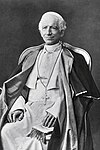
Pope Leo X on Pope Leo XIII
“Precisely because I feel called to continue in this vein, I thought of taking the name Leo XIV. There are several reasons for this, but mainly because Pope Leo XIII, with his historic encyclical Rerum novarum, addressed the social question in the context of the first great industrial revolution, and today the Church offers everyone its heritage of social teaching to respond to another industrial revolution and the developments of artificial intelligence, which pose new challenges for the defence of human dignity, justice and work.”
Quotes About Pope Leo X
Gain deeper perspective through quotes about Pope Leo X from others.
Alexandre Dumas on Pope Leo X
“Leo X succeeded Julius II, and under his pontificate, Latin Christianity assumed a pagan, Greco-Roman character, which, passing from art into manners, gives to this epoch a strange complexion. Crimes for the moment disappeared, to give place to vices; but to charming vices, vices in good taste, such as those indulged in by Alcibiades and sung by Catullus.”

Marino Giorgi on Pope Leo X
“The pope is a good-natured and extremely free-hearted man, who avoids every difficult situation and above all wants peace; he would not undertake a war himself unless forced into it by his advisors; he loves learning; of canon law and literature he possesses remarkable knowledge; he is, moreover, a very excellent musician.”
Leo lack'd the last sacrament. Why on Pope Leo X
“Sacra sub extrema, si forte requiritis, hora Cur Leo non potuit sumere: vendiderat.”
Disputed Quotes
Quotes attributed to Pope Leo X that are questionable.
About Pope Leo X
Pope Leo X (born Giovanni di Lorenzo de' Medici, 11 December 1475 - 1 December 1521) was head of the Roman Catholic Church and ruler of the Papal States from 9 March 1513 to his death in 1521.