Link Copied!
Pindar Quotes (-518--438)
Poet
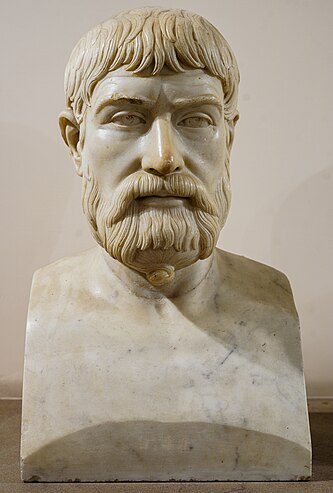
About Pindar
Pindar (518 BC – 438 BC) was a Boeotian poet, counted as one of the nine lyric poets of Greece. The only works of his to have survived complete are a series of odes written to celebrate the victors in athletic games.
Best Pindar Quotes
Shortest
Earliest
Explore our curated collection of the most famous and impactful Pindar quotes.


“γλυκύ δ᾽ἀπείρῳ πόλεμος.
πεπειραμένων δέ τις ταρβεῖ προσιόντα νιν καρδία περισσῶς.
• War is sweet to those who have no experience of it,
but the experienced man trembles exceedingly at heart on its approach.”
πεπειραμένων δέ τις ταρβεῖ προσιόντα νιν καρδία περισσῶς.
• War is sweet to those who have no experience of it,
but the experienced man trembles exceedingly at heart on its approach.”

“Ἄριστον μὲν ὕδωρ, ὁ δὲ χρυσὸς αἰθόμενον πῦρ ἅτε διαπρέπει
νυκτὶ μεγάνορος ἔξοχα πλούτου.
• Best blessing of all is water, And gold like a fiery flame gleaming at night,
Supreme amidst the pride of lordly wealth.
• Closer translation:”
νυκτὶ μεγάνορος ἔξοχα πλούτου.
• Best blessing of all is water, And gold like a fiery flame gleaming at night,
Supreme amidst the pride of lordly wealth.
• Closer translation:”

“οὔ τοι ἅπασα κερδίων
φαίνοισα πρόσωπον ἀλάθει᾽ ἀτρεκής·
καὶ τὸ σιγᾶν πολλάκις ἐστὶ σοφώτατον ἀνθρώπῳ νοῆσαι.
• Here profits not
To tell the whole truth with clear face unveiled.
Often is man's best wisdom to be silent.”
φαίνοισα πρόσωπον ἀλάθει᾽ ἀτρεκής·
καὶ τὸ σιγᾶν πολλάκις ἐστὶ σοφώτατον ἀνθρώπῳ νοῆσαι.
• Here profits not
To tell the whole truth with clear face unveiled.
Often is man's best wisdom to be silent.”

“μή, φίλα ψυχά, βίον ἀθάνατον
σπεῦδε, τὰν δ᾿ ἔμπρακτον ἄντλει μαχανάν.
• Do not yearn, O my soul, for immortal life!
Use to the utmost
the skill that is yours.
• Variant translation: Seek not, my soul, immortal life, but make the most of the resources that are within your reach.”
σπεῦδε, τὰν δ᾿ ἔμπρακτον ἄντλει μαχανάν.
• Do not yearn, O my soul, for immortal life!
Use to the utmost
the skill that is yours.
• Variant translation: Seek not, my soul, immortal life, but make the most of the resources that are within your reach.”

“ἐπάμεροι: τί δέ τις;
τί δ᾽ οὔ τις; σκιᾶς ὄναρ
ἄνθρωπος. ἀλλ᾽ ὅταν αἴγλα διόσδοτος ἔλθῃ,
λαμπρὸν φέγγος ἔπεστιν ἀνδρῶν καὶ μείλιχος αἰών
• Creatures of a day! What is a man?
What is he not? A dream of a shadow
Is our mortal being. But when there comes to men
A gleam of splendour given of Heaven,
Then rests on them a light of glory
And blessèd are their days.”
Pindar Quotes by Topic
Find exactly what you are looking for by browsing this categorized list of Pindar quotes by topic.
Pindar on Rome: Total War
“War is sweet to those who have never experienced it”
Pindar on Silence
“I shall halt. Truth does not always Gain if she displays Her face unflinching; and silence is often a man’s wisest counsel.”
Pindar on Artemis

Pindar on Dike
“Eunomia and that unsullied fountain Dikē, her sister, sure support of cities; and Eirene of the same kin, who are the stewards of wealth for mankind — three glorious daughters of wise-counselled Themis."”
Quotes About Pindar
Gain deeper perspective through quotes about Pindar from others.
Maurice Bowra on Pindar
“His innate, unquestioning pride in his poetical mission means that he gives to it all his gifts and all his efforts. The result is a poetry that by any standards deserves the name because it is based on a radiant vision of reality and fashioned with so subtle, so adventurous, and so dedicated an art that it is worthy to be an earthly counterpart of the songs which Apollo and the Muses sing on Olympus, and which Pindar regards as the archetype of music on those lofty occasions when all discords are resolved and all misgivings obliterated by the power of the life-giving word.”

Jacob Burckhardt on Pindar
“The association between the agon and the aristocratic made it possible for individual families to cherish a tradition of competing and winning. Such families of champions were Pindar's best customers, and it is from him that we learn of them; he is our indispensable informant on the competitive spirit.”
J. C. D. Clark on Pindar
“Of Greek poets only one, Pindar, expressed the full range of ideals which achieved so much prominence in the last decades of the eighteenth and the first decades of the nineteenth century. The themes of military victory, national glory, personal triumph and emancipation linked with the freedom of the community were enforced in Pindar with a 'vehement intensity' which spoke to the new aesthetic; and in England the first poet to respond to these widening opportunities was Gray.”
Edith Hamilton on Pindar
“Pindar is austere. Splendor can be cold, and Pindar glitters but never warms. He is hard, severe, passionless, remote, with a kind of haughty magnificence. He never steps down from his frigid eminence. Aristocrats did not stoop to lies, and his pen would never deviate from the strict truth in praising any triumph. He would glorify a victor so far as he was really glorious, but no further. As he himself puts it, he would not tell "a tale decked out with dazzling lies against the worth of truth." Only what was in actual fact nobly praiseworthy would be praised by him.”
Richard Claverhouse Jebb on Pindar 3 quotes
“He began his poetical career at the age of twenty, with an ode on a Thessalian youth's victory in the games. He grew to be the national lyrist of Greece. It is a sign of the coming time that he also pays his homage to Athens,—"the bulwark of Hellas," the city that "laid the foundation of freedom."”
About Pindar
Pindar (518 BC – 438 BC) was a Boeotian poet, counted as one of the nine lyric poets of Greece. The only works of his to have survived complete are a series of odes written to celebrate the victors in athletic games.