Link Copied!
Pierre-Simon Laplace Quotes (1749-1827)
Mathematician
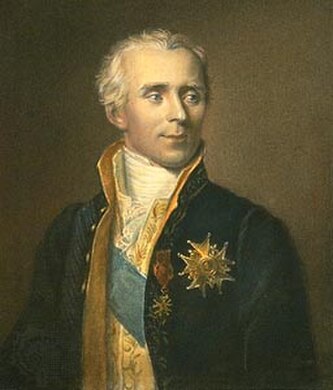
About Pierre-Simon Laplace
Pierre-Simon Laplace (23 March 1749 – 5 March 1827) was a French mathematician and astronomer, discoverer of the Laplace transform and Laplace's equation.
Best Pierre-Simon Laplace Quotes
Shortest
Earliest
Explore our curated collection of the most famous and impactful Pierre-Simon Laplace quotes.
“"Nature laughs at the difficulties of integration."”
“"Il est facile de voir que..."
• Translation: "It is therefore obvious that..."”
• Translation: "It is therefore obvious that..."”

“"L'homme ne poursuit que des chimères."
• Translation: "Man follows only phantoms."”
• Translation: "Man follows only phantoms."”
“Let us recall that formerly, and at no remote epoch... all the unusual phenomena were regarded as so many signs of celestial wrath.”
“"Ce que nous connaissons est peu de chose, ce que nous ignorons est immense."
• Translation: "What we know is not much. What we do not know is immense."”
• Translation: "What we know is not much. What we do not know is immense."”
“"La dernière chose que nous attendions de vous, Général, est une leçon de géométrie !"
• Translation: "The last thing we expect of you, General, is a lesson in geometry!"”
• Translation: "The last thing we expect of you, General, is a lesson in geometry!"”
“"Lisez Euler, lisez Euler, c'est notre maître à tous."
• Translation: "Read Euler, read Euler, he is the master of us all." (Sometimes freely translated as: "Read Euler: he is our master in everything.")”
• Translation: "Read Euler, read Euler, he is the master of us all." (Sometimes freely translated as: "Read Euler: he is our master in everything.")”
“Imaginary causes have gradually receded with the widening bounds of knowledge and disappear entirely before sound philosophy, which sees in them only the expression of our ignorance of the true causes.”
“The theory of chance consists in reducing all the events of the same kind to a certain number of cases equally possible, that is to say, to such as we may be equally undecided about in regard to their existence, and in determining the number of cases favorable to the event whose probability is sought.”
“On demandait à Laplace quel était selon lui le plus grand mathématicien de l'Allemagne. C'est Pfaff, répondit-il. - Je croyais, reprit l'interlocuteur, que Gauss lui était supérieur. - Mais, s'écria Laplace, vous me demandez quel est le plus grand mathématicien de l'Allemagne, et Gauss est le plus grand mathématicien de l'Europe.”
“All these efforts in the search for truth tend to lead it [the human mind] back continually to the vast intelligence... but from which it will always remain infinitely removed. This tendency peculiar to the human race is that which renders it superior... and their progress in this respect distinguishes nations and ages and constitutes their true glory.”

“"Les questions les plus importantes de la vie ne sont en effet, pour la plupart, que des problèmes de probabilité." Théorie analytique des probabilités, 1812.Pierre-Simon Laplace 23 mars 1749 - 5 mars 1827, language: fr, at: 2017-03-04
• Translation: "Life's most important questions are, for the most part, nothing but problems of chance."”
• Translation: "Life's most important questions are, for the most part, nothing but problems of chance."”
“The most important questions of life... are indeed for the most part only problems of probability. Strictly speaking it may even be said that nearly all our knowledge is problematical; and in the small number of things which we are able to know with certainty, even in the mathematical sciences themselves, the principal means for ascertaining truth—induction and analogy—are based on probabilities.
Ch. 2 Concerning Probability”

“"On voit, par cet Essai, que la théorie des probabilités n'est, au fond, que le bon sens réduit au calcul; elle fait apprécier avec exactitude ce que les esprits justes sentent par une sorte d'instinct, sans qu'ils puissent souvent s'en rendre compte."
• Translation: "One sees, from this Essay, that the theory of probabilities is basically just common sense reduced to calculus; it makes one appreciate with exactness that which accurate minds feel with a sort of instinct, often without being able to account for it."”
• Translation: "One sees, from this Essay, that the theory of probabilities is basically just common sense reduced to calculus; it makes one appreciate with exactness that which accurate minds feel with a sort of instinct, often without being able to account for it."”
“It is India that gave us the ingenious method of expressing all numbers by means of ten symbols, each symbol receiving a value of position as well as an absolute value; a profound and important idea which appears so simple to us now that we ignore its true merit.But its very simplicity and the great ease which it has lent to computations put our arithmetic in the first rank of useful inventions; and we shall appreciate the grandeur of the achievement the more when we remember that it escaped the genius of Archimedes and Apollonius, two of the greatest men produced by antiquity.”
“Said the great and magnanimous Laplace: 'It is India that gave us the ingenious method of expressing all numbers by ten symbols, each receiving a value of position as well as an absolute value; a profound and important idea which appears so simple to us now that we ignore its true merit. But its very simplicity, the great ease which it has lent to all computations, puts our arithmetic in the first rank of useful inventions; and we shall appreciate the grandeur of this achievement the more when we remember that it escaped the genius of Archimedes and Apollonius, two of the greatest men produced by antiquity.'”
“Given for one instant an intelligence which could comprehend all the forces by which nature is animated and the respective situation of the beings who compose it—an intelligence sufficiently vast to submit these data to analysis—it would embrace in the same formula the movements of the greatest bodies of the universe and those of the lightest atom; for it, nothing would be uncertain and the future, as the past, would be present to its eyes. The human mind offers, in the perfection which it has been able to give to astronomy, a feeble idea of this intelligence. Its discoveries in mechanics and geometry, added to that of universal gravity, have enabled it to comprehend in the same analytical expressions the past and future states of the system of the world.”

“It is to the influence of the opinion of those whom the multitude [the populous] judges best informed, and to whom it has been accustomed to give its confidence in regard to the most important matters of life, that the propagation of those errors is due, which in times of ignorance, have covered the face of the earth. Magic and astrology offer us two great examples. These errors... having for a basis only universal credence, have maintained themselves during a very long time; but at last the progress of science has destroyed them in the minds of enlightened men, whose opinion consequently has caused them to disappear... through the power of imitation and habit which had so generally spread them... This power, the richest resource of the moral world, establishes and conserves in a whole nation ideas entirely contrary to those... elsewhere... What indulgence ought we not then to have for opinions different from ours, when this difference often depends only upon the various points of view where circumstances have placed us! Let us enlighten those whom we judge insufficiently instructed; but first let us examine critically our own opinions, and weigh with impartiality, their respective probabilities.”
Pierre-Simon Laplace Quotes by Topic
Find exactly what you are looking for by browsing this categorized list of Pierre-Simon Laplace quotes by topic.
Pierre-Simon Laplace on Atheism 2 quotes
“I had no need of that hypothesis.”

Pierre-Simon Laplace on Integration 2 quotes
“Nature laughs at the difficulties of integration.”
Pierre-Simon Laplace on Determinism 2 quotes
“The curve described by a single molecule of air or vapor is regulated in a manner just as certain as the planetary orbits; the only difference between them that which comes from our ignorance.”
Pierre-Simon Laplace on Evidence
“The weight of evidence for an extraordinary claim must be proportioned to its strangeness.”

Pierre-Simon Laplace on Paganism
“Hesiod, the oldest author to have written on theogony, asserted that the gods and men are created by unknown natural forces. We can therefore consider paganism as a superstitious form of atheism.”
Pierre-Simon Laplace on Calculus
“The theory of probabilities is basically only common sense reduced to a calculus. It makes one estimate accurately what right-minded people feel by a sort of instinct, often without being able to give a reason for it.”

Pierre-Simon Laplace on History of science and technology in the Indian subcontinent
“Said the great and magnanimous Laplace: 'It is India that gave us the ingenious method of expressing all numbers by ten symbols, each receiving a value of position as well as an absolute value; a profound and important idea which appears so simple to us now that we ignore its true merit. But its very simplicity, the great ease which it has lent to all computations, puts our arithmetic in the first rank of useful inventions; and we shall appreciate the grandeur of this achievement the more when we remember that it escaped the genius of Archimedes and Apollonius, two of the greatest men produced by antiquity.'”

Pierre-Simon Laplace on 1 (number)
“Plus one, minus one, plus one, minus one, etc. By adding the first two terms, the next two, and so forth, the result is converted into another for which each term is zero. Grandi, the Italian Jesuit, had concluded the possibility of creation from this series; because the result is always equal to ½, he saw the unborn fraction of infinitely many zeros, or nothingness. It was thus that Leibnitz saw in his binary arithmetic the image of creation. He imagined that Unity represented God, and Zero the void; and that the Supreme Being drew all beings from the void, just as unity and zero express all numbers in this system of numeration. This conception was so pleasing to Leibnitz that he communicated it to the Jesuit, [Claudio Filippo] Grimaldi, president of the Chinese tribunal for mathematics, in the hope that this emblem of creation would convert the Emperor of China, since he was very fond of the sciences, to Christianity. I mention this merely to show how childhood prejudices may lead astray even the greatest men.”
Pierre-Simon Laplace on Mathematics and mysticism
“Plus one, minus one, plus one, minus one, etc. By adding the first two terms, the next two, and so forth, the result is converted into another for which each term is zero. Grandi, the Italian Jesuit, had concluded the possibility of creation from this series; because the result is always equal to ½, he saw the unborn fraction of infinitely many zeros, or nothingness. It was thus that Leibnitz saw in his binary arithmetic the image of creation. He imagined that Unity represented God, and Zero the void; and that the Supreme Being drew all beings from the void, just as unity and zero express all numbers in this system of numeration. This conception was so pleasing to Leibnitz that he communicated it to the Jesuit, [Claudio Filippo] Grimaldi, president of the Chinese tribunal for mathematics, in the hope that this emblem of creation would convert the Emperor of China, since he was very fond of the sciences, to Christianity. I mention this merely to show how childhood prejudices may lead astray even the greatest men.”

Pierre-Simon Laplace on Inductive reasoning
“Induction, analogy, hypotheses founded upon facts and rectified continually by new observations, a happy tact given by nature and strengthened by numerous comparisons of its indications with experience, such are the principal means for arriving at truth. If one considers a series of objects of the same nature one perceives among them and in their changes ratios which manifest themselves more and more in proportion as the series is prolonged, and which, extending and generalizing continually, lead finally to the principle from which they were derived. But these ratios are enveloped by so many strange circumstances that it requires great sagacity to disentangle them and to recur to this principle: it is in this that the true genius of sciences consists. Analysis and natural philosophy owe their most important discoveries to this fruitful means, which is called induction. Newton was indebted to it for his theorem of the binomial and the principle of universal gravity. It is difficult to appreciate the probability of the results of induction, which is based upon this that the simplest ratios are the most common; this is verified in the formulae of analysis and is found again in natural phenomena, in crystallization, and in chemical combinations. This simplicity of ratios will not appear astonishing if we consider that all the effects of nature are only mathematical results of a small number of immutable laws. Yet induction, in leading to the discovery of the general principles of the sciences, does not suffice to establish them absolutely. It is always necessary to confirm them by demonstrations or by decisive experiences; for the history of the sciences shows us that induction has sometimes led to inexact results.”
Pierre-Simon Laplace on Natural philosophy
“Induction, analogy, hypotheses founded upon facts and rectified continually by new observations, a happy tact given by nature and strengthened by numerous comparisons of its indications with experience, such are the principal means for arriving at truth. If one considers a series of objects of the same nature one perceives among them and in their changes ratios which manifest themselves more and more in proportion as the series is prolonged, and which, extending and generalizing continually, lead finally to the principle from which they were derived. But these ratios are enveloped by so many strange circumstances that it requires great sagacity to disentangle them and to recur to this principle: it is in this that the true genius of sciences consists. Analysis and natural philosophy owe their most important discoveries to this fruitful means, which is called induction. Newton was indebted to it for his theorem of the binomial and the principle of universal gravity. It is difficult to appreciate the probability of the results of induction, which is based upon this that the simplest ratios are the most common; this is verified in the formulae of analysis and is found again in natural phenomena, in crystallization, and in chemical combinations. This simplicity of ratios will not appear astonishing if we consider that all the effects of nature are only mathematical results of a small number of immutable laws. Yet induction, in leading to the discovery of the general principles of the sciences, does not suffice to establish them absolutely. It is always necessary to confirm them by demonstrations or by decisive experiences; for the history of the sciences shows us that induction has sometimes led to inexact results.”

What Pierre-Simon Laplace Said About Others
Discover personal opinions Pierre-Simon Laplace shared regarding contemporaries.
Pierre-Simon Laplace on Leonhard Euler
“Read Euler: he is our master in everything.”

Quotes About Pierre-Simon Laplace
Gain deeper perspective through quotes about Pierre-Simon Laplace from others.
Nathaniel Bowditch on Pierre-Simon Laplace
“Whenever I meet in La Place with the words "Thus it plainly appears," I am sure that hours, and perhaps days, of hard study will alone enable me to discover how it plainly appears.”
Morris Kline on Pierre-Simon Laplace 2 quotes
“Laplace made many important discoveries in mathematical physics... Indeed, he was interested in anything that helped to interpret nature. He worked on hydrodynamics, the wave propagation of sound, and the tides. In the field of chemistry, his work on the liquid state of matter is classic. His studies of the tension in the surface layer of water, which accounts for the rise of liquids inside a capillary tube, and of the cohesive forces in liquids, are fundamental. Laplace and Lavoisier designed an ice calorimeter (1784) to measure heat and measured the specific heat of numerous substances; heat, to them, was still a special kind of matter. Most of Laplace's life was, however, devoted to celestial mechanics.”
Kathryn Schulz on Pierre-Simon Laplace
“This is another important dispute in the history of how we think about being wrong: whether error represents an obstacle in the path toward truth, or the path itself. The former idea is a conventional one. The latter... emerged during the Scientific Revolution and continued to evolve throughout the Enlightenment. But it didn't really reach its zenith until the early nineteenth century, when... Pierre Simon Laplace refined the distribution of errors, illustrated by the now-familiar bell curve. ...Laplace used the bell curve to determine the precise orbit of the planets. ...By using the normal distribution to graph... individually imperfect data points, Laplace was able to generate a far more precise picture of the galaxy. ...aggregate enough flawed data, and you get a glimpse of the truth.”
Brian L. Silver on Pierre-Simon Laplace
“Laplace had taken Newton's science and turned it into philosophy. The universe was a piece of machinery, its history was predetermined, there was no room for chance or for free will. The cosmos was indeed an ice-cold clock.”
Thomas Young on Pierre-Simon Laplace
“With respect to the cohesion and capillary action of liquids, I have had the good fortune to anticipate Mr. Laplace in his late researches, and I have endeavoured to show, that my assumptions are more universally applicable to the facts, than those which that justly celebrated mathematician has employed.”
Disputed Quotes
Quotes attributed to Pierre-Simon Laplace that are questionable.
“"[Sire,] je n'ai pas eu besoin de cette hypothèse."
• Translation: "[No, Sire,] I had no need of that hypothesis."”
• Translation: "[No, Sire,] I had no need of that hypothesis."”
“The exchange is reported by Victor Hugo (who in turn was citing François Arago) as:”
“"Comment, vous faites tout le système du monde, vous donnez les lois de toute la création et dans tout votre livre vous ne parlez pas une seule fois de l'existence de Dieu !"
• Translation: "How can this be! You made the system of the world, you explain the laws of all creation, but in all your book you speak not once of the existence of God!"
• Alternate translation: "You have written this huge book on the system of the world without once mentioning the author of the universe!"
• Alternate translation: "How is it that, although you say so much about the Universe, you say nothing about its Creator?"”
“"[Sire,] je n'avais pas besoin de cette hypothèse-là."
• Translation: "I did not need to make such an assumption."”
• Translation: "I did not need to make such an assumption."”
“Lagrange, also present (or to whom Napoleon repeated Laplace's reply, in another version), then commented: "Ah ! C’est une belle hypothèse; ça explique beaucoup de choses."
• Translation: "Ah! That is a beautiful assumption; it explains many things."
• Alternate translation: "Ah, but that is such a good hypothesis. It explains so many things!"”
• Translation: "Ah! That is a beautiful assumption; it explains many things."
• Alternate translation: "Ah, but that is such a good hypothesis. It explains so many things!"”
About Pierre-Simon Laplace
Pierre-Simon Laplace (23 March 1749 – 5 March 1827) was a French mathematician and astronomer, discoverer of the Laplace transform and Laplace's equation.