Link Copied!
Philolaus Quotes (-470--385)
Philosopher

About Philolaus
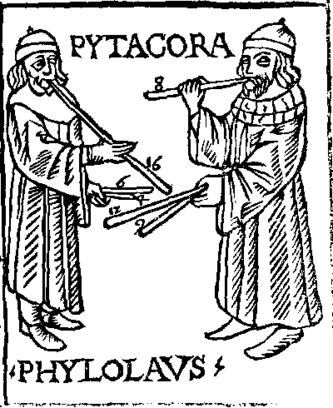
Philolaus (c. 470 – c. 385 BCE) was a Greek Pythagorean and Presocratic philosopher. He argued that at the foundation of everything is the part played by the limiting and limitless, which combine together in a harmony. He is credited with originating the theory that the Earth was not the center of the universe. Philolaus may have been the successor of Pythagoras.
Best Philolaus Quotes
Shortest
Earliest
Explore our curated collection of the most famous and impactful Philolaus quotes.
“[Number is] the commanding and self-begotten container of the eternal duration of mundane concerns.”
“The ancient theologists and priests... testify that the soul is united with the body as if for the sake of punishment; and so is buried in body as in a sepulchre.”
“Fragment 3. The harmony is generally the result of contraries; for it is the unity of multiplicity, and the agreement of discordances. (Nicom.Arith.2:509).”

“Fragment 1. (Stob.21.7; Diog.#.8.85) The world's nature is a harmonious compound of infinite and finite elements; similar is the totality of the world in itself, and of all it contains.
b. All beings are necessarily finite or infinite, or simultaneously finite and infinite; but they could not all be infinite only.”
b. All beings are necessarily finite or infinite, or simultaneously finite and infinite; but they could not all be infinite only.”
“Fragment 2. All things, at least those we know, contain number; for it is evident that nothing whatever can either be thought or known, without number. Number has two distinct kinds: the odd, and the even, and a third, derived from a mingling of the other two kinds, the even-odd. Each of its subspecies is susceptible of many very numerous varieties; which each manifests individually.”
“Fragment 4. This is the state of affairs about nature and harmony. The essence of things is eternal; it is a unique and divine nature, the knowledge of which does not belong to man. Still it would not not be possible that any of the things that are, and are known by us, should arrive to our knowledge, if this essence was not the internal foundation of the principles of which the world was founded, that is, of the finite and infinite elements. Now since these principles are not mutually similar, neither of similar nature, it would be impossible that the order of the world should have been formed by them, unless the harmony had intervened... the dissimilar things, which have neither a similar nature, nor an equivalent function, must be organized by the harmony, if they are to take their place in the connected totality of the world.”

Philolaus Quotes by Topic
Find exactly what you are looking for by browsing this categorized list of Philolaus quotes by topic.
Philolaus on Number 3 quotes
“[Number is] the commanding and self-begotten container of the eternal duration of mundane concerns.”
Quotes About Philolaus
Gain deeper perspective through quotes about Philolaus from others.
Alexander von Humboldt on Philolaus
“In the old Pythagorean representation of the celestial system, according to Philolaus, the five planets were mentioned... among the ten deified bodies which revolve round the central fire (the focus of the universe έστἱα) "immediately beneath the region of fixed stars;" these were succeeded by the Sun, Moon, Earth, and... the anti-Earth...”
Charles Peter Mason on Philolaus
“The first publication of the Pythagorean doctrines is pretty uniformly attributed to Philolaus. He composed a work on the Pythagorean philosophy in three books, which Plato is said to have procured at the cost of 100 minae through Dion of Syracuse, who purchased it from Philolaus, who was at the time in deep poverty. ...Out of the materials which he derived from these books Plato is said to have composed the Timaeus. But in the age of Plato the leading features of the Pythagorean doctrines had long ceased to be secret; and if Philolaus taught the Pythagorean doctrines at Thebes, he was hardly likely to feel much reluctance in publishing them... little more can be regarded as trustworthy, except that Philolaus was the first who published a book on the Pythagorean doctrines, and that Plato read and made use of it.”
Murray on Philolaus
“According to the Pythagorean Philolaus, "the Dekad, the full and perfect number, was of supreme and universal efficacy as the guide and principle of life, both to the Kosmos and to man. The nature of number was imperative and lawgiving, affording the only solution of all that was perplexing or unknown; without number, all would be indeterminate and unknowable."”
Heinrich Ritter on Philolaus
“Philolaus divided the world into three parts—viz. Olympus, which holds within itself the purity of the elements, i. e. probably the central fire and the fire outwardly embracing the world; Kosmus, or the world in a limited sense, i. e. the perfectly ordered world, which comprises all mundane bodies except the earth; and Uranus, i. e. the part of the universe which belongs to the terrestrial sphere.”
Eduard Zeller on Philolaus 2 quotes
“The importance of the decuple system in relation to the Pythagoreans is much greater. For as they considered numbers over ten to be only the repetition of the first ten numbers, all numbers and all powers of numbers appeared to them to be comprehended in the decad, which is therefore called by Philolaus, great all-powerful and all-producing, the beginning and the guide of the divine and heavenly, as of the terrestrial life.”
About Philolaus
Philolaus (c. 470 – c. 385 BCE) was a Greek Pythagorean and Presocratic philosopher. He argued that at the foundation of everything is the part played by the limiting and limitless, which combine together in a harmony. He is credited with originating the theory that the Earth was not the center of the universe. Philolaus may have been the successor of Pythagoras.