Philip Schaff on Girolamo Savonarola
← Back to Philip Schaff Profile
“The preacher himself was burning with religious passion. He felt deeply and he was a man of deep devotion. He had the eye of the mystic and saw beneath the external and ritual to the inner movements of spiritual power. The biblical element was also a conspicuous feature of his preaching. Defective as Savonarola's exegesis was, the biblical element was everywhere in control of his thought and descriptions. … He insisted upon the authority of Scripture. "I preach the regeneration of the Church," he said, "taking the Scriptures as my sole guide."”
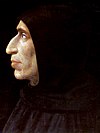
“Savonarola was not merely the expounder of righteousness. He claimed to be a prophet revealing things which, to use his own words, "are beyond the scope of the knowledge which is natural to any creature." This element would have been a sign of weakness, if it had not been associated with a great personality, bent on noble ends. The severity of his warnings was often so fearful that the preacher himself shrank back from delivering them. On one occasion, he spent the entire night in vigils and prayer that he might be released from the duty of making known a message, but in vain. The sermon, he then went forth to preach, he called a terrific sermon.”
“Dizzy flights of fancy abounded in Savonarola's discourses and took the place of calm and logical exposition. On the evening before he preached his last sermon in Advent, 1492, Savonarola beheld in the middle of the sky a hand holding a sword with the inscription, Behold the sword of the Lord will descend suddenly and quickly upon the earth — Ecce gladius Domini super terram cito et velociter. Suddenly the sword was turned toward the earth, the sky was darkened, swords, arrows and flames rained down. The heavens quaked with thunder and the world became a prey to famine and death. The vision was ended by a command to the preacher to make these things known. Again and again, in after years did he refer to this prophetic vision. Its memory was also preserved by a medal, representing on one side Savonarola and on the other a sword in the heavens held by a hand and pointing to a city beneath. The inscription on the heavenly sword well represents the style of Savonarola's preaching. It was impulsive, pictorial, eruptive, startling, not judicial and instructive. And yet it made a profound impression on men of different classes.”