Link Copied!
Peter Senge Quotes (1947-)
Author, Director, Scientist



About Peter Senge
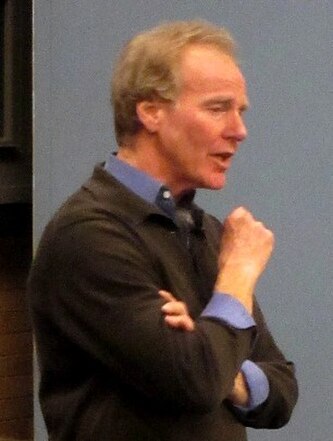
Peter M. Senge (born 1947) is an American scientist, director of the Center for Organizational Learning at the MIT Sloan School of Management and author of the seminal work on learning organizations, The Fifth Discipline (1990).
Best Peter Senge Quotes
Shortest
Earliest
Explore our curated collection of the most famous and impactful Peter Senge quotes.
“In essence, leaders are people who "walk ahead," people genuinely committed to deep changes, in themselves and in their organizations.”
“"Scratch the surface of most cynics and you find a frustrated idealist – someone who made the mistake of converting his ideals into expectations"”

“It is a testament to our naïveté about culture that we think that we can change it by simply declaring new values. Such declarations usually produce only cynicism.”
“When executives lead as teachers, stewards, and designers, they fill roles that are much more subtle and long-term than those of power-wielding hierarchical leaders.”
“Learning to see the structures within which we operate begins a process of freeing ourselves from previously unseen forces and ultimately mastering the ability to work with them and change them.”
“We believe that, ultimately, the most important learning occurs in the context of our day-to-day life, the aspirations we pursue, the challenges we face, and the responses we bring forth.”
“Systems thinking is a framework for seeing interrelationships rather than things, for seeing patterns rather than static snapshots. It is a set of general principles spanning fields as diverse as physical and social sciences, engineering and management”
“Systems thinking is a discipline for seeing the 'structures' that underlie complex situations, and for discerning high from low leverage change. That is, by seeing wholes we learn how to foster health. To do so, systems thinking offers a language that begins by restructuring how we think.”
“"Learning organizations" [are] organizations where people continually expand their capacity to create the results they truly desire, where new and expansive patterns of thinking are nurtured, where collective aspiration is set free, and where people are continually learning how to learn together.”
“In a learning organization, leaders are designers, stewards, and teachers. They are responsible for building organizations where people continually expand their capabilities to understand complexity, clarify vision, and improve shared mental models – that is, they are responsible for learning.”

“Mutual reflection. Open and candid conversation. Questioning of old beliefs and assumptions. Learning to let go. Awareness of how our own actions create the systemic structures that produce our problems. Developing these learning capabilities lies at the heart of profound change.”
“Real learning gets to the heart of what it means to be human. Through learning we re-create ourselves. Through learning we become able to do something we never were able to do. Through learning we reperceive the world and our relationship to it. Through learning we extend our capacity to create, to be part of the generative process of life. There is within each of us a deep hunger for this type of learning.”
“A cloud masses, the sky darkens, leaves twist upward, and we know that it will rain. We also know that after the storm, the runoff will feed into groundwater miles away, and the sky will clear by tomorrow. All these events are distant in time and space, and yet they are all connected within the same pattern. Each has an influence on the rest, an influence that is usually hidden from view. You can only understand the system of a rainstorm by contemplating the whole, not any individual part of the pattern.
Businesses and other human endeavors are also systems. They, too, are bound by invisible fabrics of interrelated actions, which often take years to fully play out their effects on each other. Since we are part of that lacework ourselves, it's doubly hard to see the whole pattern of change. Instead we tend to focus on snapshots of isolated parts of the system, and wonder why our deepest problems never seem to get solved.”
Businesses and other human endeavors are also systems. They, too, are bound by invisible fabrics of interrelated actions, which often take years to fully play out their effects on each other. Since we are part of that lacework ourselves, it's doubly hard to see the whole pattern of change. Instead we tend to focus on snapshots of isolated parts of the system, and wonder why our deepest problems never seem to get solved.”

Peter Senge Quotes by Topic
Find exactly what you are looking for by browsing this categorized list of Peter Senge quotes by topic.
Peter Senge on Learning organization 3 quotes
“A learning organization is an] organization that is continually expanding its capacity to create its future.”

Peter Senge on Systems thinking 2 quotes
“Systems thinking is a framework for seeing interrelationships rather than things, for seeing patterns rather than static snapshots. It is a set of general principles spanning fields as diverse as physical and social sciences, engineering and management”

Peter Senge on Thought
“Learning to see the structures within which we operate begins a process of freeing ourselves from previously unseen forces and ultimately mastering the ability to work with them and change them.”
Peter Senge on Organizational learning
“Real learning gets to the heart of what it means to be human. Through learning we re-create ourselves. Through learning we become able to do something we never were able to do. Through learning we reperceive the world and our relationship to it. Through learning we extend our capacity to create, to be part of the generative process of life. There is within each of us a deep hunger for this type of learning.”
Peter Senge on Business
“A cloud masses, the sky darkens, leaves twist upward, and we know that it will rain. We also know that after the storm, the runoff will feed into groundwater miles away, and the sky will grow clear by tomorrow. All of these events are distant in time and space, if they're all connected within the same pattern. Each has an influence on the rest, and influence that is usually hidden from view. You can only understand the system of rainstorm by contemplating the whole not any part of the pattern. Businesses and other human endeavors are also systems. They, too, are bound by invisible fabrics of interrelated actions, which often take years to fully play out their effects on each other. Since we are part of that lacework ourselves, it's doubly hard to see the whole pattern of change. Instead we tend to focus on snapshots of isolated parts of the system, and wonder why our deepest problems never seem to get resolved.”

About Peter Senge
Peter M. Senge (born 1947) is an American scientist, director of the Center for Organizational Learning at the MIT Sloan School of Management and author of the seminal work on learning organizations, The Fifth Discipline (1990).