Link Copied!
Peter Drucker Quotes (1909-2005)
Writer





















About Peter Drucker
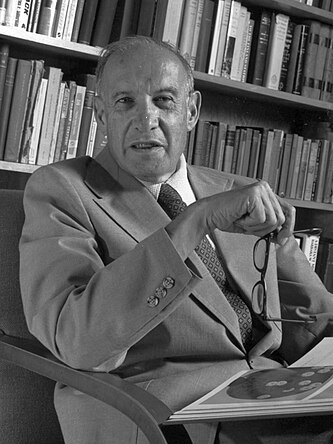
Peter Ferdinand Drucker (November 19 1909 – November 11 2005) was an Austrian-born American writer, management consultant and university professor. In 1943 he became a naturalized citizen of the United States. He taught at New York University and Claremont Graduate University respectively.
Best Peter Drucker Quotes
Shortest
Earliest
Explore our curated collection of the most famous and impactful Peter Drucker quotes.


“[[Management] has authority only as long as it performs.”

“There is a point at which a transformation has to take place.”

“The first step toward making the worker achieving is to make work productive.”
“The purpose of an organization is to enable common men to do uncommon things.”
“There is a point of complexity beyond which a business is no longer manageable.”
“The worker's effectiveness is determined largely by the way he is being managed.”
“One has to make a decision when a condition is likely to degenerate if nothing is done.”
“[W]e have been forced to put a major emphasis on the acquisition of technical knowledge.”
“There is only one valid definition of a business purpose: to create a customer.”

“A success that has outlived its usefulness may, in the end, be more damaging than failure.”
“The rule should be to minimize the need for people to get together to accomplish anything.”
“Without institution there is no management. But without management there is no institution.”
“The major incentive to productivity and efficiency are social and moral rather than financial.”

“A superior who works on his own development sets an almost irresistible example.”
“A management decision is irresponsible if it risks disaster this year for the sake of a grandiose future.”
“Whenever anything is being accomplished, it is being done, I have learned, by a monomaniac with a mission.”

“The basic definition of the business and of its purpose and mission have to be translated into objectives.”

“It does not matter whether the worker wants responsibility or not, ...The enterprise must demand it of him.”

“With Christianity, freedom and equality became the two basic concepts of Europe; they are themselves Europe.”

“The society of organizations is new-only seventy years ago employees were a small minority in every society.”

“Morale in an organization does not mean that "people get along together"; the test is performance not conformance.”
“A primary task of management in the developed countries in the decades ahead will be to make knowledge productive.”
“Free enterprise cannot be justified as being good for business. It can be justified only as being good for society.”
“The manager is a servant. His master is the institution he manages and his first responsibility must therefore be to it.”
“Financial "synergy" is a will-o'-the-wisp.It looks good on paper, but it fails to work out in practice.”
“That knowledge has become the resource, rather than a resource, is what makes our society "post-capitalist.”

“Absolute size by itself is no indicator of success and achievement, let alone of managerial competence. Being the right size is.”

“We have only one alternative: either to build a functioning industrial society or see freedom itself disappear in anarchy and tyranny.”
“A man should never be appointed into a managerial position if his vision focuses on people's weaknesses rather than on their strengths.”
“As with every phenomenon of the objective universe, the first step toward understanding work is to analyze it.”

“Wherever an impact can be eliminated by dropping the activity that causes it, this is therefore the best-indeed the only truly good-solution.”
“All economic activity is by definition "high risk." And defending yesterday--that is, not innovating--is far more risky than making tomorrow.”
“Unless the power of the corporation can be organized on an accepted principle of legitimacy, it will... be taken over by a Central government...”

“There is every indication that the period ahead will be an innovative one, one of rapid change in technology, society, economy, and institutions.”
“Universities won't survive. The future is outside the traditional campus, outside the traditional classroom. Distance learning is coming on fast.”

“The large industrial enterprise is... the representative institution of an industrial society. It determines the individual's view of his society.”
“There is a definite trend in Italy and Germany to eliminate profit participation and the ownership rights of nonmanaging partners and shareholders.”
“To be a manager requires more than a title, a big office, and other outward symbols of rank. It requires competence and performance of a high order.”

“The moment people talk of "implementing" instead of "doing," and of "finalizing" instead of "finishing," the organization is already running a fever.”

“This is a political book... It has a political purpose: to strengthen the will to maintain freedom against the threat of its abandonment in favor of totalitarianism.”


“Executives do many things in addition to making decisions. But only executives make decisions. The first managerial skill is, therefore, the making of effective decisions.”
“[T]he Western European democracies... will be forced into totalitarianism unless they produce a noneconomic society striving for the freedom and equality of the individual.”
“[I]n a free society each individual has a responsibility towards the beliefs of his society—a responsibility on which all the rights and duties of citizenship are founded.”
“There can be no freedom if one man or one group of men... is assumed... inherently perfect or perfectible. Its claim to perfection or perfectibility is a claim to absolute rule.”
“[T]hroughout the ages to be educated meant to be unproductive.... our word "school" - and its equivalent in all European languages - derives from a Greek word meaning "leisure."”
“"Value added" is a meaningless concept for a retail business , for a bank, for a life insurance company, and for any other business which is not primarily engaged in manufacturing.”

“A tool is not necessarily better because it is bigger. A tool is best if it does the job required with a minimum of effort, with a minimum of complexity, and with a minimum of power.”
“...all earlier pluralist societies destroyed themselves because no one took care of the common good. They abounded in communities but could not sustain community, let alone create it.”
“One reason for the tremendous increase in health-care costs in the U.S. is managerial neglect of the "hotel services" by the people who dominate the hospital, such as doctors and nurses.”
“A manager's task is to make the strengths of people effective and their weakness irrelevant - and that applies fully as much to the manager's boss as it applies to the manager's subordinates”
“Large organizations cannot be versatile. A large organization is effective through its mass rather than through its agility. Fleas can jump many times their own height, but not an elephant.”
“If "socialism" is defined as "ownership of the means of production"--and this is both the orthodox and the only rigorous definition--then the United States is the first truly Socialist country.”

“Keep the boss aware. Bosses, after all, are held responsible by their own bosses for the performance of their subordinates. They must be able to say: "I know what Anne [or John] is trying to do."”
“If war production should remain the only way out of a long-term depression, industrial society would be reduced to the choice between suicide through total war or suicide through total depression.”

“The first organization structure in the modern West was laid down in the canon law of the Catholic Church eight hundred years ago.”
“Growth as a goal, to repeat, is delusion. William James, the American philosopher, talked of the "bitch goddess success." A philosopher of business today might well talk of the "bitch goddess growth."”

“And no matter how serious an environmental problem the automobile poses in today's big city, the horse was dirtier, smelled worse, killed and maimed more people, and congested the streets just as much.”
“[T]he ‘total state’ of fascism is not a political alignment within the existing political and social setup, but that it is a revolution which, like all revolutions, works from without.”

“[C]ollaboration between... divergent systems is possible... only as long as both are stable. ...International security is ...based upon the internal political and social security of each of the Great Powers.”

“- A manager sets objectives - A manager organizes - A manager motivates and communicates - A manager, by establishing yardsticks, measures - A manager develops people.”

“The world economy is not yet a community--not even an economic community...Yet the existence of the "global shopping center" is a fact that cannot be undone. The vision of an economy for all will not be forgotten again.”
“That people even in well paid jobs choose ever earlier retirement is a severe indictment of our organizations -- not just business, but government service, the universities. These people don't find their jobs interesting.”
“The subordinate's job is not to reform or reeducate the boss, not to make him conform to what the business schools or the management book say bosses should be like. It is to enable a particular boss to perform as a unique individual.”
“It has been said, and only half in jest, that a tough, professionally led union is a great force for improving management performance. It forces the manager to think about what he is doing and to be able to explain his actions and behavior.”
“Engineers speak half–jokingly about Murphy's Law: " If anything can go wrong, it will." But complexity stands under a second law as well. Let me call it Drucker's law: "If one thing goes wrong, everything else will, and at the same time."”

“Few companies that installed computers to reduce the employment of clerks have realized their expectations; most computer users have found that they now need more, and more expensive clerks, even though they call them "operators" or "programmers.”


“No matter how deeply wedded one may be to the free enterprise system (and I, for one, am wedded for life), one has to accept the need for positive government; one has to consider government action on a sizable scale as desirable rather than as a necessary evil.”
“Tomorrow everybody - or practically everybody - will have had the education of the upper class of yesterday, and will expect equivalent opportunities. That is why we face the problem of making every kind of job meaningful and capable of satisfying every educated man.”
“For if this country—or any other of the great powers—were to make its defense program a function of its domestic employment situation, it would become impossible to conduct a constructive and well-thought out foreign policy or to develop any lasting collaboration.”
“Capitalism is being attacked not because it is inefficient or misgoverned but because it is cynical. And indeed a society based on the assertion that private vices become public benefits cannot endure, no matter how impeccable its logic, no matter how great its benefits.”

“In the modern corporation the decisive power, that of the managers, is derived from no one but the managers themselves controlled by nobody and nothing and responsible to no one. It is in the most literal sense unfounded, unjustified, uncontrolled and irresponsible power.”

“The fundamental reality for every worker, from sweeper to executive vice-president, is the eight hours or so that he spends on the job. In our society of organizations, it is the job through which the great majority has access to achievement, to fulfillment, and to community.”

“Fascism is the result of the collapse of Europe's spiritual and social order... catastrophes broke through the everyday routine which makes men accept existing forms, institutions and tenets as unalterable natural laws. They suddenly exposed the vacuum behind the facade of society.”
“...what's absolutely unforgivable is the financial benefit top management people get for laying off people. There is no excuse for it. No justification. This is morally and socially unforgivable, and we will pay a heavy price for it.”
“I would hope that American managers - indeed, managers worldwide - continue to appreciate what I have been saying almost from day one: that management is so much more than exercising rank and privilege, that it is much more than "making deals." Management affects people and their lives.”
“The individual needs the return to spiritual values, for he can survive in the present human situation only by reaffirming that man is not just a biological and psychological being but also a spiritual being, that is creature, and existing for the purposes of his Creator and subject to Him.”
“[J]ustification of power must be the central problem. For it is through this problem alone that freedom and equality—or... justice—can be projected into the social and political reality... But to fascism the problem does not even exist except as a ridiculous relic of "Jewish liberalism."”

“The arts alone give direct access to experience. To eliminate them from education - or worse, to tolerate them as cultural ornaments - is antieducational obscurantism. It is foisted on us by the pedants and snobs of Hellenistic Greece who considered artistic performance fit only for slaves...”
“For the social ecologist language is not "communication." It is not just "message." It is substance. It is the cement that holds humanity together. It creates community and communication. ...Social ecologists need not be "great" writers; but they have to be respectful writers, caring writers.”
“That the government's power under the Taft-Hartley Act to stop a strike by injunction so clearly strengthens the hand of the employer—even though it is used only when a strike threatens the national health, welfare, or safety—is a grave blemish and explains much of union resistance to the Act.”
“The company is not and must never claim to be home, family, religion, life or fate for the individual. It must never interfere in his private life or his citizenship. He is tied to the company through a voluntary and cancellable employment contract, not through some mystical or indissoluble bond.”

“We no longer even understand the question whether change is by itself good or bad, ...We start out with the axiom that it is the norm. We do not see change as altering the order... We see change as being order itself--indeed the only order we can comprehend today is a dynamic, a moving, a changing one.”

“Sören Kierkegaard has another answer: human existence is possible as existence not in despair, as existence not in tragedy; it is possible as existence in faith... Faith is the belief that in God the impossible is possible, that in Him time and eternity are one, that both life and death are meaningful.”

“I think the growth industry of the future in this country and the world will soon be the continuing education of adults. ...I think the educated person of the future is somebody who realizes the need to continue to learn. That is the new definition and it is going to change the world we live in and work in.”

“Increasingly, politics is not about "who gets what, when, how" but about values, each of them considered to be absolute. Politics is about "the right to life"...It is about the environment. It is about gaining equality for groups alleged to be oppressed...None of these issues is economic. All are fundamentally moral.”

“There is an unbroken chain of opposition to the introduction of economic freedom and to the capitalist autonomy of the economic sphere... In every case the opposition could only be overcome - peacefully or by force - because of the promise of capitalism to establish equality... That this promise was an illusion we all know.”
“In addition, profits are so completely subordinated in Germany and Italy to requirements of a militarily conceived national interest and of full employment that the maintenance of the profit principle is purely theoretical. Profits have lost their autonomy as an independent, not to say the supreme, goal of economic activity.”
“Equally striking is the fact that racial anti-Semitism was not taken seriously even by the great majority of Nazis. ‘It is just a catchword to attract voters’ was a standing phrase which everybody repeated and believed, and that I took it seriously was more than once regarded as definite proof of my stupidity and gullibility.”

“The Nazi agitator whom, many years ago, I heard proclaim to a wildly cheering peasants’ meeting: ‘We don’t want lower bread prices, we don’t want higher bread prices, we don’t want unchanged bread prices—we want National-Socialist bread prices,’ came nearer explaining fascism than anybody I have heard since.”

“It is this country today which has to prove—to a skeptical world and in constant competition—that it is possible to found a strong and stable modern industrial nation on the concept of citizenship in a free society. Hence the central task in this country, the task with the attainment of which we will stand or fall, is education.”

“What the worker needs is to see the plant as if he were a manager. Only thus can he see his part; from his part he cannot reach the whole. This "seeing" is not a matter of information, training courses, conducted plant tours, or similar devices. What is needed is the actual experience of the whole in and through the individual's work.”
“[F]reedom cannot be legislated into existence—though it can be legislated out of existence if the necessary minimum of free government is destroyed. ...[F]reedom rests upon beliefs and social institutions and not upon laws. ...[L]egislative enactment does not create or determine institutional structure, social beliefs and human nature.”

“[C]hronic unemployment is a denial of citizenship, a destruction of the rationality of our society, and a sign that we are socially incapable of mastering our economic tools. Reasonably full employment... is... a prerequisite to internal stability. ...[F]ailure to stabilize our economy would be the most severe threat to international order.”

“Through systematic terror, through indoctrination, through systematic manipulation of stimulus, reward, and punishment, we can today break man and convert him into brute animal... The first step toward survival is therefore to make government legitimate again by attempting to deprive it of these powers... by international action to ban such powers.”
“Ideas are somewhat like babies--they are born small, immature, and shapeless. They are promise rather than fulfillment. In the innovative company executives do not say, "This is a damn-fool idea." Instead they ask, "What would be needed to make this embryonic, half-baked, foolish idea into something that makes sense, that is an opportunity for us?"”
“We still think and talk of the basic problems of an industrial society as problems that can be solved by changing the "system," that is the superstructure of political organization. Yet the real problems lie within the [industrial] enterprise. On the contrary, it is the solution of the problems of the enterprise that will shape the system under which we live.”
“Today we know that a free society is not the product of nature, but of man; that it is not self-maintaining and self-winding, but demands the vigilant and constant support of responsible citizens... freedom is not inevitable and easy... but the product of a long, hard struggle of man's reason and man's faith that has to be fought over and won again by every generation.”
“One of the great movements in my lifetime among educated people is the need to commit themselves to action. Most people are not satisfied with giving money; we also feel we need to work. That is why there is an enormous surge in the number of unpaid staff, volunteers. The needs are not going to go away. Business is not going to take up the slack, and government cannot.”
“[T]he nineteenth century was under the illusion that citizenship can take care of itself. It thought that a free society was "natural" and... would maintain itself by its own momentum. ..."[A]utomatic progress" would preserve liberty. ...[T]hese beliefs were false... they were destructive. They are not... the source and origin of Hitlerism, but they greatly facilitated its rise.”

“There can... be no freedom if a man-made absolute is set up as the one and exclusive goal of human endeavor, or as the one and exclusive rule of individual or social conduct. The man-made absolute may be peace or war, economic progress or security, the Nordic Race or the greatest happiness of the greatest number. Each of these must destroy freedom if it is set up as The Absolute.”
“The regimentation of agriculture was in both fascist countries the first, and for a considerable time the most drastic, intervention in the free play of economic forces. In either country, and especially in Germany, the threat of the industrial revolution in agriculture had reached a point at which government intervention in the social structure of farming was entirely unavoidable.”

“Knowing Yourself ...We also seldom know what gifts we are not endowed with. We will have to learn where we belong, what we have to learn to get the full benefit from our strengths, where our weaknesses lie, what our values are. We also have to know ourselves temperamentally: "Do I work well with people, or am I a loner? What am I committed to? And what is my contribution?"”
“Freedom rests on ethical decisions. But the political sphere deals with power. ...Individually, power may well be the goal of personal ambition. But socially it is a servant; its organization is only a means to a social end. ...[P]ower distributes rank and determines relations within society; it is a means of internal organization. But the end of society is always an ethical purpose.”
“It does not follow from the separation of planning and doing in the analysis of work that the planner and the doer should be two different people. It does not follow that the industrial world should be divided into two classes of people: a few who decide what is to be done, design the job, set the pace, rhythm and motions, and order others about; and the many who do what and as they are told.”

“Capitalism as a social order and as a creed is the expression of the belief in economic progress as leading toward the freedom and equality of the individual in a free and open society. Marxism expects this society to result from the abolition of private profit. Capitalism expects the free and equal society to result from the enthronement of private profit as supreme ruler of social behavior...”
“[The masses] … must turn their hopes toward a miracle. In the depths of their despair reason cannot be believed, truth must be false, and lies must be truth. "Higher bread prices," "lower bread prices," "unchanged bread prices" have all failed. The only hope lies in a kind of bread price which is none of these, which nobody has ever seen before, and which belies the evidence of one's reason.”
“[W]e are all learning fast that we have to respect each other's basic beliefs and institutions, however much we must dislike them. If there is one lesson to this war, it is that the attempt to impose one's own system on the world, such as was made by both the Germans and the Japanese, must end not only in total world-wide conflict, but in the defeat and destruction of the country that makes the attempt.”

“An organization belongs on a sick list when promotion becomes more important to its people than accomplishment of their job they are in. It is sick when it is more concerned with avoiding mistakes than with taking risks, with counteracting the weaknesses of its members than with building on their strength. But it is sick also when "good human relations" become more important than performance and achievement.”
“The prevailing economic theory of business enterprise and behavior, the maximization of profit—which is simply a complicated way of phrasing the old saw of buying cheap and selling dear—may adequately explain how Richard Sears operated. But it cannot explain how Sears, Roebuck or any other business enterprise operates, nor how it should operate. The concept of profit maximization is, in fact, meaningless.”
“Fascism is the stage reached after communism has proved an illusion. And it has been proven as much of an illusion in Stalinist Russia as it proven an illusion in pre-Hitler Germany. Communism in anything but name was abandoned in Russia when the Five-Year Plan was substituted for the New Economic Policy (NEP) after Lenin’s death.”

“Top management as a function and as a structure was first developed by Georg von Siemens (1839-1901) in Germany between 1870 and 1880, when he designed and built the Deutsche Bank and made it, within a very few years, into continental Europe's leading and most dynamic financial institution.”
“Unless we realize that the essence of Nazism is also an attempt to solve a universal problem of Western civilization - that of the industrial society - and that the basic principles on which the Nazis base this attempt are also in no way confined to Germany, we do not know what we fight for or what we fight against... The war is being fought for the structure of industrial society--its basic principles, its purposes, and its institutions.”

“In the political, the social, the economic, even the cultural sphere, the revolutions of our time have been revolutions "against" rather than revolutions "for"… On the whole throughout this period the man--or party--that stood for doing the positive has usually cut a pathetic figure; well meaning but ineffectual, civilized but unrealistic, he was suspect alike to [by both] the ultras of destruction and the ultras of preservation and restoration.”
“An employer has no business with a man's personality. Employment is a specific contract calling for a specific performance... Any attempt to go beyond that is usurpation. It is immoral as well as an illegal intrusion of privacy. It is abuse of power. An employee owes no "loyalty," he owes no "love" and no "attitudes"--he owes performance and nothing else. .... The task is not to change personality, but to enable a person to achieve and to perform.”

“The postwar [WWII] GI Bill of Rights - and the enthusiastic response to it on the part of America's veterans - signaled the shift to the knowledge society. Future historians may consider it the most important event of the twentieth century.
We are clearly in the midst of this transformation; indeed, if history is any guide, it will not be completed until 2010 or 2020. But already it has changed the political, economic and moral landscape of the world.”
We are clearly in the midst of this transformation; indeed, if history is any guide, it will not be completed until 2010 or 2020. But already it has changed the political, economic and moral landscape of the world.”
“...human beings need community. If there are no communities available for constructive ends, there will be destructive, murderous communities... Only the social sector, that is, the nongovernmental, nonprofit organization, can create what we now need, communities for citizens... What the dawning 21st century needs above all is equally explosive growth of the nonprofit social sector in building communities in the newly dominant social environment, the city.”
“We need in this modern world... an incredible number of very highly trained technicians and professional men... But nothing will be gained unless [they] are also educated as citizens... to know about the ends, the beliefs, the purposes, to... which their craft and skill is to contribute... about the basic issues which... every generation of free men has had to decide... [I]t is the liberal arts... that is our lighthouse in the dark and uncharted waters of the postwar world.”

“The world political system is till based on the concept of the national sovereign state. For the first time therefore, in three hundred years economy and sovereignty are becoming divorced from each other.”

“The newly emerging dominant group is "knowledge workers." The very term was unknown forty years ago. (I coined it in a 1959 book, Landmarks of Tomorrow.) By the end of this century knowledge workers will make up a third or more of the work force in the United States--as large a proportion as manufacturing workers ever made up, except in wartime. The majority of them will be paid at least as well as, or better than, manufacturing workers ever were. And the new jobs offer much greater opportunities.”

“Those German businessmen and industrialists, who, lured by the denunciation of fascism as antisocialist, concluded that it must be procapitalist, have since learned the better. But whereas originally the Right in France and England favored resistance to fascism, the slogan of the inevitable Russo-German war has made a large section favor the fascist advance, so that ‘both monsters devour each other.’”

“This society in which knowledge workers dominate is in danger of a new "class conflict" between the large minority of knowledge workers and the majority of workers who will make their livings through traditional ways, either by manual work... or by service work. The productivity of knowledge work - still abysmally low - will predictably become the economic challenge of the knowledge society. On it will depend the ability of the knowledge society to give decent incomes, and with them dignity and status, to non knowledge people.”
“Actually, the specter of the Russo-German alliance is already the nightmare of every European government, however much they protest their belief in the inevitability of a Russo-German war. And what is only a nightmare today may be reality tomorrow. The two regimes will have to come together because they are similar ideologically and socially. That the European Left has not dared to admit this is understandable. By conceding that Soviet Russia is as fascist a state as Germany, they would have conceded that socialism must fail and would have abandoned themselves.”

“Frederick W. Taylor was the first man in recorded history who deemed work deserving of systematic observation and study. On Taylor's 'scientific management' rests, above all, the tremendous surge of affluence in the last seventy-five years which has lifted the working masses in the developed countries well above any level recorded before, even for the well-to-do. Taylor, though the Isaac Newton (or perhaps the Archimedes) of the science of work, laid only first foundations, however. Not much has been added to them since – even though he has been dead all of sixty years.”
“As for the explanation that fascism is a last desperate attempt of capitalism to delay the socialist revolution, it simply is not true. It is not true that ‘big business’ promoted fascism. On the contrary, both in Italy and in Germany the proportion of fascist sympathizers and backers was smallest in the industrial and financial classes. It is equally untrue that ‘big business’ profits from fascism; of all the classes it probably suffers most from totalitarian economics and Wehrwirtschaft.”
“[T]he enemy of totalitarian Nazism is not in the East. It is not Russian communism. The complete collapse of the belief in the attainability of freedom and equality through Marxist socialism has forced Russia to travel the same road toward a totalitarian, purely negative, noneconomic society of unfreedom and inequality which Germany has been following… During the last few years Russia has therefore been forced to adopt one purely totalitarian and fascist principle after the other; not, it must be emphasized, because of a "Stalinist conspiracy," but because there was no other possibility.”

“[T]echnical questions... constitute the bulk of our daily problems... But to everyone there is one correct answer. What is correct today may be made incorrect tomorrow by an advance in our knowledge or experience or by changes in the facts; but at any given time and place there is one optimum... provable, measurable, demonstrable... [i.e.,] objectively correct. ...[T]hat means that the human will does not enter. Without human will, however, there is no choice... no freedom. The whole technical and scientific field, is... ethically neutral; and freedom, like all other basic values, is an ethical value.”
“This new knowledge economy will rely heavily on knowledge workers. ...the most striking growth will be in “knowledge technologists:” computer technicians, software designers, analysts in clinical labs, manufacturing technologists, paralegals. ...They are not, as a rule, much better paid than traditional skilled workers, but they see themselves as “professionals.” Just as unskilled manual workers in manufacturing were the dominant social and political force in the 20th century, knowledge technologists are likely to become the dominant social—-and perhaps also political—-force over the next decades.”
“Thirty years from now the big university campuses will be relics. Universities won't survive. It's as large a change as when we first got the printed book. Do you realize that the cost of higher education has risen as fast as the cost of health care? And for the middle-class family, college education for their children is as much of a necessity as is medical care—without it the kids have no future. Such totally uncontrollable expenditures, without any visible improvement in either the content or the quality of education, means that the system is rapidly becoming untenable. Higher education is in deep crisis.”

“Of course, every revolution repudiates what went on before and considers itself a conscious break with the past; it is only posterity that sees, or imagines it sees, the historical continuity. Fascism, however, goes much further in its negation of the past than any earlier political movement, because it makes this negation its main platform. What is even more important, it denies simultaneously ideas and tendencies which are in themselves antithetic. It is antiliberal, but it is also anticonservative; antireligious and antiatheist; anticapitalist and antisocialist; antiwar and antipacifist...”

“[A] totalitarian country... has a much greater freedom of political action and can use whatever policies seem expedient regardless of their moral or philosophical implications. ...[T]here is nothing weaker than a free society which no longer believes strongly enough in the principles on which it is founded to base a living faith on them, but still believes strongly enough in them to be unable to act contrary to them; for such a society will be paralyzed. ...But ...nothing is stronger than a free society which is conscious of its beliefs and vigorous in its adherence to them. For such a society possesses a moral strength and dignity and inspires a loyalty among its members which are invincible.”
“Without... a subconscious unity, understanding of each other's behavior is difficult to attain. ...We have all ...had experience ...where someone from a different environment, a different region of the country, a different social group, perhaps a different country, behaves contrary to what we consider normal behavior ...In international affairs we have had a grotesque and tragic example of such failure to understand, and of its dangers, in Mr. Neville Chamberlain's profound belief that Hitler must react, think, and act like a successful British businessman; and it was probably Hitler's undoing that he expected the British and Americans to react and act in the "realistic" fashion of a Nazi boss.”

“The political and social conclusion from the freedom of the individual is self-government, self-government as a right and as a duty of the individual. If there is no individual decision in self-government, it is only a sham. But it is just as much a sham and a camouflage for tyranny if there is no individual responsibility. There must be active, responsible, and spontaneous participation of the individual in government as his government, in its decisions as his decisions, in its burdens as his burdens. Political freedom is neither easy nor automatic, neither pleasant nor secure. It is the responsibility of the individual for the decisions of society as if they were his own decisions—as in moral truth and accountability they are.”
“The most dangerous and at the same time most stupid explanation of fascism is the propaganda theory. In the first place, I have never been able to find anyone who could reconcile it with the fact that right up to the fascist victory—and in Italy beyond it—literally all means of propaganda were in the hands of uncompromising enemies of fascism. There was not one widely-read newspaper but poured ridicule on Hitler and Mussolini while the Nazi and the fascist press were unread and on the verge of bankruptcy. The radio in Germany, owned by the government, issued one anti-Nazi broadside after the other. More powerful than both, the established churches used all the enormous direct influence of the pulpit and the confessional to fight fascism and Nazism.”
“The citizen of today in every developed country is typically an employee. He works for one of the institutions. He looks to them for his livelihood. He looks to them for his opportunities. He looks to them for access to status and function in society, as well as for personal fulfillment and achievement.
The citizen of 1900 if employed worked for a small family-type operation; the small pop-and-mom store employing a helper or two; the family household; and so on. And of course, the great majority of people in those days, except in the most highly industrialized countries—such as Britain or Belgium—worked on the farm.
Our society has become an employee society. In the early 1900s people asked, “What do you do?” Today they tend to ask, “Whom do you work for?””
The citizen of 1900 if employed worked for a small family-type operation; the small pop-and-mom store employing a helper or two; the family household; and so on. And of course, the great majority of people in those days, except in the most highly industrialized countries—such as Britain or Belgium—worked on the farm.
Our society has become an employee society. In the early 1900s people asked, “What do you do?” Today they tend to ask, “Whom do you work for?””
“[N]othing is easier to attain than full employment... All we would have to do, for instance, would be to continue a war-economy at no more, perhaps, than half its present level. Or we could adopt some sort of state socialism, under which the surplus resources... would be employed on non-economic projects, it makes... little difference what twentieth century equivalent of the Egyptian pyramids... so long as we do not use the surplus labor to produce ordinary economic goods. ...But we refuse to accept the kind of society to which either [a permanent war economy or state socialism] would lead. We demand more than a stable society, we demand a good society. Specifically, we demand of our economic system... that it produce goods... that add to the wealth... and... that these goods be produced... under... the free enterprise system.”
“To eliminate depressions we must distribute capital investment... to eliminate the collapse of producer goods during the slack years... through a taxation policy... funds... should be spread... by means of a fiscal policy which rewards the accumulation of capital funds to be used for employment-creating investments in slack years. ...At the same time we should be able to organize for a steady expansion of our economic activity. One way of doing this would be to organize systematically the satisfaction of such major unfulfilled needs as housing. ...The only thing we lack today is the organization necessary for the mass production and mass assembly of houses, which could easily by supplied either by large corporation or by local cooperatives. ...[T]he problem of full employment is primarily one of organizing the resources which we so amply possess. ...[I]t requires that rarest of all qualities, political imagination ...”
“...the information revolution. Almost everybody is sure ...that it is proceeding with unprecedented speed; and ...that its effects will be more radical than anything that has gone before. Wrong, and wrong again. Both in its speed and its impact, the information revolution uncannily resembles its two predecessors ...The first industrial revolution, triggered by James Watt's improved steam engine in the mid-1770s...did not produce many social and economic changes until the invention of the railroad in 1829 ...Similarly, the invention of the computer in the mid-1940s, ...it was not until 40 years later, with the spread of the Internet in the 1990s, that the information revolution began to bring about big economic and social changes. ...the same emergence of the “super-rich” of their day, characterized both the first and the second industrial revolutions. ...These parallels are close and striking enough to make it almost certain that, as in the earlier industrial revolutions, the main effects of the information revolution on the next society still lie ahead.”
“Of these denials of European tradition one is especially important: that is the refutation of the demand that the political and social order and the authority set up under it have to justify themselves as benefiting their subjects. Hardly any other concept or idea of our past is held up to so much ridicule by fascism as that of the justification of power. ‘Power is its own justification’ is regarded as self-evident. Nothing shows better how far the totalitarian revolution has already gone than the general acceptance of this new maxim throughout Europe as a matter of course... [I]t is the most startling innovation. For the last two thousand years... justification of power and authority has been the central problem of European political thought and... political history. And since Europe became Christian there has never been any other approach... than... seeking justification in the benefit which the exercise of power confers upon its subjects... Not even the most fanatical advocates of absolute monarchy would have dared to justify the sovereign otherwise.”
“In the 1950s, industrial workers had become the largest single group in every developed country, and unionized industrial workers in mass-production industry (which was then dominant everywhere) had attained upper-middle-class income levels. They had extensive job security, pensions, long paid vacations, and comprehensive unemployment insurance or "lifetime employment." Above all, they had achieved political power... Thirty-five years later, in 1990, industrial workers and their unions were in retreat. They had become marginal in numbers. Whereas industrial workers who make or move things had accounted for two fifths of the American work force in the 1950s, they accounted for less than one fifth in the early 1990s--that is, for no more than they had accounted for in 1900, when their meteoric rise began... By the year 2000 or 2010, in every developed free-market country, industrial workers will account for no more than an eighth of the work force. Union power has been declining just as fast... By the year 2000 or 2010, in every developed free-market country, industrial workers will account for no more than an eighth of the work force. Union power has been declining just as fast.”
Peter Drucker Quotes by Topic
Find exactly what you are looking for by browsing this categorized list of Peter Drucker quotes by topic.
Peter Drucker on Knowledge worker 5 quotes
“To make the right decision the knowledge-worker must know what performance and results are needed... He cannot be supervised. He must direct, manage and motivate himself.”

Peter Drucker on Business 3 quotes
“Business has only two basic functions: marketing and innovation.”
Peter Drucker on Organization 3 quotes
“The purpose of an organization is to enable common men to do uncommon things.”
Peter Drucker on Nazism 3 quotes
“Fascism is the stage reached after communism has proved an illusion. And it has been proven as much of an illusion in Stalinist Russia as it proven an illusion in pre-Hitler Germany. Communism in anything but name was abandoned in Russia when the Five-Year Plan was substituted for the New Economic Policy (NEP) after Lenin’s death.”

Peter Drucker on Leadership 2 quotes
View all 2 quotes on Leadership →What Peter Drucker Said About Others
Discover personal opinions Peter Drucker shared regarding contemporaries.
Peter Drucker on Stephen Covey
Peter Drucker on Warren Bennis
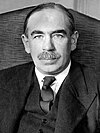
Peter Drucker on John Maynard Keynes
“I suddenly realized that Keynes and all the brilliant economic students in the room were interested in the behavior of commodities... while I was interested in the behavior of people.”
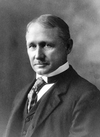
Peter Drucker on Frederick Winslow Taylor
“Frederick W. Taylor was the first man in recorded history who deemed work deserving of systematic observation and study. On Taylor's 'scientific management' rests, above all, the tremendous surge of affluence in the last seventy-five years which has lifted the working masses in the developed countries well above any level recorded before, even for the well-to-do. Taylor, though the Isaac Newton (or perhaps the Archimedes) of the science of work, laid only first foundations, however. Not much has been added to them since – even though he has been dead all of sixty years.”
Peter Drucker on Chester Barnard
“Before World War II management was the concern of a tiny band of “true believers,” mostly consultants and professors. Very few practicing managers paid any attention, though Alfred P. Sloan at General Motors, Robert E. Wood at Sears, Roebuck, and Chester Barnard at the American Telephone Company—to mention some prominent Americans—were significant exceptions. But even Barnard’s colleagues at the Telephone Company showed no interest in what they considered his hobby. Few managers at that time would have even realized that they practiced management; and concern with management as a field of study, as a discipline, and as a social function was practically nonexistent.”

Quotes About Peter Drucker
Gain deeper perspective through quotes about Peter Drucker from others.
Robert Heller on Peter Drucker
“Although he reputedly hated the label of ‘guru’, Peter Drucker was, by any standards, the greatest management guru the world has yet seen. In 1996, the McKinsey Quarterly journal described him as ‘the one guru to whom other gurus kowtow’ and Robert Heller described him as ‘the greatest man in the history of management’, praise indeed for a man who described himself as ‘just an old journalist’.”
Henry Kaufman on Peter Drucker
“What fascinated me about Drucker, and still does, is how he infuses his broad perspective on business issues with philosophical and historical considerations.”
Shaker A. Zahra on Peter Drucker
“The publication of Peter F. Drucker's The Practice of Management in 1954 was a turning point in the development of the discipline of management.”
Misattributed Quotes
Quotes mistakenly credited to Peter Drucker
About Peter Drucker
Peter Ferdinand Drucker (November 19 1909 – November 11 2005) was an Austrian-born American writer, management consultant and university professor. In 1943 he became a naturalized citizen of the United States. He taught at New York University and Claremont Graduate University respectively.