Perry Anderson on A Theory of Justice
← Back to Perry Anderson Profile
“No work of modern political philosophy, in any language, has generated such an enormous output of learned commentary as John Rawls's Theory of Justice. After some twenty years of uninterrupted critical flow, Rawls's new book is billed as a correction of the original, in the light of subsequent discussion. Political Liberalism offers abundant – even super-abundant – evidence of careful response to the reception of A Theory of Justice, in a forest of footnotes to different readings of it. But the attention proves selective, and the result disconcerting. Rawls's pristine theory argued for two fundamental principles of justice: first in order – equal political rights and liberties for all, and second – only such social or economic inequalities as are compatible with equal opportunity, and yield most benefit to the least well-off. These principles, Rawls maintained, would infallibly be chosen by us if we were to imagine ourselves deciding the form of a just society from the hypothetical standpoint of an ‘original position’, without any knowledge of what might be our particular lot within it. Around this core doctrine, conceived as an updated variant of Kantian constructivism to supersede all latter-day forms of utilitarian calculus, Rawls developed a capacious intellectual edifice, culminating in ethical reflections of noble scope.”
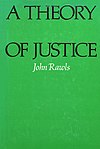
“In the advanced capitalist countries of today, the claims of absolute need are rarer than those of relative deprivation. How satisfactory is Rawls's formula for meeting these? The 'difference principle' – warranting only those inequalities which are to the greatest benefit of the least advantaged – is the most memorable single thesis of A Theory of Justice. But what is its actual import? The massive ambiguity of the Rawlsian theory of justice lies at precisely this point. Is the difference principle a powerful call for an all but socialist redistribution of income – since, on one reading, so little of the glaring disparities of wealth that surround us contributes to the well-being of the poor? Or is it, on another reading, simply a sensible defence of the normal operation of capitalism – whose constant increase of productivity, raising general living standards, requires precisely the incentive structures, tried and tested by experience, we have today? To grasp the full depth of the indeterminacy at the crux of Rawls's construction, it is enough to note that it can be applauded imperturbably at one extreme by John Roemer on the Left, and at another by Friedrich Hayek on the Right, each contending that its message coincides with their own. Clearly, both cannot be right. But Rawls's Theory, in which the legitimacy of socialism can be mooted on one page and American society held nearly just on the next, leaves space for either view. It might be said that, within its framework, the difference principle is politically indifferent.”