Paul Samuelson on Great Depression
← Back to Paul Samuelson Profile
“What ended the Great Depression? If you talk about the rest of the world, in Germany, it was the preparation for World War II. In economic terms that is fiscal policy. Not pump priming, because the pump priming notion is defective. When I put water in a country pump with a dry valve, a small amount of water is large enough to wet that valve so as to permit me to get any amount of water following it. The Keynesian multiplier says you have to put something in and you have to continually put something in. By the way, my disillusionment with straight monetary policy, orthodox policy like what Clark Warburton wrote about and what Friedman later came to write about, came when we had this "golden avalanche." We had this tremendous increase in central bank reserves. We were able to have, by this time I was at Harvard, interest rates which were really at bottom, often zero at times. And that did not operate with an infinitely elastic marginal efficiency of capital. So at that time you had to use the other macro tool of deficit fiscal policy.”
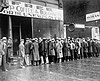
“Oh yes, and it was also valuable that the Chicago I went to was the best place in the world at that time in neoclassical economics. But that does not mean it was the best place in the world to understand the Great Depression. The Great Depression was not Euclidian geometry. I was very sensitive to this mismatch, that is to the fact that what I was learning in class could not rationalize for me that almost every bank in my neighborhoods in Northern Indiana and Illinois went broke and that almost all the money that my older brother had earned to go to college was lost. In a nutshell, about one third of the population had no jobs. And the two thirds who had jobs would not trade with them. The one third without jobs would gladly trade with them or gladly work for even less. But of course they couldn’t do that. To try and handle this kind of disequilibrium system with the historic tools of economics that were in the textbooks I was being assigned was impossible. So you can understand why, then, by complete good luck, I happily got out of Chicago.”