Link Copied!
Paul Ricœur Quotes (1913-2005)
Philosopher
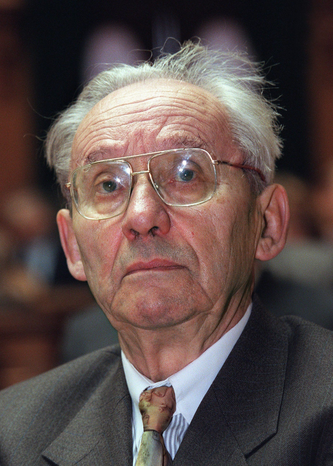

About Paul Ricœur
Paul Ricœur (1913 – 2005) was a French philosopher famous for combining phenomenological description with hermeneutics.
Best Paul Ricœur Quotes
Shortest
Earliest
Explore our curated collection of the most famous and impactful Paul Ricœur quotes.
“I dislike those who present myself as a Protestant philosopher; I am a philosopher and a Protestant.”
“If we go back to the intention [Marx, Nietzsche and Freud] had in common, we find in it the decision to look upon the whole of consciousness primarily as "false" consciousness.”

“The possibility of noncongruence, of discrepancy, in many ways already presupposes that individuals as well as collective entities are related to their own lives and to social reality not only in the mode of participation without distance but precisely in the mode of noncongruence. ... The presupposition here is precisely that of a social imagination, operating in both constructive and destructive ways, as both confirmation and contestation of the present situation.”
“People do things, and then they imagine what they are doing in a kind of cloudy realm. Thus we say first there is a social reality in which people fight to earn their living, and so on, and this is real reality, as praxis. This reality is then represented in the heaven of ideas, but it is falsely represented as having a meaning autonomous to this realm, as making sense on the basis of things which can be thought and not done or lived. The claim against ideology therefore comes from a kind of realism of life, a realism of practical life for which praxis is the alternative concept to ideology. Marx's system is materialist precisely in its insistence that the materiality of praxis precedes the ideality of ideas.”

Paul Ricœur Quotes by Topic
Find exactly what you are looking for by browsing this categorized list of Paul Ricœur quotes by topic.
Paul Ricœur on Ideology
“People do things, and then they imagine what they are doing in a kind of cloudy realm. Thus we say first there is a social reality in which people fight to earn their living, and so on, and this is real reality, as praxis. This reality is then represented in the heaven of ideas, but it is falsely represented as having a meaning autonomous to this realm, as making sense on the basis of things which can be thought and not done or lived.”

Quotes About Paul Ricœur
Gain deeper perspective through quotes about Paul Ricœur from others.
Rita Felski on Paul Ricœur
“The "hermeneutics of suspicion" is a phrase coined by Paul Ricoeur to capture a common spirit that pervades the writings of Marx, Freud, and Nietzsche. In spite of their obvious differences, he argued, these thinkers jointly constitute a "school of suspicion." That is to say, they share a commitment to unmasking "the lies and illusions of consciousness;" they are the architects of a distinctively modern style of interpretation that circumvents obvious or self-evident meanings in order to draw out less visible and less flattering truths (Ricoeur 356). Ricoeur’s term has sustained an energetic after-life within religious studies, as well as in philosophy, intellectual history, and related fields[.]”
Massimo Introvigne on Paul Ricœur
“In 1965, French philosopher Paul Ricœur called Marx, Nietzsche, and Freud the three “maîtres du soupçon,” the “masters of suspicion” that made us regard the conscience as something suspect. Because of these three ideologues, many no longer trust their conscience. They are no longer sure that it is the innate voice of God or human nature. What if the “masters of suspicion” were right, and what we call the voice of conscience is in fact the voice of those who want to deny us the right to revolution, to power, and to pleasure, who have instilled in us their pseudo-values and taught us to call them conscience?”

Ruthellen Josselson on Paul Ricœur
“Ricoeur distinguishes between two forms of hermeneutics: a hermeneutics of faith which aims to restore meaning to a text and a hermeneutics of suspicion which attempts to decode meanings that are disguised.”
Anne Hunt Overzee on Paul Ricœur
“Paul Ricœur speaks of the theologian as a hermeneut, whose task is to interpret the multivalent, rich metaphors arising from the symbolic bases of tradition so that the symbols may 'speak' once again to our existential situation.”
Marco Respinti on Paul Ricœur
“French philosopher Paul Ricœur (1913–2005), in his book “De l’interprétation. Essai sur Sigmund Freud,” published in 1965, coined the expression “school of suspicion” to describe the collective cultural aim of such famous authors as Karl Marx (1818–1883), Sigmund Freud (1856–1939), and Friedrich Nietzsche (1844–1900). While proclaiming very different and even opposite philosophies, in Ricœur’s view the ultimate attempt of Marx, Freud, and Nietzsche was to teach that reality itself cannot be trusted and fundamentally lies, and that all existing authorities are false. As “masters” (or teachers) “of suspicion,” their credo was not the legitimate critique of existing authorities for their mistakes and misdeeds, but the basic delegitimization of the very concept of authority in itself.”
About Paul Ricœur
Paul Ricœur (1913 – 2005) was a French philosopher famous for combining phenomenological description with hermeneutics.