Link Copied!
Paul Gabriël Quotes (1828-1903)
Painter
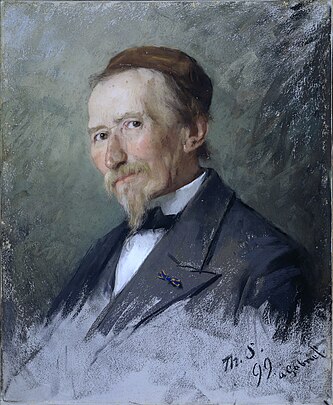
About Paul Gabriël
Paul Joseph Constantin Gabriël or Paul Gabriël (Amsterdam, 5 July 1828 – The Hague, 23 August 1903) was a painter, draftsman, watercolorist, and etcher who belonged to the Dutch Hague School. He painted frequently landscape-paintings in open air.
Best Paul Gabriël Quotes
Shortest
Earliest
Explore our curated collection of the most famous and impactful Paul Gabriël quotes.
“'Peintre Paysagiste des Polders Hollandais', ('Landscape Painter of the Dutch Polders')”
“'An early morning may look superficially gray, but it is not.. ..the dew is much more colorful than one would believe, often so strongly that the palette fails. (translation from the Dutch original: Fons Heijnsbroek)”

“Be something, be yourself; if not, ]then] throw your palette in the fire. Form a school if you wish, but it must come from the inside of you, but you yourself may not belong to any school. (translation from the Dutch original: Fons Heijnsbroek)”
“(Gabriël advises her to make both big studies and small ones) [and small studies,] ..for throwing in three curses and a sigh - forgive me that corny expression - impressions and transient effects on the canvas. Observe especially the hue of every occurring moment. (translation from the Dutch original: Fons Heijnsbroek)”

“[to mr. L. de Haes] Well, go upstairs, you know the way; are you going to take a look? At the moment you will not find many special things, but you find always something; and then we have another chat, anyway. Go ahead, I'll follow you; beware of entering because there is a large painting just in front of the door. (translation from the Dutch original: Fons Heijnsbroek)”
“..keep working quietly and have faith in what I tell you, never ask how someone else did it or is doing, try to understand nature, observe everything, try to learn to see and find your easiest way to represent it; one can make different choices from nature, follow what the heart tells you, for which you feel the most.. ..search for what contains effect, something what wants to tell clear things. (translation from the Dutch original: Fons Heijnsbroek)”
“Amice, be so good, if it is not too late, to scrape the title 'l'Aprês-Midi' ['Afternoon', title of the work submitted for the exhibition] and simply put on it 'Paysage', for the simple reason.. ..because I chose the moment [in the work] that the sun starts to color and (sic) because there is vapor - many people will wrongly see it as a 'morning'. Mauve will send another aquarelle.. (translation from the Dutch original: Fons Heijnsbroek)”
“Oh, for that matter you must look carefully how in every region of our country the map looks completely different. Not only the pastures have different shades, but the cows are different, yes even the people have, as it were, adopted the character of the soil [where] they were born and raised. That is so evident, that when I still stayed with Roelofs in Brussels [early 1860's] and we used to go to Holland to make our studies in the beautiful part of the season, coming home Roelofs didn't have to tell me where he had been. I recognized it in his work and one by one I called him the spots of our homeland [The Netherlands], where he had made sketches of the countryside and its residents during his study trip. (translation from the Dutch original: Fons Heijnsbroek)”

“Although I can look a bit grumpy myself, I love it when the sun shines in the water, but besides that I think my country is colored and what I particularly noticed when I came from abroad: our country is colored sappy fat, that's why our beautiful- colored and built cattle, their flesh, milk and butter, nowhere you can find this, but they [the cows] are also fed by that sappy, greasy and colored land - I have often heard strangers say, those Dutch painters all paint gray and their land is green.. ..the more I observe the more colored and transparent nature becomes and then the air seen altogether, something very different and yet so [strong] in harmony, it is delightful when one has learned to see, because that too must be learned, I repeat, our country is not gray, even not in gray weather, the dunes aren't gray either. (translation from the Dutch original: Fons Heijnsbroek)”
“..that one [a tree study in Gabriël's studio] is from my early times; I don't make them that way anymore; look how the thing is painted..; and those days my teachers told me that nothing would come of me in this way. What kind of folks were they? [o.a. his early and short teacher Koekoek, c. 1844-45] And which guys belonged to them? Well, let's keep mum about that; all those guys are dead already. But those days [c. 1840's] it was the ruling idea to use nature only as a tool; she had to be embellished later with imagination and so on .... imagination .... the stupidest thing in the world. (L. de Haes asked him: Do you think imagination is so improper?) Improper, I think it is simply an unhealthy trait. You see; imagination is the proper way to insanity. Imagine that you start painting from your imagination without knowing nature; after all, there will be no result whatsoever. All those people of imagination imagine so much, and it is the greatest misfortune you can have in life, you know what it is good for: to idealize your faults. (translation from the Dutch original: Fons Heijnsbroek)”
About Paul Gabriël
Paul Joseph Constantin Gabriël or Paul Gabriël (Amsterdam, 5 July 1828 – The Hague, 23 August 1903) was a painter, draftsman, watercolorist, and etcher who belonged to the Dutch Hague School. He painted frequently landscape-paintings in open air.