Link Copied!
P. G. Wodehouse Quotes (1881-1975)
Writer



About P. G. Wodehouse
Pelham Grenville Wodehouse KBE (/ˈwʊdhaʊs/; 15 October 1881 – 14 February 1975) was an English comic writer who enjoyed enormous popular success during a career that lasted more than seventy years.
Best P. G. Wodehouse Quotes
Shortest
Earliest
Explore our curated collection of the most famous and impactful P. G. Wodehouse quotes.


“"She loves this newt-nuzzling blister."”

“Ice formed on the butler's upper slopes.”
“Bingo swayed like a jelly in a high wind.”

“"The fellow with a face rather like a walnut."”
“He vanished abruptly, like an eel going into mud.”
“’You know your Shelley, Bertie!’
‘Oh, am I?’”
‘Oh, am I?’”
“I started violently, as if some unseen hand had goosed me.”
“Gussie, a glutton for punishment, stared at himself in the mirror.”

“It was a harsh, rasping voice, in its timbre not unlike a sawmill.”
“The Duke’s moustache was rising and falling like seaweed on an ebb-tide.”
“My Aunt Agatha, the curse of the Home Counties and a menace to one and all.”
“‘Are you sure?’ I said that sure was just what I wasn’t anything but.”
“‘Stinko, is he?’
'Not perhaps stinko, but certainly effervescent.’”
'Not perhaps stinko, but certainly effervescent.’”

“Aunt Agatha, who eats broken bottles and wears barbed wire next to the skin.”
“I shuddered from stem to stern, as stout barks do when buffeted by the waves.”
“I could see that, if not actually disgruntled, he was far from being gruntled.”

“Oofy, thinking of the tenner he had given Freddie, writhed like an electric fan.”

“Unseen, in the background, Fate was quietly slipping the lead into the boxing-glove.”
P. G. Wodehouse Quotes by Topic
Find exactly what you are looking for by browsing this categorized list of P. G. Wodehouse quotes by topic.
P. G. Wodehouse on Bricks
“It is pretty generally admitted that few of them were to be trusted within reach of a trowel and a pile of bricks.”

P. G. Wodehouse on Gnomes
P. G. Wodehouse on Charvet Place Vendôme
“Old Nick had taken out a cambric handkerchief, one of a set of twelve he had bought a year ago, if you call it buying, at the establishment of M. Charvet in Paris.”

P. G. Wodehouse on Tom Brown's School Days
“'You see,' went on my companion, 'the difficulty about Tom Brown's Schooldays is this. It is obvious that part one and part two were written by different people. You admit that, I suppose?'”
P. G. Wodehouse on Novel
P. G. Wodehouse on Upas
P. G. Wodehouse on Vultures
“For an author Jerry Vail was rather nice-looking, most authors, as is widely known, resembling in appearance the more degraded types of fish, unless they look like birds, when they could pass as vultures and no questions asked.”

P. G. Wodehouse on Stone Age
“When first I whispered words of love, When first you turned aside to hear, The wingèd griffin flew above, The mammoth gaily gamboll’d near; I wore the latest thing in skins Your dock-leaf dress had just been mended And fastened-up with fishes' fins— The whole effect was really splendid.”
P. G. Wodehouse on Audacity
“"Oh?" she said. "So you have decided to revise my guest list for me? You have the nerve, the – the –" I saw she needed helping out. "Audacity," I said, throwing her the line. "The audacity to dictate to me who I shall have in my house." It should have been "whom", but I let it go. "You have the –" "Crust." "– the immortal rind," she amended, and I had to admit it was stronger, "to tell me whom" – she got it right that time – "I may entertain at Brinkley Court and who" – wrong again – "I may not."”
P. G. Wodehouse on Rugby league
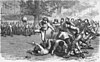
“Rugby is by its nature violent, a quality beautifully caught, via the agency of his creation Bertie Wooster, by P.G. Wodehouse, a committed fan until his post-war exile in the United States: The normal scheme is to work the ball down the field somehow and deposit it over the line at the other end, and in order to squelch this programme each side is allowed to put ina certain amount of assault and battery and do thing to its fellow man which, if done elsewhere, would result in fourteen days without the option, with some strong remarks from the bench.”

What P. G. Wodehouse Said About Others
Discover personal opinions P. G. Wodehouse shared regarding contemporaries.
P. G. Wodehouse on Geoffrey Chaucer
“It is pretty generally admitted that Geoffrey Chaucer, the eminent poet of the fourteenth century, though obsessed with an almost Rooseveltian passion for the new spelling, was there with the goods when it came to profundity of thought.”

Quotes About P. G. Wodehouse
Gain deeper perspective through quotes about P. G. Wodehouse from others.
Paul Whitehouse on P. G. Wodehouse
“I don't condone murder but your charming use of Latin and ballyhoo has left me nostalgic for the whimsical class divisions of P. G. Wodehouse, and I've forgotten your homicidal idiosyncrasies already!.”
Noel Annan on P. G. Wodehouse 2 quotes
“Wodehouse revived light English prose. He was the only Englishman who saw how the American vernacular revitalized the English language. Wodehouse's metaphors and similes replaced the epigram... Adoring public school life he remained the irrepressible fifth-former to the end of time to whom high-brows, Freud, aunts, magnates, club-bores and the Right Hon. "who looked as if he had been poured into his clothes and had forgotten to say 'When!'" were God-given targets for ragging.”
Hilaire Belloc on P. G. Wodehouse 2 quotes
“Now in the course of this broadcast I gave as the best writer of English now alive, Mr. P. G. Wodehouse... Now the end of writing is the production in the reader's mind of a certain image and a certain emotion. And the means towards that end are the use of words in any particular language; and the complete use of that medium is the choosing of the right words and the putting of them into the right order. It is this which Mr. Wodehouse does better, in the English language, than anyone else alive; or at any rate than anyone else whom I have read for many years past.”
Q. D. Leavis on P. G. Wodehouse
“A novelist has now, therefore, to choose between these alternatives: either to deal in stereotyped humour (Gentlemen Prefer Blondes and the works of P. G. Wodehouse are examples of ingenious variations on a laugh in one place—cf. humour of the eighteenth and nineteenth centuries, which communicated a whole comic attitude).”
Seán O'Casey on P. G. Wodehouse
“It is amusing to read the various wails about the villainy of Wodehouse. The harm done to England's cause and to England's dignity is not the poor man's babble in Berlin, but the acceptance of him by a childish part of the people and the academic government of Oxford, dead from the chin up, as a person of any importance whatsoever in English humorous literature, or any literature at all. It is an ironic twist of retribution on those who banished Joyce and honoured Wodehouse. If England has any dignity left in the way of literature, she will forget for ever the pitiful antics of English Literature's performing flea. If Berlin thinks the poor fish great, so much the better for us.”
Richard Usborne on P. G. Wodehouse
“The idiosyncrasy is in the false concord of phrases, the syntax of stately with vernacular, a Bible quotation collapsing into Fourth Form slang, the great Amen on the organ followed by a few notes of piffling piccolo voluntary. If you analyse the feeble mind that Wodehouse has given Bertie Wooster, you find that its feebleness, to our joy, is Bertie's inability to connect his teeming tags and images prosaically. The result is an English unofficial prose fluent with mad alienations, most savoury similes, but innocent, vulnerable and often wonderfully vivid.”
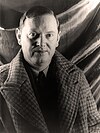
Evelyn Waugh on P. G. Wodehouse 3 quotes
“[T]he University [of Oxford] in conferring an honorary degree on Mr P. G. Wodehouse has suddenly exerted its failing strength in an action worthy of its tradition. It is speaking, as one of its most splendid functions to speak, for the educated class of the country, in recognizing Mr Wodehouse's place in literature, not perhaps, as Mr Agate claims, as "a little below Shakespeare's and any distance you like above anybody else's", but certainly as the equal among his contemporaries, as Sir Max Beerbohm and Mgr Knox, and high in the historic succession of the master-craftsmen of his trade.”
Herbert Warren Wind on P. G. Wodehouse 2 quotes
“The breadth of Wodehouse's appeal is also exceptional; down through the years, his hard-core fans have ranged from Bertrand Russell to Bix Beiderbecke, the great jazz cornettist, who could quote page after page from his stories. Herbert Asquith, during the difficult weeks that followed his defeat in 1918, found solace in reading Wodehouse, and two other British Prime Ministers, Arthur Balfour and Stanley Baldwin, were also ardent Wodehousians.”
About P. G. Wodehouse
Pelham Grenville Wodehouse KBE (/ˈwʊdhaʊs/; 15 October 1881 – 14 February 1975) was an English comic writer who enjoyed enormous popular success during a career that lasted more than seventy years.