Link Copied!
Norman Angell Quotes (1872-1967)
Writer
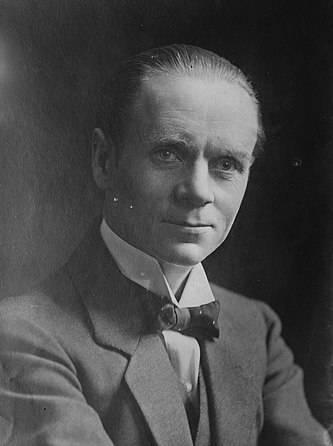
About Norman Angell
Sir Norman Angell, born Ralph Norman Angell Lane, (26 December 1872 – 7 October 1967) was a British economist, lecturer, writer, Member of Parliament for the Labour Party, and winner of the Nobel Peace Prize in 1933.
Best Norman Angell Quotes
Shortest
Earliest
Explore our curated collection of the most famous and impactful Norman Angell quotes.

“It is not the facts which guide the conduct of men, but their opinions about facts; which may be entirely wrong. We can only make them right by discussion.”
“Not more knowledge but better use of the knowledge which we now have, is perhaps the main educational need and the main educational problem which confronts us.”

“Our evils are due mainly to the failure to apply to our international relationships knowledge which is of practically universal possession, often self-evident in the facts of daily life and experience.”
“Political nationalism has become, for the European of our age the most important thing in the world, more important than civilization, humanity, decency, kindness, pity, more important than life itself.”

“The economic difficulty of the modern world is not shortage of materials but the organization of their exchange and distribution; distress arises, not from scarcity but from dislocation and maladjustment.”
“I joined the Labour Party not because it was Left Wing, but because it was definitely internationalists and would seem to be the group in the Labour Party which would serve my purpose best for propaganda along internationalist lines.”
“It is, of course, merely a truism to say that war, like other social or political evils, is the outcome of the bad management of human society, which is, in its turn, due to certain errors or deficiencies. But our task is to discern the sort of error or deficiency.”

“The root problem is very simply stated: if there were no sovereign independent states, if the states of the civilized world were organized in some sort of federalism as the states of the American Union, for instance, are organized, there would be no international war as we know it. ... The main obstacle is nationalism.”
“Within the state we have made defense of the individual the obligation of the whole community, and by that fact have established such preponderance of power on the side of the law that it could never be good business to challenge it. And that fact has, in large measure, swept highwaymen from the roads and pirates from the seas.”

“The Council of the Union of Democratic Control re-affirms its unshaken conviction that a lasting settlement cannot be secured by a peace based upon the right of conquest and followed by commercial war, but only by a peace which gives just consideration to the claims of nationality, and which lays the foundation of a real European partnership.”

“The conception that we can only protect ourselves if we are prepared to protect others surely ought to belong to the nursery stage of social education.
But such things as the mechanism of security through law, the place of force in society, are things not, it would seem, included usually in the common education of our peoples.”
But such things as the mechanism of security through law, the place of force in society, are things not, it would seem, included usually in the common education of our peoples.”
“The parties, Fascist, or other, which bring about dictatorship want dictatorship. But John Smith who insists on certain policies which produce war does not want war. The first is the result of conscious intention duly carried into effect. The second is the result of an intention which miscarries, miscarries because of certain current errors and fallacies.”

“War has no longer the justification that it makes for the survival of the fittest; it involves the survival of the less fit. The idea that the struggle between nations is a part of the evolutionary law of man's advance involves a profound misreading of the biological analogy.
The warlike nations do not inherit the earth; they represent the decaying human element.”
The warlike nations do not inherit the earth; they represent the decaying human element.”

“Why is it relatively easy for a few armament makers to persuade 'men to go to war, to give their lives; and quite impossible for the much larger group who would benefit by another form of general destruction to persuade men to destroy their property? It is broadly, of course, because the folly of burning down houses is plain; the folly of the policies which lead to war is not so plain.”
“Man's greatest advances these last few generations have been made by the application of human intelligence to the management of matter. Now we are confronted by a more difficult problem, the application of intelligence to the management of human relations. Unless we can advance in that field also, the very instruments that man's intelligence has created may be the instruments of his destruction.”

“I would not hesitate to say that nine out of ten of the critics of the peace movement get the argument turned upside down. "You cannot change human nature" has become a sort of incantation with those critics. Perhaps you cannot "change human nature" — I don't indeed know what the phrase means. But you can certainly change human behavior, which is what matters, as the whole panorama of history shows.”

“One cannot take up a leading article in even the foremost papers dealing with foreign relations, without finding it assumed that European governments have the instincts of savages and the foresight of cattle-lifters. Are we to assume that the governments of the world, which presumably are directed by men as farsighted as bankers, are permanently to fall below the banker in their conception of enlightened self-interest?”
“Let us face squarely the paradox that the world which goes to war is a world, usually, genuinely desiring peace. War is the outcome, not mainly of evil intentions, but on the whole, of good intentions which miscarry or are frustrated. It is made, not usually by evil men knowing themselves to be wrong, but is the outcome of policies pursued by good men usually passionately convinced that they are right.”
“The more our commercial system gains in complication, the more does the common prosperity of us all come to depend upon the due performance of all contracts. Commercial development is broadly illustrating one profound truth: that the real basis of social morality is self-interest. If the subject of rivalry between nations is business, the code which has come to dominate business must necessarily come to dominate the conduct of governments.”

“The prosperity of a people depends upon such facts as the natural wealth of the country in which they live, their social discipline and industrial character, the result of generations, of centuries, it may be, of tradition. In addition it depends upon a special technical capacity for such-and-such a manufacture, a special aptitude for meeting the peculiarities of such-and-such a market, the efficient equipment of elaborately constructed workshops, and the existence of a population trained to given trades.”
“The convictions of the multitudes — and on certain points like the desirability of organizing the world on a nationalist basis there is overwhelming agreement — are sincere convictions. They are, as we know, sometimes disastrously erroneous; but they are also disastrously honest. The Nationalisms, the Protectionisms, the Mercantilisms and all the other fallacies which rack Europe and create the chaos are sincerely held fallacies. They are, to these multitudes, the truth, and the prophet who denies them shall be stoned.”
“We seem to assume that if only someone could find the cure for our disease, some new plan, we should at once see that it was the cure and apply it. We ask for leaders and leadership. But if the right course, which the leader indicates, is regarded by the multitudes sincerely as the wrong one, they will declare that he is no leader but a misleader. Inevitably in a democracy the leader is he who expresses existing convictions in the most vivid way, who possesses, as someone puts it, "the common mind to an uncommon degree".”
“'''In the modern world, material is only wealth if you can get rid of it. The British miner cannot eat his coal, nor clothe his children with it, nor build his house with it. If coal is to mean for the British miner food and shelter and clothing, he must get rid of it. Get rid of it, that is, to someone who has money, sell it. But how is that someone to get money? He can only get it by one means: By getting rid of his material to someone who has money, who can only get money by getting rid of his material — round the world.”

Quotes About Norman Angell
Gain deeper perspective through quotes about Norman Angell from others.
John Quiggin (28 July 2004) on Norman Angell
“Angell argued that in a modern economy no economic benefit could be generated even by successful wars of conquest... Angell’s argument showed, beyond reasonable doubt, that war and territorial expansion are not, in general sensible policies. His views have often been derided on the basis that they were falsified by the outbreak of the Great War in 1914, which was pursued to the bitter end even though it destroyed the global market economy that had formed the backdrop to his analysis. But in reality the outcome proved him right. Of course, Germany, the power most influenced by the arguments of Clausewitz and his successors, reaped nothing but grief from the war. But the attempts of the victorious allies to exact reparations, extend their colonial influence and so on were also entirely futile, exactly as Angell had predicted.”
Source on Norman Angell 6 quotes
“In 1909, he published a little book of some hundred pages, Europe's Optical Illusion, and he awoke one morning to find himself famous.”
About Norman Angell
Sir Norman Angell, born Ralph Norman Angell Lane, (26 December 1872 – 7 October 1967) was a British economist, lecturer, writer, Member of Parliament for the Labour Party, and winner of the Nobel Peace Prize in 1933.