Link Copied!
Niels Bohr Quotes (1885-1962)
Physicist, Philosopher









About Niels Bohr
Niels Henrik David Bohr (7 October 1885 – 18 November 1962) was a Danish physicist who made foundational contributions to understanding atomic structure and quantum theory, for which he received the Nobel Prize in Physics in 1922. Bohr was also a philosopher and a promoter of scientific research.
Best Niels Bohr Quotes
Shortest
Earliest
Explore our curated collection of the most famous and impactful Niels Bohr quotes.
“Contraria Sunt Complementa”
“I go into the Upanishads to ask questions.”

“Truth and clarity are complementary.”


“Anyone who is not shocked by quantum theory has not understood it.”
“Every sentence I utter must be understood not as an affirmation, but as a question.”

“It is a great pity that human beings cannot find all of their satisfaction in scientific contemplativeness.”
“Those who are not shocked when they first come across quantum theory cannot possibly have understood it.”
“Even the mathematical framework helps nothing, I would first like to understand how Nature avoids the contradictions. (1927)”

“Isolated material particles are abstractions, their properties being definable and observable only through their interaction with other systems.”
“We must be clear that when it comes to atoms, language can be used only as in poetry. The poet, too, is not nearly so concerned with describing facts as with creating images and establishing mental connections.”
“The great extension of our experience in recent years has brought light to the insufficiency of our simple mechanical conceptions and, as a consequence, has shaken the foundation on which the customary interpretation of observation was based.”
“I am absolutely prepared to talk about the spiritual life of an electronic computer: to state that it is reflecting or is in a bad mood... The question whether the machine really feels or ponders, or whether it merely looks as though it did, is of course absolutely meaningingless. ”
“Two sorts of truth: profound truths recognized by the fact that the opposite is also a profound truth, in contrast to trivialities where opposites are obviously absurd.
• Unsourced variant: The opposite of a correct statement is a false statement. But the opposite of a profound truth may well be another profound truth.”
• Unsourced variant: The opposite of a correct statement is a false statement. But the opposite of a profound truth may well be another profound truth.”

“For a parallel to the lesson of atomic theory regarding the limited applicability of such customary idealizations, we must in fact turn to quite other branches of science, such as psychology, or even to that kind of epistemological problems with which already thinkers like Buddha and Lao Tzu have been confronted, when trying to harmonize our position as spectators and actors in the great drama of existence.”
“Physics is to be regarded not so much as the study of something a priori given, but rather as the development of methods of ordering and surveying human experience. In this respect our task must be to account for such experience in a manner independent of individual subjective judgement and therefore objective in the sense that it can be unambiguously communicated in ordinary human language.”

“What is it that we humans depend on? We depend on our words... Our task is to communicate experience and ideas to others. We must strive continually to extend the scope of our description, but in such a way that our messages do not thereby lose their objective or unambiguous character ... We are suspended in language in such a way that we cannot say what is up and what is down. The word "reality" is also a word, a word which we must learn to use correctly.”
“However far the phenomena transcend the scope of classical physical explanation, the account of all evidence must be expressed in classical terms. The argument is that simply by the word "experiment" we refer to a situation where we can tell others what we have done and what we have learned and that, therefore, the account of the experimental arrangement and of the results of the observations must be expressed in unambiguous language with suitable application of the terminology of classical physics.”
“The grand discoveries which scientific experiment yielded at and about the turn of the century, in which investigators in many countries took an eminent part and which were destined all unexpectedly to give us a fresh insight into the structure of atoms, were due in the first instance, as all are aware, to the work of the great investigators of the English school, Sir Joseph Thomson and Sir Ernest Rutherford, who have inscribed their names on the tablets of the history of scientific research as distinguished witnesses to the truth that imagination and acumen are capable of penetrating the crowded mass of registered experience and of revealing Nature's simplicity to our gaze.”
“I feel very much like Dirac: the idea of a personal God is foreign to me. But we ought to remember that religion uses language in quite a different way from science. The language of religion is more closely related to the language of poetry than to the language of science. True, we are inclined to think that science deals with information about objective facts, and poetry with subjective feelings. Hence we conclude that if religion does indeed deal with objective truths, it ought to adopt the same criteria of truth as science. But I myself find the division of the world into an objective and a subjective side much too arbitrary. The fact that religions through the ages have spoken in images, parables, and paradoxes means simply that there are no other ways of grasping the reality to which they refer. But that does not mean that it is not a genuine reality. And splitting this reality into an objective and a subjective side won't get us very far.”

“In mathematics we can take our inner distance from the content of our statements. In the final analysis mathematics is a mental game that we can play or not play as we choose. Religion, on the other hand, deals with ourselves, with our life and death; its promises are meant to govern our actions and thus, at least indirectly, our very existence. We cannot just look at them impassively from the outside. Moreover, our attitude to religious questions cannot be separated from our attitude to society. Even if religion arose as the spiritual structure of a particular human society, it is arguable whether it has remained the strongest social molding force through history, or whether society, once formed, develops new spiritual structures and adapts them to its particular level of knowledge. Nowadays, the individual seems to be able to choose the spiritual framework of his thoughts and actions quite freely, and this freedom reflects the fact that the boundaries between the various cultures and societies are beginning to become more fluid. But even when an individual tries to attain the greatest possible degree of independence, he will still be swayed by the existing spiritual structures — consciously or unconsciously. For he, too, must be able to speak of life and death and the human condition to other members of the society in which he's chosen to live; he must educate his children according to the norms of that society, fit into its life. Epistemological sophistries cannot possibly help him attain these ends. Here, too, the relationship between critical thought about the spiritual content of a given religion and action based on the deliberate acceptance of that content is complementary. And such acceptance, if consciously arrived at, fills the individual with strength of purpose, helps him to overcome doubts and, if he has to suffer, provides him with the kind of solace that only a sense of being sheltered under an all-embracing roof can grant. In that sense, religion helps to make social life more harmonious; its most important task is to remind us, in the language of pictures and parables, of the wider framework within which our life is set.”

“I consider those developments in physics during the last decades which have shown how problematical such concepts as "objective" and "subjective" are, a great liberation of thought. The whole thing started with the theory of relativity. In the past, the statement that two events are simultaneous was considered an objective assertion, one that could be communicated quite simply and that was open to verification by any observer. Today we know that 'simultaneity' contains a subjective element, inasmuch as two events that appear simultaneous to an observer at rest are not necessarily simultaneous to an observer in motion. However, the relativistic description is also objective inasmuch as every observer can deduce by calculation what the other observer will perceive or has perceived. For all that, we have come a long way from the classical ideal of objective descriptions.
In quantum mechanics the departure from this ideal has been even more radical. We can still use the objectifying language of classical physics to make statements about observable facts. For instance, we can say that a photographic plate has been blackened, or that cloud droplets have formed. But we can say nothing about the atoms themselves. And what predictions we base on such findings depend on the way we pose our experimental question, and here the observer has freedom of choice. Naturally, it still makes no difference whether the observer is a man, an animal, or a piece of apparatus, but it is no longer possible to make predictions without reference to the observer or the means of observation. To that extent, every physical process may be said to have objective and subjective features. The objective world of nineteenth-century science was, as we know today, an ideal, limiting case, but not the whole reality. Admittedly, even in our future encounters with reality we shall have to distinguish between the objective and the subjective side, to make a division between the two. But the location of the separation may depend on the way things are looked at; to a certain extent it can be chosen at will. Hence I can quite understand why we cannot speak about the content of religion in an objectifying language. The fact that different religions try to express this content in quite distinct spiritual forms is no real objection. Perhaps we ought to look upon these different forms as complementary descriptions which, though they exclude one another, are needed to convey the rich possibilities flowing from man's relationship with the central order.”
In quantum mechanics the departure from this ideal has been even more radical. We can still use the objectifying language of classical physics to make statements about observable facts. For instance, we can say that a photographic plate has been blackened, or that cloud droplets have formed. But we can say nothing about the atoms themselves. And what predictions we base on such findings depend on the way we pose our experimental question, and here the observer has freedom of choice. Naturally, it still makes no difference whether the observer is a man, an animal, or a piece of apparatus, but it is no longer possible to make predictions without reference to the observer or the means of observation. To that extent, every physical process may be said to have objective and subjective features. The objective world of nineteenth-century science was, as we know today, an ideal, limiting case, but not the whole reality. Admittedly, even in our future encounters with reality we shall have to distinguish between the objective and the subjective side, to make a division between the two. But the location of the separation may depend on the way things are looked at; to a certain extent it can be chosen at will. Hence I can quite understand why we cannot speak about the content of religion in an objectifying language. The fact that different religions try to express this content in quite distinct spiritual forms is no real objection. Perhaps we ought to look upon these different forms as complementary descriptions which, though they exclude one another, are needed to convey the rich possibilities flowing from man's relationship with the central order.”
Niels Bohr Quotes by Topic
Find exactly what you are looking for by browsing this categorized list of Niels Bohr quotes by topic.
Niels Bohr on Trivialism 7 quotes
View all 7 quotes on Trivialism →Niels Bohr on Atom 2 quotes
“We must be clear that when it comes to atoms, language can be used only as in poetry. The poet, too, is not nearly so concerned with describing facts as with creating images and establishing mental connections.”

Niels Bohr on Upanishads
“I go into the Upanishads to ask questions.”
Niels Bohr on Quantum mechanics
“For those who are not shocked when they first come across quantum theory cannot possibly have understood it.”

Niels Bohr on Mistakes
“An expert is a person who has found out by his own painful experience all the mistakes that one can make in a very narrow field.”
What Niels Bohr Said About Others
Discover personal opinions Niels Bohr shared regarding contemporaries.
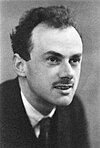
Niels Bohr on Paul Dirac
“Dirac was the strangest man who ever visited my institute. […] During one of Dirac’s visits I asked him what he was doing. He replied that he was trying to take the square-root of a matrix, and I thought to myself what a strange thing for such a brilliant man to be doing. Not long afterwards the proof sheets of his article on the equation arrived, and I saw he had not even told me that he had been trying to take the square root of the unit matrix!”
Quotes About Niels Bohr
Gain deeper perspective through quotes about Niels Bohr from others.
Alain Aspect on Niels Bohr
“We pretend that if I get result +1 here, immediately the photon there is in the state |x>, but if I find -1, immediately the other photon assume[s] another state of polarization... [T]his image is not acceptable for Einstein because it seems as [though] something is going faster-than-light. ...It is by this ...reasoning that Einstein said... "If you want to make sense of this correlation at a distance, you have to accept that before they arrive at the measuring apparatus, the particles have already a property determining the outcome." ...Bohr disagreed immediately. ...I don't know anybody who finds Bohr's reply understandable. It's not a joke, what I'm going to say, although it sounds [like] a joke. Bohr is so cautious in his wording that he makes it almost impossible to understand... Bohr insisted on complementarity, and at one point he declared... that "Clarity and truth are complementary," and he made all efforts to be as true as possible.”

John S. Bell on Niels Bohr
“Bohr seemed to think that he had solved this question. I could not find his solution in his writings. But there was no doubt that he was convinced that he had solved the problem and, in so doing, had not only contributed to atomic physics, but to epistemology, to philosophy, to humanity in general. And there are astonishing passages in his writings in which he is sort of patronizing to the ancient Far Eastern philosophers, almost saying that he had solved the problems that had defeated them. It's an extraordinary thing for me—the character of Bohr—absolutely puzzling. I like to speak of two Bohrs: one is a very pragmatic fellow who insists that the apparatus is classical, and the other is a very arrogant, pontificating man who makes enormous claims for what he has done.”
Hans Henrik Bohr on Niels Bohr
“One of the favorite maxims of my father was the distinction between the two sorts of truths, profound truths recognized by the fact that the opposite is also a profound truth, in contrast to trivialities where opposites are obviously absurd.”
Max Born on Niels Bohr
“If quantum theory has any philosophical importance at all, it lies in the fact that it demonstrates for a single, sharply defined science the necessity of dual aspects and complementary considerations. Niels Bohr has discussed this question with respect to many applications in physiology, psychology, and philosophy in general.”




Disputed Quotes
Quotes attributed to Niels Bohr that are questionable.
“Anyone who is not shocked by quantum theory has not understood it.”
“Prediction is very difficult, especially about the future.
• Variant: It's hard to make predictions, especially about the future.”
• Variant: It's hard to make predictions, especially about the future.”
“Stop telling God what to do with his dice.
• Variant: Einstein, don't tell God what to do.
• Variant: Don't tell God what to do with his dice.
• Variant: You ought not to speak for what Providence can or can not do. – As described in The Physicists: A generation that changed the world (1981) by C. P. Snow, p. 84”
• Variant: Einstein, don't tell God what to do.
• Variant: Don't tell God what to do with his dice.
• Variant: You ought not to speak for what Providence can or can not do. – As described in The Physicists: A generation that changed the world (1981) by C. P. Snow, p. 84”
Misattributed Quotes
Quotes mistakenly credited to Niels Bohr
“Everything we call real is made of things that cannot be regarded as real.”
About Niels Bohr
Niels Henrik David Bohr (7 October 1885 – 18 November 1962) was a Danish physicist who made foundational contributions to understanding atomic structure and quantum theory, for which he received the Nobel Prize in Physics in 1922. Bohr was also a philosopher and a promoter of scientific research.