Niall Ferguson on Stalinism
← Back to Niall Ferguson Profile
“'Socialism in one country' was Stalin's solution to the problem that had repeatedly divided the leadership of the Bolshevik Party since Lenin's death in 1924. How could the revolutionary regime achieve the industrialization of Russia's backward rural economy without the resources of the more developed West? Trotsky had seen world revolution as the only answer. When that failed to materialize, other Bolshevik leaders, notably Nikolai Bukharin, were inclined to conclude that rapid industrialization was no longer an option. The pace would have to be slow. Stalin, ruthlessly positioning himself to be Lenin's successor - suppressing Lenin's deathbed warning against him - rode roughshod over these rarefied debates. Rapid industrialization, he insisted, was possible within the borders of the Soviet Union. All that was needed was a plan, and the iron willpower that had won the civil war. What Stalin meant by 'socialism in one country' was a new revolution - an economic revolution that he, the self-styled 'man of steel', would lead. Under the first Five-Year Plan, Soviet output was to be increased by a fifth. Managers were encouraged to 'over-fulfil their quotas'; workers were exhorted to work superhumanly long shifts in imitation of the heroic miner and shock worker (udarnik) Aleksei Stakhanov.”
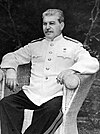
“Ostensibly, the aim was to strengthen the Soviet Union, to make it the economic, and hence the military, equal of the 'imperialist' powers still ranged against it. Yet Stalin always saw the strategic benefits of industrialization as secondary to the social transformation it implied. By forcing a huge transfer of manpower and resources from the countryside into the cities, he aimed to enlarge at a stroke the Soviet proletariat on which the Revolution was supposedly based. He succeeded: between 1928 and 1939 the urban labour force trebled in size. How precisely this was achieved was something Stalin's star-struck Western admirers preferred to ignore. Even as the working class was artificially bloated in size, around four million people were 'disfranchised' because they had been 'class enemies' before the Revolution. 'Non-toilers' found themselves ousted from their jobs, from schools and hospitals, from the system of food rationing, even from their homes. In Stalin's eyes, all surviving elements of the pre-revolutionary society - former capitalists, nobles, merchants, officiais, priests and kulaks - remained a real threat 'with all their class sympathies, antipathies, traditions, habits, opinions, world views and so on'. They had to be unmasked and expelled from the Soviet body politic. Only in late 1935, after years of denunciations, disfranchisements and all the attendant deprivations, did Stalin seem to signal an end to the campaign against the offspring of 'class aliens' - but only to turn public attention to a new category of 'enemies of the people'.”
“It was all economic lunacy, perfectly symbolized by the palm trees the workers at Magnitogorsk built for themselves out of telegraph poles and sheet steel in lieu of real foliage. Collectivization wrecked Soviet agriculture. Forced industrialization misallocated resources as much as it mobilized them. Cities like Magnitogorsk cost far more to support than the planners acknowledged, since coal had to be transported there from Siberian mines more than a thousand miles away. Just heating the homes of miners in Arctic regions burned a huge proportion of the coal they dug up. For all these reasons the economic achievements of Stalinism were far less than was claimed at the time by the regime and its numerous apologists. Between 1929 and 1937, according to the official Soviet statistics, the gross national product of the USSR increased at an annual rate of between 9.4 and 16.7 per cent and per capita consumption by between 3.2 and 12.5 per cent, figures that bear comparison with the growth achieved by China since the early 1990s. But when allowances are made for idiosyncratic pricing conventions, real GNP growth was closer to 3-4.9 per cent per annum, while per capita consumption rose by no more than 1.9 per cent and perhaps by as little as 0.6 per cent per annum - roughly a fifth or a sixth of the official figure. In any case, what do per capita figures mean when the number of people is being drastically reduced by political violence? If there was any productivity growth under the Five-Year Plans - and the statistics suggest that there was - it was partly because so much labour was being shed for political rather than economic reasons. No serious analysis can regard a policy as economically 'necessary' if it involves anything up to twenty million excess deaths. For every nineteen tons of additional steel produced in the Stalinist period, approximately one Soviet citizen was killed. Yet anyone who questioned the rationality of Stalin's policies risked incurring the wrath of his loyal lieutenants.”