Link Copied!
Neil Postman Quotes (1931-2003)
Author

About Neil Postman
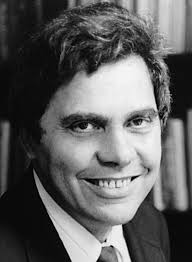
Neil Postman (8 March 1931 - 5 October 2003) was an American author, educator, media theorist and cultural critic, who eschewed technology, including personal computers in school and cruise control in cars, and is best known for twenty books regarding technology and education and his association with New York University for more than forty years.
Best Neil Postman Quotes
Shortest
Earliest
Explore our curated collection of the most famous and impactful Neil Postman quotes.
“A definition is the start of an argument, not the end of one.”

“The clearest way to see through a culture is to attend to its tools for conversation.”

“As technical people, we are apt to be preoccupied with scores, not competence...”
“The effects of technology are always unpredictable. But they are not always inevitable.”

“What ideas are convenient to express inevitably becomes the important content of a culture.”
“Reflect on these questions — and others that these can generate. Please do not merely react to them.”
“The principal strength of the telegraph was its capacity to move information, not collect it, explain it or analyze it.”
“There is a difference between rape and seduction, technology can rape a culture or be forced to seduce it.”

“Eyeglasses refuted the belief that anatomy is destiny by putting forward the idea that our bodies as well as our minds are improvable.”
“In a purely oral culture, intelligence is often associated with aphoristic ingenuity, that is, the power to invent compact sayings of wide applicability.”

“In a world without spiritual or intellectual order, nothing is unbelievable; nothing is predictable, and therefore, nothing comes as a particular surprise.”

“What I am claiming here is not that television is entertaining but that it has made entertainment itself the natural format for the representation of all experience.”


“The key to all fanatical beliefs is that they are self-confirming....(some beliefs are) fanatical not because they are "false", but because they are expressed in such a way that they can never be shown to be false.”
“We do not know nearly as much as we should about how children learn language, but if there is one thing we can say with assurance it is that knowledge of grammatical nomenclature and skill in sentence-parsing have no bearing whatsoever on the process.”
“Gutenberg thought his invention would advance the cause of the Holy Roman See, whereas in fact, it turned out to bring a revolution which destroyed the monopoly of the Church.”


“Writing freezes speech and in so doing gives birth to the grammarian, the logician, the rhetorician, the historian, the scientist -- all those who must hold language before them so that they can see what it means, where it errs, and where it is leading.”

“There is no such thing in nature as “man” or “tree.” The universe offers no such categories or simplifications; only flux and infinite variety. The photograph documents and celebrates the particularities of this infinite variety. Language makes them comprehensible.”
“The world in which we live is very nearly incomprehensible to most of us. There is almost no fact - whether actual or imagined - that will surprise us for very long, since we have no comprehensive and consistent picture of the world which would make the fact appear as an unacceptable contradiction.”

“Of all things to be learned, in school or out, languaging, as I prefer to call the process, is least like a mechanical skill. It is, in fact, the most intimate, integrated, emotion-laden learning we do. At no point can we separate what we know and what we are from how our linguistic powers develop...”
“We no longer have a coherent conception of ourselves, and our universe, and our relation to one another and our world. We no longer know, as the Middle Ages did, where we come from, and where we are going, or why. That is, we don't know what information is relevant, and what information is irrelevant to our lives.”
“They will give us artificial intelligence, and tell us that this is the way to self-knowledge... instantaneous global communication... the way to mutual understanding... Virtual Reality... the answer to spiritual poverty. But that is only the way of the technician, the fact-mongerer, the information junkie, and the technological idiot.”

“Since there is no such thing as complete knowledge of a subject, one is always working to improve one's reading, writing, etc., of a subject. As Thomas Henry Huxley said, "If a little knowledge is a dangerous thing, is there anyone who knows so much as to be out of danger?" …. The problems of learning to read or write are inexhaustible.”

Neil Postman Quotes by Topic
Find exactly what you are looking for by browsing this categorized list of Neil Postman quotes by topic.
Neil Postman on Definition 8 quotes
“A definition is the start of an argument, not the end of one.”
Neil Postman on Devotion
Neil Postman on Fanaticism
“The key to all fanatical beliefs is that they are self-confirming....(some beliefs are) fanatical not because they are "false", but because they are expressed in such a way that they can never be shown to be false.”

Neil Postman on Judgment
“You cannot avoid making judgements but you can become more conscious of the way in which you make them. This is critically important because once we judge someone or something we tend to stop thinking about them or it.”

Neil Postman on Democracy
“One of the insidious facts about totalitarianism is its seeming "efficiency." …Democracy — with all of its inefficiency — is still the best system we have so far for enhancing the prospects of our mutual survival.”

Neil Postman on World view
“Two opposing world-views — the technological and the traditional — coexisted in uneasy tension. The technological was the stronger, of course, but the traditional was there — still functional, still exerting influence...”

Neil Postman on Time
“Children are the living messages we send to a time we will not see. From a biological point of view it is inconceivable that any culture will forget that it needs to reproduce itself. But it is quite possible for a culture to exist without a social idea of children. Unlike infancy, childhood is a social artifact, not a biological category.”

Neil Postman on Method
“If every college teacher taught his courses in the manner we have suggested, there would be no needs for a methods course. Every course would be a course in methods of learning and, therefore, in methods of teaching. For example, a "literature" course would be a course in the process of learning how to read. A history course would be a course in the process of learning how to do history. And so on. But this is the most farfetched possibility of all since college teachers, generally speaking, are more fixated on the Trivia game, than any group of teachers in the educational hierarchy. Thus we are left with the hope that, if methods courses could be redesigned to be model learning environments, the educational revolution might begin.”
Neil Postman on Psychotherapy
“Scientific language, which Korzybski used as his model of sane language, is almost exclusively extensional and denotative, or at least tries to be. The language of the mentally ill, most obviously "un-sane," is almost totally intensional and connotative. This is the language that does not correspond to anything "out there," and this is, in fact, how and perhaps even why the user is mentally ill. Korzybski's concern with keeping the conscious "connection" or correspondence between language and verifiable referents is, for all practical purposes, paralleled by the process of psychotherapy. In this process, which is largely "just talk," the purpose is to foster closer and more accurate correspondence between the patient's language and externally verifiable meanings.”

What Neil Postman Said About Others
Discover personal opinions Neil Postman shared regarding contemporaries.
Neil Postman on Alfred Korzybski
“Scientific language, which Korzybski used as his model of sane language, is almost exclusively extensional and denotative, or at least tries to be. The language of the mentally ill, most obviously "un-sane," is almost totally intensional and connotative. This is the language that does not correspond to anything "out there," and this is, in fact, how and perhaps even why the user is mentally ill. Korzybski's concern with keeping the conscious "connection" or correspondence between language and verifiable referents is, for all practical purposes, paralleled by the process of psychotherapy. In this process, which is largely "just talk," the purpose is to foster closer and more accurate correspondence between the patient's language and externally verifiable meanings.”

About Neil Postman
Neil Postman (8 March 1931 - 5 October 2003) was an American author, educator, media theorist and cultural critic, who eschewed technology, including personal computers in school and cruise control in cars, and is best known for twenty books regarding technology and education and his association with New York University for more than forty years.