Link Copied!
Nathuram Godse Quotes (1910-1949)
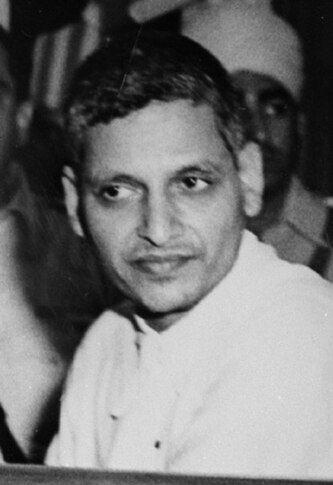

About Nathuram Godse
Nathuram Vinayak Godse (19 May 1910 – 15 November 1949) was the assassin of Mahatma Gandhi. He was a Hindu nationalist who shot Gandhi in the chest three times at point blank range at a multi-faith prayer meeting in Birla House in New Delhi on 30 January 1948. Godse was a member of the political party, the Hindu Mahasabha; and a member of the Rashtriya Swayamsevak Sangh (RSS), a right-wing Hindu paramilitary volunteer organization; and a popularizer of the work of his mentor Vinayak Damodar Savarkar, who had created the ideology of Hindutva.
Best Nathuram Godse Quotes
Shortest
Earliest
Explore our curated collection of the most famous and impactful Nathuram Godse quotes.

“Had this act not been done by me, of course it would have been better for me. But circumstances were beyond my control.”
- Nathuram Godse, Nathuram Godse

“Please, see to it that mercy is not imposed on me. I want to show that through me, Gandhiji’s non-violence is being hanged.”
“I never took a vow of celibacy as I was already practising celibacy. (Godse referring to Gandhi's diktat of advocating celibacy even to newlyweds)”
- Nathuram Godse, Excerpts from the play Mee Nathuram Godse boltoy)
“There was only one common factor in Gandhi's life and mine. We were both the cause of each other's death. He wanted to live at any cost for his principles and I was prepared to die at all costs for mine.”
- Nathuram Godse, Excerpts from the play Mee Nathuram Godse boltoy)

“I sat brooding intensely on the atrocities perpetrated on Hinduism and its dark and deadly future if left to face Islam outside and Gandhi inside, and (…) decided all of a sudden to take the extreme step against Gandhi.”
- Nathuram Godse, Nathuram Godse

“I never stole in my childhood, so there was no question of apologising to my father. (Godse referring to Gandhi's autobiographical story, where Gandhi stole a piece of gold from his father's watch and later on apologised to his father)”
- Nathuram Godse, Excerpts from the play Mee Nathuram Godse boltoy)
“I was moving around the refugee camps and helping the destitute with food and clothes. But I did not wander half-naked because the refugees were naked. (Godse referring to Gandhi's way of empathising with destitutes not by helping them but by imitating their unfortunate circumstances)”
- Nathuram Godse, Excerpts from the play Mee Nathuram Godse boltoy)
“Bhajans were also not spared (by Gandhi). The soul-elevating chanting of "Raghupati Raja Ram patita pavana Sita Ram" was intoned on the lips of millions of our countrymen for the last several centuries. A new line "Ishwar Allah tere nam, sab so sanmati de Bhagavan" was added to the original.”
- Nathuram Godse, The Tragic Story of Partition)
“‘150. My confidence about the moral side of my action has not been shaken even by the criticism levelled against it on all sides. I have no doubt honest writers of history will weigh my act and find the true value thereof on some day in future.
‘Akhand Bharat Amar Rahe!
‘Vande Mataram!’”
‘Akhand Bharat Amar Rahe!
‘Vande Mataram!’”
- Nathuram Godse, Nathuram Godse

“128. It would not be out of place to state here that the ashes of Gandhiji were distributed in large towns and many rivers in India and abroad but the said ashes could not be immersed in the Holy Indus passing through the Pakistan in spite of the endeavors of Shri Shree Prakash, the Indian High Commissioner in Pakistan.”
- Nathuram Godse, Nathuram Godse

“All this reading and thinking led me to believe it was my first duty to serve Hindudom and Hindus both as a patriot and as a world citizen. To secure the freedom and to safeguard the just interests of some thirty crores (300 million) of Hindus would automatically constitute the freedom and the well-being of all India, one fifth of human race.”
- Nathuram Godse, Nathuram Godse

“‘136. There now remains hardly anything for me to say. If devotion to one’s country amounts to a sin, I admit I have committed that sin. If it is meritorious, I humbly claim the merit thereof. I fully and confidently believe that if there be any other court of justice beyond the one founded by mortals, my act will not be taken as unjust.’”
- Nathuram Godse, Nathuram Godse

“‘149. It is a fact that in the presence of a crowd numbering 300 to 400 people I did fire shots at Gandhiji in open daylight. I did not make any attempt to run away; in fact, I never entertained any idea of running away. I did not try to shoot myself, it was never my intention to do so, for it was my ardent desire to give vent to my thoughts in an open Court.”
- Nathuram Godse, Nathuram Godse

“The Flag Committee in 1931 consisting of Sardar Patel, Nehru, Maulana Azad, Master Tara Singh, D B Kalelkar, N S Hardikar and Pattabhi Sitaramayya recommended that the national flag should be of kesari or saffron color having on it at the left top quarter the charkha in blue. However, the AICC dare not differ from Gandhi’s choice of the tricolor scheme. It simply okayed his decision.”
- Nathuram Godse, The Tragic Story of Partition)

“‘16. On 13th of January 1948. I learnt that Gandhiji had decided to go on fast unto death. The reason given for such fast was that he wanted an assurance of Hindu-Muslim unity in Indian Dominion. But I and many others could easily see that the real motive behind the fast was not merely the so-called Hindu-Muslim Unity, but to compel the Dominion Government to pay the sum of Rs. 55 crores to Pakistan, the payment of which was emphatically refused by the Government.’”
- Nathuram Godse, Nathuram Godse

“25. Having reached Delhi in great despair, I visited the refugee camps at Delhi. While moving in the camps my thoughts took a definite and final turn. Chancely I came across a refugee who was dealing in arms and he showed me the pistol. I was tempted to have it and I bought it from him. It is the pistol which I later used in the shots I fired. On coming to the Delhi Railway station I spent the night of 29th thinking and re-thinking about my resolve to end the present chaos and further destruction of the Hindus.”
- Nathuram Godse, Nathuram Godse

“124. When all these happenings were taking place in Pakistan, Gandhiji did not even by a single word protest and censure the Pakistan Government or the Muslims concerned. The Muslim atrocities resorted to in Pakistan to root out the Hindu culture and the Hindu society have been entirely due to the teachings of Gandhiji and his behavior. If the Indian politics had been handled in a practical manner there would never have been the terrible human slaughter as has taken place–a thing without any precedent in history.”
- Nathuram Godse, Nathuram Godse
“‘115. In the year 1938, I led the first batch of volunteers who marched into the territory of the Hyderabad State when the passive resistance movement was started by the Hindu Mahasabha, with a demand for Responsible Government in the State. I was arrested and sentenced to one year's imprisonment. I have personal experience of the uncivilized, nay barbarous rule of Hyderabad and have undergone corporal punishment of dozens of cane slashes, for the offence of singing the 'Vande Mataram’ song at the time of prayer.’”
- Nathuram Godse, Nathuram Godse

“‘140. (…) So strong was the impulse of my mind that I felt that this man should not be allowed to meet a natural death so that the world may know that he had to pay the penalty of his life for his unjust, anti-national and dangerous favouritism towards a fanatical section of the country. I decided to put an end to this matter and to the further massacre of lakhs of Hindus for no fault of theirs. May God now pardon him for his egoistic nature which proved to be too disastrous for the beloved sons of this Holy Land.’”
- Nathuram Godse, Nathuram Godse

“Gandhi exploited the feelings of tolerant Hindus with one-sided practices. Gandhi's recent prayer meetings in Hindu temples had started the practice of reading passages from the Quran, despite Hindus protesting this practice. However, Gandhi dared not read the Gita in a mosque in the teeth of Muslim opposition. Gandhi knew what a terrible Muslim reaction would have been if he had done so. Gandhi knew it is safe to trample on the tolerant Hindu. To belie this belief, I wanted to prove that a Hindu too could be intolerant when his honour was insulted.”
- Nathuram Godse, Nathuram Godse
“122 . Every day that dawned brought forth the news about thousands of Hindus being massacred, Sikhs numbering 15 000 having been shot dead, hundreds of women torn of their clothes being made naked and taken into procession and that Hindu women were being sold in the market places like cattle. Thousands and thousands of Hindus had to run away for their lives and they had lost everything of theirs. Along line of refugees extending over the length of 40 miles was moving towards the Indian Union. How was this terrible happening counter-acted by the Union Government? Oh! by throwing bread to the refugees from the air!”
- Nathuram Godse, Nathuram Godse
Nathuram Godse Quotes by Topic
Find exactly what you are looking for by browsing this categorized list of Nathuram Godse quotes by topic.
Nathuram Godse on Assassination of Mahatma Gandhi
In his appeal after assassinating Gandhi, Nathuram Godse claimed the act was motivated by Gandhi's pro-Muslim stance and the partition's perceived destruction of India.
“The accumulating provocation of years culminating in his last pro Muslim fast, at last, goaded me to the conclusion that the existence of Gandhiji should be brought to an end immediately. When the top rank leaders of the Congress with the consent of Gandhiji divided and tore the country – which we consider as a deity of worship – my mind became full with the thoughts of direful anger. I felt that the Indian politics in the absence of Gandhiji would surely be practical, able to retaliate, and would be powerful with armed forces. I have resorted to the action I did purely for the benefit of the humanity. I do say that my shots were fired at the person whose policy and action had brought rack (sic) and ruin and destruction to lacs of Hindus.”

Quotes About Nathuram Godse
Gain deeper perspective through quotes about Nathuram Godse from others.
Gopal Godse on Nathuram Godse
“Nathuram had declared before the court that he had left the RSS in 1934 as the then RSS chief was facing a lot of trouble. But he actually never left the organisation.”
Ashis Nandy on Nathuram Godse
“Both [Gandhi and Godse] were committed and courageous nationalists; both felt that the problem of India was basically the problem of the Hindus because they constituted the majority of Indians; and both were allegiant to the idea of an undivided free India. Both felt austerity was a necessary part of political activity. Gandhi’s asceticism is well-known, but Godse too lived like a hermit. He slept on a wooden plank, using occasionally a blanket and even in the severest winter wore only a shirt. Contrary to the idea fostered by the popular Hollywood film on him, Nine Hours to Rama, Godse neither smoked nor drank. In fact, he took Gandhi’s rejection of sexuality even further: he never married and remained a strict celibate. Like Gandhi, Godse considered himself a sanatani or traditional Hindu and, in deference to his own wishes, he was cremated according to sanatani rites... Yet, and in this respect too he resembled Gandhi, he said he believed in a casteless Hindu society and in a democratic polity. He was even in favour of Gandhi’s attempts to mobilize the Indian Muslims for the nationalist cause by making some concessions to the Muslim leadership. Perhaps it was not an accident that Godse began his political career as a participant in the civil disobedience movement started by Gandhi and ended his political life with a speech from the witness stand which, in spite of being an attack on Gandhi, none the less revealed a grudging respect for what Gandhi had done for the country.”
About mass killings of Brahmins on Nathuram Godse
Following Gandhi's assassination by a Brahmin, this passage highlights a largely unacknowledged wave of retaliatory violence against Brahmins and Hindu nationalist groups, potentially resulting in hundreds of deaths.
“One immediate consequence of the murder which is usually left unmentioned in the numerous hagiographies of the Mahatma is the wave of revenge which hit the Hindu Mahasabha, the RSS and most of all, the Chitpavan Brahmin caste. It seems that most hagiographers were embarrassed with the way the apostle of non-violence was mourned by his fans as well as by others who merely used the opportunity for, as in Red Fort Trial (p. 4) P.L. Inamdar puts it, ‘the manhunt of Maharashtrian Brahmins irrespective of their party allegiance by non-Brahmins in Poona and other districts.’ Offices and houses were burnt down, numerous people were molested and at least eight people were killed, according to an official tradition. However the article ‘Gandhi is killed by a Hindu’, published by The New York Times on 31 January 1948, puts the number of mortal victims in Bombay (now called Mumbai) alone, and on the first day alone, already at fifteen. Locals in Pune (where of course the Hindu Rastra office was set on fire, along with the offices of other pro-Hindu papers) told me they estimated the death toll in Pune alone at fifty. One of the rare studies of the event, by Maureen Patterson, concludes that the greatest violence took place not in the cities of Mumbai, Pune and Nagpur, centres of Hindu nationalism, but in ‘the extreme southwest of the Deccan plateau—the Desh—of the Marathi linguistic region’, including Satara, Belgaum and Kolhapur. Then, as now, press reporting on communal rioting was under strict control, and Maureen Patterson reports that even decades after the facts, she was not given access to relevant police files. So, we may not know the exact magnitude of this ‘Gandhian violence’ until all the records are opened, but the death toll may well run into several hundreds.... But unlike in the case of the anti-Sikh pogrom, where a few local Congress leaders were brought to trial after a long delay, and where references to the events keep on being made in studies of ‘communalism’, the Mahatma riots had no consequences for the perpetrators and were flushed down the memory hole, probably because the accused in the latter case did not have a high profile.”
Justice Gopal Das Khosla on Nathuram Godse
Judge Khosla recounts the powerful impact of Godse's defense in his book, suggesting that the audience, if a jury, would likely have acquitted him.
“‘The audience was visibly and audibly moved. There was a deep silence when he ceased speaking. Many women were in tears and men were coughing and searching for their handkerchiefs. (…) I have, however, no doubt that had the audience on that day been constituted into a jury and entrusted with the task of deciding Godse’s appeal, they would have brought in a verdict of ‘not guilty’ by an overwhelming majority.”
Quoted from Elst on Nathuram Godse
“In 1998, a Mumbai playwright, Pradeep Dalvi, tried to recreate some of the atmosphere in his play Me Nathuram Godse Boltoy (‘This Is Nathuram Godse Speaking’). After seven performances, Prime Minister Atal Bihari Vajpayee managed to convince the Maharashtra state government, a Hindu nationalist coalition of Shiv Sena and BJP, to withdraw clearance for the play.”
Justice Achhru Ram. on Nathuram Godse
“Although he failed in his matriculation examination, he is widely read. While arguing his appeal, he showed a fair knowledge of the English language and a remarkable capacity for clear thinking.”
About Nathuram Godse
Nathuram Vinayak Godse (19 May 1910 – 15 November 1949) was the assassin of Mahatma Gandhi. He was a Hindu nationalist who shot Gandhi in the chest three times at point blank range at a multi-faith prayer meeting in Birla House in New Delhi on 30 January 1948. Godse was a member of the political party, the Hindu Mahasabha; and a member of the Rashtriya Swayamsevak Sangh (RSS), a right-wing Hindu paramilitary volunteer organization; and a popularizer of the work of his mentor Vinayak Damodar Savarkar, who had created the ideology of Hindutva.